
OSCE plans frontline monitoring due to ceasefire breaches
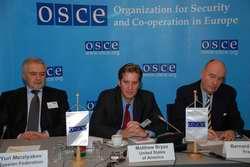
The OSCE mediators brokering a settlement to the
Upper (Nagorno) Garabagh conflict believe the situation on the
Armenia-Azerbaijan frontline remains tense and plan to monitor the
area for ceasefire violations.
"The ceasefire violations have become regular during the past few
days and necessitates holding an urgent crisis monitoring," Matthew
Bryza, the US co-chair of the OSCE Minsk Group (MG) said.
Bryza told a Monday news conference in Yerevan, which reviewed the
group`s visit to the region, that continuing ceasefire violations
were alarming and clarification of what is occurring is
necessary.
Andrjej Caspzyk, the OSCE chairman`s special envoy, did not rule
out that this monitoring would begin within days.
Caspzyk recently told the press that during the past year 25 people
have been killed on the frontline between Azerbaijani and Armenian
troops as a result of ceasefire violations. He did not specify
which side was responsible for the clashes.
Armenia and Azerbaijan waged a war over the mountainous region in
the early 1990s, which claimed some 30,000 lives and displaced
about one million Azerbaijanis. Armenia has been occupying over 20%
of Azerbaijan`s internationally-recognized territory since then.
The ceasefire accord was signed in 1994, but Armenian armed forces
have been repeatedly breaching the ceasefire along the
frontline.
The purpose of the co-chairs` visit to the region was to discuss
with the parties those issues stemming from the November 2
declaration and to map out further steps toward reaching a solution
to the long-running dispute.
The mediators met with President Ilham Aliyev and Foreign Minister
Elmar Mammadyarov last Thursday. Upon completing talks in Baku,
they left for the Armenian capital Yerevan, followed by their visit
to Upper Garabagh on Saturday. On Monday, the diplomats again
headed to Yerevan where they met with President Serzh
Sarkisian.
Bryza said the co-chairs` visit to the region was successful and
constructive, adding that the environment of "mutual understanding
and mutual respect" was increasing between Presidents Aliyev and
Sarkisian.
The diplomat said a positive atmosphere was emerging, which the
co-chairs should capitalize upon. He added that the key objective
now was to avoid factors that could potentially harm the road
covered in the peace process so far and derail efforts aimed at
easing tension in the relations between Baku and
Yerevan.
Timing of ministerial set
A date has been set for the next meeting between the Azerbaijani
and Armenian foreign ministers to discuss the Garabagh settlement.
Elmar Mammadyarov and Eduard Nalbandian will hold talks on the eve
of the OSCE Foreign Ministers Council meeting, to take place in
Helsinki December 4-5, the Russian co-chair, Yury Merzlyakov,
announced.
Merzlyakov said the mediators hoped they would also be able to
arrange a meeting between the two countries` leaders, but the venue
and timing of the presidential talks were unknown at this
point.
He emphasized that "no one was trying to artificially prolong" the
process of resolving the Garabagh conflict. He expressed
disappointment that the dispute has remained unresolved since
Azerbaijan and Armenia signed a ceasefire accord in 1994.
"But I am hopeful that we will now be able to reach the goal that
hasn`t been accomplished over 14 years," he said, adding that the
negotiating process would be accelerated while avoiding
hastiness.
Regarding the outcome of the mediators` talks with the leader of
the self-proclaimed Upper Garabagh republic, Bako Saakian,
Merzlyakov said that without the participation of the Armenian
community of the region it would be impossible to set the stage for
a settlement to the conflict.
Also, French co-chairman Bernard Fassier, said the Upper Garabagh
regime was not estranged from peace talks. Armenian media quoted
Fassier as saying that in the current course of negotiations the
self-proclaimed republic was contributing to efforts aimed at
reaching a solution.
"At times, people think that Upper Garabagh has been alienated from
the process. What does this mean? The reasons for our frequent
visits here are not just to try the highly-appreciated Garabagh
cuisine or drink mulberry vodka. We come here to work with your
leadership," Fassier told reporters in Khankandi, the center of the
occupied republic.
Territorial integrity
The US co-chair has refuted his earlier statement that Armenia must
return Azerbaijan`s territories.
During a news conference in Yerevan, Matthew Bryza did not refrain
from using degrading rhetoric against the Azerbaijani media.
"The media in Azerbaijan interprets everything in a one-sided
manner, whether it is politics or agriculture.
"I don`t remember what language my interview was in - Russian or
English. But my words were translated at least twice, or
re-translated," Bryza said.
According to Bryza, the status of Upper Garabagh cannot be
determined unilaterally and the positions of both parties to the
conflict should be taken into account in dealing with the
issue.
"It is possible that a vote will take place in Garabagh at some
point, but it may never happen - I just don`t know. The presidents
have to come to an agreement on the matter. As a co-chair, I can`t
dictate when this will happen and on what conditions," Bryza
said.
As for the possible stationing of Russian peacekeepers in the
conflict zone, the US diplomat said this was unlikely.
"Neither side currently wants this. On the other hand, the
following principle has always been in place: if peacekeepers are
stationed in the region, they cannot be pulled in from co-chairing
or neighboring countries."
Here we are to serve you with news right now. It does not cost much, but worth your attention.
Choose to support open, independent, quality journalism and subscribe on a monthly basis.
By subscribing to our online newspaper, you can have full digital access to all news, analysis, and much more.
You can also follow AzerNEWS on Twitter @AzerNewsAz or Facebook @AzerNewsNewspaper
Thank you!