
Project aims to monitor Kura river using space technology
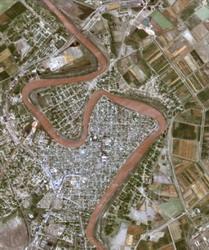
A project on monitoring Kura, the largest river in Azerbaijan, is
being implemented with the assistance of a grant co-sponsored by
the US University of Wisconsin-Madison to mitigate risks posed by
floods.
The project, entitled "Application of remote sensing and GIS technology to reduce flood risk," is being implemented within the framework of innovative projects for reducing the impact of disasters and involves Azeri scientists. The project is being carried out under the team leader, scholar Saida Salahova.
The project includes databases presenting electronic and hard copy maps, tables, and figures for the selected target area of Azerbaijan's Salyan district. An ALOS space image with 10m resolution for mapping of Land Use (vegetation)/Land Cover, with classification of areas like urban, agriculture, gardens, rivers, streams, channels, roads, and railroads, has been used.
The project executers are interested in providing an advanced GIS database to relevant government agencies and local authorities.
In the meantime, LANDSAT ETM space imagery was used for the detection of flood-prone areas within the selected part of the Kura River in Salyan. A Digital Elevation Model (DEM) with identified elevation points has been developed for the area being researched. Based on this data, there is an opportunity to determine, in advance, the inundation areas by mapping potential inundation zones.
Taking into account foregoing impacts, permanent monitoring of the Kura River condition is a highly important issue for the economy of Azerbaijan. Today, advances in information systems, satellite imaging systems and improved software technologies have led to opportunities for a new level of information products from remotely sensed data. The integration of these new products into existing response systems can provide a wide range of analysis tools and information products on the basis of the developed Geographical Information System (GIS). Using higher resolution of space imagery and change detection analysis, natural disaster awareness and damage assessment can be conducted promptly and accurately.
The Kura River stretches for 1,515 kilometers and covers an area of 188,000 sq. km. The Kura originates in Hel River in Turkey, passes through Georgia and Azerbaijan and flows into the Caspian Sea in the southeastern part of the country. The second largest river, Araz, covers an area of 86,000 sq. km until it meets with the Kura River near the Sabirabad district of Azerbaijan.
Kura and Araz belong to the group of rivers flowing largely under the influence of snow and rainfalls in spring and autumn.
Typically, weather produces the greatest impact on the river flow in Azerbaijan. Intensive increases in temperature cause the melting of snow at heights of over 1500 mm. The melting of snow further intensifies after the heavy rainfalls of April and May. Heavy rainfalls that may, from time to time, occur in July and August lead to floods, causing significant damages and covering huge areas of infrastructure. For example, August and September 2003 saw torrential rain with the result being rising water levels in the rivers and their overflow. Over 6,000 houses had been flooded and about 300 houses heavily damaged in the worst-affected districts of Neftchala, Salyan, Sabirabad, Imishli, Zardab, Kurdamir, and Ali-Bayramli. Based on the preliminary assessment of the government, total damage caused to the domestic economy by flooding is estimated at $50-60 million.
Here we are to serve you with news right now. It does not cost much, but worth your attention.
Choose to support open, independent, quality journalism and subscribe on a monthly basis.
By subscribing to our online newspaper, you can have full digital access to all news, analysis, and much more.
Subscribe
You can also follow AzerNEWS on Twitter @AzerNewsAz or Facebook @AzerNewsNewspaper
Thank you!