
Collapse threat looming over OSCE Minsk Group
Russia`s latest military incursion in Georgia has raised questions
about the future of the OSCE group brokering a settlement to the
Armenia-Azerbaijan Upper (Nagorno) Garabagh conflict. Additionally,
Washington has warned its future cooperation with Moscow will be
possible only after a Russian pullout from two Georgian rebel
regions.
Matthew Bryza, US co-chair of the OSCE Minsk Group (MG), has said it could continue operating only after Moscow honors the peace plan agreed upon by Russian and French Presidents Dmitry Medvedev and Nicolas Sarkozy.
"The resumption of MG`s work will be possible only after Russia complies with the agreements reached with President Sarkozy on the withdrawal of its troops from Georgia," Bryza said.
Georgia launched large-scale military operations in its breakaway republic of South Ossetia on August 8 to restore its territorial integrity. Moscow responded by sending troops to the pro-Russian region, which struck at the Georgian armed forces using overwhelming force. A ceasefire was, subsequently, reached on August 17 with the European Union`s mediation, but Russia continues to maintain part of its troops in the South Caucasus republic.
Observers believe Russia will not fully implement the Medvedev-Sarkozy plan. In particular, it has been noted that one of the founding principles laid out in the ceasefire accord, that the armed forces of both sides involved in the conflict were to return to the positions they held prior to the outbreak of hostilities, has not been honored by Russia. Also, the issues of ensuring security in South Ossetia and another Georgian rebel region, Abkhazia and, possibly, the future status of these territories, were to be addressed at an international conference in Geneva. However, Russia has already recognized the independence of Abkhazia and South Ossetia and stated that it plans to station its troops in these "new states," which will act not as peacekeepers, but will be stationed with the authorization of the two republics` "legitimate authorities." This is seen as evidence that Moscow will never implement the basic provisions of the Medvedev-Sarkozy plan.
President Medvedev signed a decree on August 26 recognizing the independence of Abkhazia and South Ossetia, heightening tension in the volatile Caucasus region. Tbilisi, the United States and numerous European powers condemned Russia`s move.
Bryza, a US Deputy Assistant Secretary of State, made it clear, after holding talks in Baku last week, including a meeting with President Ilham Aliyev, that Russia`s military actions against Georgia were unacceptable and uncalled for.
"The Russian army is 100 times more powerful than that of Georgia, and Russia`s behavior was an indication of a mindset that existed in the 18th and 19th centuries. But we hope Russia will go back to the way of thinking of the 21st century."
"I look forward to continuing work with Yuri Merzlyakov [the Russian co-chair] in the MG, but this will be possible only after Medvedev meets the terms of the agreement reached with Sarkozy," Bryza said.
Commenting on Russian Foreign Minister Sergei Lavrov`s recent statement that the Garabagh problem has no similarity with other conflicts, the State Department official termed it as Moscow`s "possible aspiration to return to the negotiating process."
Bryza went on with his criticism of Russia, accusing the Kremlin of violating international principles and double standards.
"During the war in Chechnya [the Russian republic where military action raged for many years], Russia publicly declared the priority of its territorial integrity principle and its inviolability.
But during the developments in Georgia, Moscow openly violated this very principle," Bryza said.
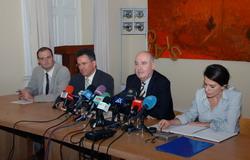
French co-chairman, Bernard Fassier, disagreed with his US counterpart. "The Minsk Group does not imply the United States alone, and it includes over ten countries. Certainly, there are certain challenges regarding Russia. But this does not mean at all that the MG will not continue operating," Fassier told a news conference on the outcomes of his visit to Azerbaijan last week.
Vasiliy Istratov, the Russian ambassador in Baku, also said tension in US-Russian relations will have no impact on the MG format for a Garabagh settlement. He emphasized that the co-chairs adhere to the positions of not only their countries but also that of the entire MG.
"The MG is not formed based upon some principles or statements made by any given country`s diplomat. This is the OSCE`s group," he said.
During his visit to Baku, Matthew Bryza also said an agreement to settle the decade-long Garabagh conflict must be reached based upon Azerbaijan`s sovereignty and territorial integrity.
Bryza told a news conference Thursday about the outcome of his talks with Azerbaijani officials that specifically emphasized this position of Washington in his meetings with Armenian officials during his prior visit to Yerevan.
"It is possible that new principles of international law will be added to the process [of resolving the Garabagh conflict]. But in any case, we take the principle of Azerbaijan`s territorial integrity as a basis," the diplomat said.
Bryza added that a conducive environment has emerged for resolving the Garabagh problem. "Both sides understand that this is the most real time to reach a peaceful settlement and are ready to arrive at a resolution to the conflict."
Bryza said the recent tide of tension in Georgia had underscored the importance of finding a timely solution to the Garabagh conflict.
"They understand this well in Washington, and this is the goal of my visit this week…It was US Secretary of State Condoleezza Rice who requested that I visit the region and speed up the process of finding a solution."
Asked how it is possible to arrange the next meeting of the Azerbaijani and Armenian presidents at a time the MG has been rather inactive and tensions are running high between its co-chairs, he said the two leaders represent independent countries "and there is no need for a moderator" to hold such a meeting.
Bryza stressed that the U.S. has stood by Azerbaijan in the past 17 years. "Azerbaijan may rely on our assistance, both at challenging times and in peace time, and we will remain allies for many years to come."
The State Department official welcomed Turkey`s recent initiative to mediate the Garabagh settlement and Ankara`s latest attempts to normalize its relations with Yerevan.
"My Turkish friends in Ankara told me about their aspiration to assist the Minsk Group`s efforts. The changes in Turkey`s relations with Armenia could foster a change in the Armenian stance. This is normal, and it could bring positive outcomes."
Bryza was in Baku after visiting Yerevan, and Khankandi, the center of the self-proclaimed Upper Garabagh republic, as well as the Turkish and Georgian capitals, Ankara and Tbilisi. Following the US co-chair`s visit, his French counterpart, Fassier, paid a visit to the region.
The French diplomat said the conflict in Georgia has shown that military resolution of conflicts in the region is impossible.
Fassier also said that if hostilities are resumed in Upper Garabagh, this would hurt both parties to the conflict.
"I have been repeating, for three and a half years, that there is no military solution to the Garabagh problem. The very contribution of the Minsk Group is that it has not allowed the conflict to enter the phase of hostilities," he told reporters in Yerevan.
Fassier emphasized that during the brief Russian-Georgian war, both Azerbaijan and Armenia sustained damage.
"The war lasted only five days. Armenia incurred considerable financial loss, and the transportation of cargo was suspended for some time. As for Azerbaijan, it incurred losses due to the suspended operation of the Baku-Tbilisi-Ceyhan oil export pipeline and had to pump crude through the Baku-Novorossiysk [northern route] pipeline, instead. All this happened as a result of irresponsible decisions taken."
Fassier said the consequences of new military action in Upper Garabagh could be on an even larger scale. "But in my view, the South Caucasus countries have clearly realized that no war would lead to the solution of outstanding conflicts."
Touching on the trilateral meeting among Turkish, Azerbaijani and Armenian foreign ministers due to occur on the sidelines of the UN General Assembly session in New York, Fassier said this was outside the MG co-chairmen`s area of concern.
He said the MG co-chairs were paying separate visits to the region due to their work schedules.
Evidently, the stage of "separate" talks is emerging, again, in Garabagh peace talks. This means that no one is formally turning down the current format of negotiations, the OSCE MG, however, all three of its co-chairs have apparently embarked on "shuttle diplomacy." Even Matthew Bryza and Bernard Fassier, who represent the United States and France - the two countries that appeared, at first glance, to be allies on the issue of Garabagh settlement - are not acting in conjunction, not to mention Russia.
Following the outbreak of the Russian-Georgian conflict, both Azerbaijani President Ilham Aliyev and Foreign Minister Elmar Mammadyarov have visited Moscow during the past month.
The separate shuttle diplomacy among MG members is, actually, nothing new, as this option has been used by all current MG co-chairs, who, in doing so, also tried to derive certain benefits for themselves.
Azerbaijan and Armenia fought a lengthy war that ended with the signing of a cease-fire in 1994, with Russia`s mediation. However, Moscow did not succeed in furthering this success, and the parties to the conflict eventually indicated a preference to the OSCE MG format of peace talks. Presently, Armenia continues to occupy Upper Garabagh and seven other Azerbaijani districts in defiance of international law, and the OSCE-brokered peace talks have been without results, so far.
After the 1998 presidential elections in Azerbaijan, the US MG co-chair managed to broker a peace accord between the conflicting sides, but after a shooting in the Armenian parliament linked to Moscow, Russia simply "buried" the initiative.
Next, the U.S. and France decided to act, in tandem, with Paris beginning the process and Washington carrying it on. The sides were, once again, very close to reaching agreement. However, at the last moment, the Azerbaijani leaders decided to turn down the agreements reached, according to reliable sources, after which the existing international format of peace talks, which had failed to achieve tangible result over five years, had to be reactivated.
But the situation drastically changed after the Russian-Georgian conflict, with essentially all players who have interests in the region stepping up efforts. In addition to the countries co-chairing the MG, Iran and Turkey have offered to contribute to the peace process. However, it is unlikely that these two countries will be accepted as full-fledged mediators in the Garabagh settlement, as Ankara is not trusted by Armenia, while Tehran is not trusted by Azerbaijan, and neither the West nor Russia can fully confide in Iran or Turkey.
Here we are to serve you with news right now. It does not cost much, but worth your attention.
Choose to support open, independent, quality journalism and subscribe on a monthly basis.
By subscribing to our online newspaper, you can have full digital access to all news, analysis, and much more.
Subscribe
You can also follow AzerNEWS on Twitter @AzerNewsAz or Facebook @AzerNewsNewspaper
Thank you!