
FMs of Eastern Partnership countries meet in Baku (UPDATE)
By Gulgiz Dadashova
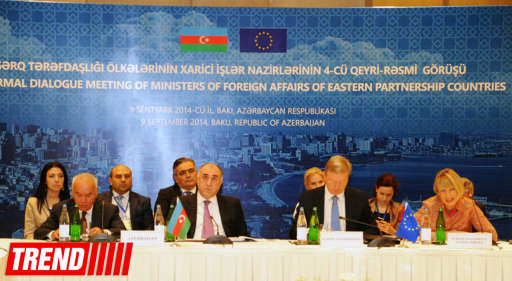
The 4th informal meeting of foreign ministers of EU Eastern Partnership countries started in Baku, the capital of Azerbaijan on September 9.
The meeting is aimed to expand partnership under the Eastern Partnership program and discuss the progress achieved after the summit Vilnius in 2013.
Addressing the participants, Foreign Minister Elmar Mammadyarov said the meeting would enable to have necessary exchange of views on expansion of cooperation among the participating countries
The minister noted that the meeting aims to promote cooperation within the Eastern Partnership framework, discuss the results of the Vilnius summit held in November 2013 and the prospects for further development.
EU Commissioner for Enlargement and European Neighbourhood Policy Stefan Fule, who is in Baku to attend the event, said energy security is one of the important issues to define sovereignty and independence of the EU partners, Trend reports.
Fule said the outcome of the informal meeting could be and should be strengthening the positions of Eastern partners, in particular Ukraine.
"We will talk about inclusiveness which is another key feature of eastern partnership as we remain committed to advance eastern partnership of the six partner countries," Fule added.
He further said that all the six countries- Azerbaijan, Ukraine, Armenia, Moldova, Georgia, Belarus- are equally important for the EU, adding that their independence, sovereignty and territorial integrity are very important.
Fule also expressed hope that following the Baku meeting there will be a better understanding of what the EU wants on one side and what can be done jointly to bring peace and stability to the region.
Deputy High Representative of the EU for Foreign Affairs and Security Policy, Helga Schmidt, in turn, voiced that the European Union remains firmly committed to continue advancing the political association, economic integration with the Eastern European partners.
"We very much believe in further strengthening of our coordination and cooperation on some of very pressing foreign policy and security challenges," she said.
Schmidt also added that she had a very interesting meeting with women representatives of civil society in Baku and had discussions on women problems around the world and the issues of strengthening civil society.
Following the meeting, there was a press briefing in Baku.
Elmar Mammadyarov said all partner countries of the Eastern
Partnership program stressed at the Baku meeting that the
territorial integrity and sovereignty of each Eastern Partnership
country is one of the main conditions of stability in the EU
partner countries.
"All members of the informal meeting of the foreign ministers also
emphasized that the internationally recognized borders of countries
can't be altered. This is the common position of all the countries
that suffer from unresolved conflicts," Mammadyarov noted.
Stefan Fule also emphasized that the sovereignty, territorial integrity and independence of Eastern Partnership member states are important for the EU.
Fule said inclusiveness is an important part of the Eastern Partnership, noting that sovereignty, territorial integrity and independence of each of the six eastern partners is very important for the EU.
He also added that the European Union is ready to support Azerbaijan and Armenia if the countries show their political will to resolve the Nagorno-Karabakh. "The settlement of the Nagorno-Karabakh conflict should be based on the international law," Fule stressed.
Deputy Prime Minister and Minister of Foreign Affairs of Moldova, Natalia Gherman also noted that the security issues have the greatest importance for the member-states of the EU "Eastern Partnership" program.
""Eastern Partnership" countries support each other," she stressed. "We coordinate our activity as part of GUAM. Moldova is Ukraine's neighboring country. So, we are concerned by observing the situation in this country. We oppose the seizure of the Crimea, taking into account the impact of the conflict in Ukraine on the whole region."
Gherman further said that Moldova made its choice and intends to integrate into the EU. "Each country has the sovereign right to choose. Our cooperation with neighboring countries will be based on this," she said.
Helga Schmidt also drew attention to the Ukrainian events, saying that the crisis in Ukraine has negative impact on the countries of the EU Eastern Partnership program.
The EU commissioner emphasized the necessity of complying with the terms of the ceasefire in Ukraine.
Schmidt underscored that the EU plays an important role in this issue, adding that the frozen conflicts in the EU countries should be resolved.
The EU program on "Eastern Partnership" was adopted on the initiative of Poland and Sweden and approved at the EU summit in Brussels in 2008. The goal of the Eastern Partnership program is the rapprochement between the EU and Azerbaijan, Ukraine, Armenia, Moldova, Georgia, Belarus.
The program envisages significant increase in the level of political interaction, large integration of former Soviet republics into EU economy, increasing the volume of financial aid to them and strengthening the energy security.
Here we are to serve you with news right now. It does not cost much, but worth your attention.
Choose to support open, independent, quality journalism and subscribe on a monthly basis.
By subscribing to our online newspaper, you can have full digital access to all news, analysis, and much more.
You can also follow AzerNEWS on Twitter @AzerNewsAz or Facebook @AzerNewsNewspaper
Thank you!