
Russia`s stance on Garabagh `unchanged`
Azerbaijan was assured on Tuesday that Russia has not altered
its position on the Upper (Nagorno) Garabagh conflict, despite
Moscow`s recent recognition of two Georgian rebel regions that
raised fears that it can no longer act as an impartial mediator in
regional disputes.
The over a decade-long Armenia-Azerbaijan conflict was high on
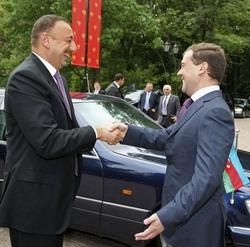
agenda of talks between Russian and Azerbaijani Presidents Dmitry
Medvedev and Ilham Aliyev outside Moscow on Tuesday.
"I confirmed that Russia`s stance remains unchanged, voiced support
for further direct talks between the Azerbaijani and Armenian
presidents, and assured President Aliyev that we will continue
providing the needed assistance in seeking a mutually acceptable
solution," Medvedev said after hosting his Azerbaijani counterpart
in the Meindorf residence.
Russia co-chairs the OSCE Minsk Group brokering Garabagh
settlement, along with the United States and France.
Aliyev said that despite a very complicated situation in the
region, "there are good pre-conditions for improving it."
"If the Garabagh problem finds its solution, new prospects will
open up for good cooperation," he said.
The Azerbaijani leader emphasized that Baku and Moscow were
maintaining high-level relations that could set an example for
other regional states. "If everyone enjoyed such good
neighborliness ties as Russia and Azerbaijan, there would not be
any conflicts, and any misunderstanding altogether."
Aliyev said there was a need for joining effort in bolstering peace
and stability in the region.
The Azerbaijani and Russian leaders also discussed economic
cooperation. Medvedev said the Russian-Azerbaijani trade is to
reach $2 billion by the end of 2008.
"We are content with our partnership. The goals we have outlined
during my visit to Baku [early in July] are being reached, and I
hope that we will achieve the trade turnover target of $2 billion
by the year-end, although the economic situation is not that
favorable," Medvedev said.
Aliyev stressed that bilateral trade was rapidly developing and its
structure was improving. "We are pleased with the development of
our cooperation, which is encompassing very broad ranges."
Expectations from Moscow visit
Russia has a plethora of questions regarding Azerbaijan. Although
Baku avoided direct involvement in the military conflict in
neighboring Georgia last month, this does not answer all of these
questions or meet all of Russia`s demands. Moscow is expecting the
South Caucasus republic, which maintained partial neutrality on the
issue, to put forth a more clear-cut stance.
Following a brief war with Georgia early in August, President
Medvedev signed a decree on August 26 recognizing the independence
of Georgia`s rebel regions of South Ossetia and Abkhazia. The move
heightened tensions in the volatile Caucasus region and put a
further strain on Moscow`s relations with the West. Tbilisi, the
U.S. and numerous European powers condemned the move.
Meanwhile, tensions remain high in the region. Unlike the West,
Russia tends to take action first and then tries to gain potential
allies. Now, Russia says the recognition of South Ossetia and
Abkhazia is irreversible. Furthermore, it has pledged to forge
diplomatic relations with the rebel regions soon and is stationing
military contingent in the regions instead of peacekeeping
forces.
Thus, Russia`s persistence is evident. But the West is not idle
either. NATO members are convening in Tbilisi, and an attempt is
being made to set up a Georgia-NATO council.
Russia`s problems are not confined to the prospect of Georgia`s
admission to the alliance. Its close ally, Armenia, is facing
isolation. In addition to that, Russia, despite shattered
confidence in its mission on brokering Garabagh settlement, is
unwilling to give up its position in the mediating Minsk Group.
Russia, which is losing ground in the South Caucasus, is seeking
new strongholds and allies. But the situation leaves a lot to be
desired. Even CIS states maintaining close ties with Russia are
unwilling to recognize the independence of South Ossetia and
Abkhazia, and it is futile to expect this step from Azerbaijan as
well. Baku has repeatedly said it was firm on supporting Georgia`s
territorial integrity.
It is likely that Russia will now attempt to weaken Azerbaijan`s
relations with Georgia as much as it can. However, these ties are
so deep that dealing a blow upon them will prove a daunting task.
Oil transportation routes, the regional group GUAM that comprises
both countries, and a railway line that is being built are all
factors strengthening these bonds.
It is also possible that Russia will prompt Azerbaijan to sell gas
to Georgia for a higher price, and the gas supplies issue will,
overall, be a key issue during talks. Additionally, Russia stands
firmly on its proposal to buy the entire bulk of gas produced by
Azerbaijan.
Furthermore, Azerbaijan`s integration with NATO is closely followed
by its northern neighbor, although Baku is acting cautiously in
this regard. This carefulness does not stem merely from
geo-political reasons. In general, Azerbaijan is exercising caution
in its Western integration, and some authoritarian tendencies
within the country are holding back these efforts. Now, Russia is
leveraging the most support from Belarus and a number of
authoritarian Central Asian republics. Aspiring democracies Ukraine
and Georgia are now seceding from CIS -- the same way the Baltic
states once pulled out of the organization`s predecessor, Soviet
Union -- in what analysts describe as the so-called "second
collapse" of the USSR.
Most likely, Azerbaijan`s hesitation will do nothing to accelerate
NATO`s unfolding advent to the region. Russia continues to assert
that it is exercising a fair approach to the Garabagh problem, but
this appears as promises with no guarantees. Moscow will keep
making these statements only as long as Azerbaijan remains in its
sphere of influence and Garabagh diplomacy proceeds under its
scenario. It is possible that as time elapses, Russia will toughen
its military and geo-political demands to Azerbaijan, although the
balance of forces in the region is changing.
But the changing balance and NATO`s interference in the region may
prompt Russia to seek expansion of its limited military alliance.
Then, it may demand that Azerbaijan join the Collective Security
Treaty Organization, a bloc of former Soviet republics, which would
essentially restrict the country`s independence.
In any case, this possibility should not be ruled out. If NATO
moves to spread its clout in the strategically-important region,
Russia will try to create a reliable military circle around itself,
and, in doing so, it will appeal to other CIS states.
In any case scenario, Moscow`s friendship is unlikely to bring any
benefits. Past experience suggests that in its relations with the
former Soviet republics, Russia has been failing to relinquish its
empire-like ambitions.
Here we are to serve you with news right now. It does not cost much, but worth your attention.
Choose to support open, independent, quality journalism and subscribe on a monthly basis.
By subscribing to our online newspaper, you can have full digital access to all news, analysis, and much more.
You can also follow AzerNEWS on Twitter @AzerNewsAz or Facebook @AzerNewsNewspaper
Thank you!