
US steps up calls to end Garabagh conflict after Russian incursion
Following Russia's military aggression against Georgia early in
August, US officials ratcheted up rhetoric on the need to settle
the Armenia-Azerbaijan conflict. The statements by the US seek to
counter Moscow's attempts to secure its clout over the volatile
Caucasus region that the West deems strategically important.
The United States has, at last, realized that the "frozen" state of the Upper (Nagorno) Garabagh conflict and other regional disputes plays into the hands of Russia, which, among other interested parties, wields the most leverage to manipulate the situation. Washington's statements come just weeks after a brief Russian-Georgian war last month which heightened tension in the region and put Moscow on a collision course with the West.
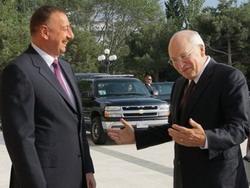
In an unseen development, the U.S. has begun to push for a solution to the long-standing Garabagh dispute. "America strongly supports the sovereignty and territorial integrity of Azerbaijan," US Vice President Dick Cheney said during a meeting with President Ilham Aliyev last Wednesday.
"We are committed to achieving a negotiated solution to the Garabagh conflict - a solution that starts with the principle of territorial integrity, and takes into account other international principles. Achieving a solution is more important now than ever before; that outcome will enhance peace and stability in the region, and Azerbaijan's security, as well," said Cheney, who was in Baku as part of his first visit to the South Caucasus.
The Azerbaijani leader said issues regarding resolution of the Armenia-Azerbaijan conflict are very important for his country, and the United States, as one of the co-chairs of the mediating OSCE Minsk Group, plays a key role in helping both sides find a solution. "But, of course, solution must be based on international law, as every other conflict, with respect to the territorial integrity of Azerbaijan and to the territorial integrity of all the countries in the region and in the world."
President Aliyev said Baku was attaching great importance to Cheney's visit, calling it a good opportunity to exchange views on bilateral relations and a wide range of issues. Successful development of US-Azeri relations continues in a variety of areas, he said.
"Our relations really have a long history, and they started, mainly, with energy issues, and those were projects which were implemented in our region, initiated by Azerbaijan with strong support from the United States."
Aliyev said US-Azeri relations cover a very broad range of cooperation, including successfully developing political relations, economic ties, relations in issues of security, defense, and ongoing collaboration in peacekeeping operations throughout the world.
Cheney thanked Azerbaijan for its "brave contributions" in the fight against global terrorism.
"Our forces have worked together in Afghanistan and Iraq. We cooperated to foil plots by violent extremists. Our countries are united in recognizing the threat posed to Azerbaijan and the world by the proliferation of nuclear weapons to dangerous regimes. America deeply appreciates Azerbaijan's contributions to the cause of peace and security, both in this volatile region and internationally. And we support the people of Azerbaijan in their efforts, often in the face of great challenges, to strengthen democracy, the rule of law, and respect for human rights, and to build a prosperous, modern, independent country that can serve as a pillar of moderation and stability in this critical part of the world."
At a news conference following the talks, the US vice-president praised the outcome of his visit and meetings in Baku. He said the U.S. and Azerbaijan have many interests in common as both countries seek greater stability, security and cooperation in this vital region.
Cheney said Washington appreciates Azerbaijan's commitment to working with Western countries on energy issues, emphasizing that the country remains pivotal to ensuring diverse and reliable energy export routes.
"The United States strongly believes that, together with the nations of Europe, including Turkey, we must work with Azerbaijan and other countries in the Caucasus and Central Asia on additional routes for energy exports that ensure the free flow of resources. Energy security is essential to us all, and the matter is becoming increasingly urgent."
President Aliyev said Azerbaijan and the U.S. were working to boost their energy partnership.
"It's a real success story. And we are working, now, on further development of an energy partnership and the diversification of energy supplies, which is important not only for consumers but also for producers like Azerbaijan."
Vice-President Cheney and President Aliyev have a long-standing relationship dating back to the times Cheney worked for the multinational company, Halliburton, while Aliyev acted as vice-president of Azerbaijan's state oil company, SOCAR.
Upon arrival in Baku, Cheney immediately met, among others, with the heads of the local divisions of BP and Chevron to discuss the situation in the Caspian region's energy market after Russia's latest incursion. The reasons for Washington's concern are obvious: Georgia is a vital transit corridor for the BTC export pipeline, which pumps Azerbaijan's oil to the Turkish Mediterranean port of Ceyhan, bypassing Russia.
Preventing Russia's control over supplies of energy resources from the resource-rich region to Western markets is one of the key objectives pursued in US foreign policy.
Moscow is no less eager to gain clout over supply routes, and the fact that it currently controls most of the energy supplies to western Europe gives it strong leverage for pressure on many European Union states.
Russia and the West have so far used, exclusively, economic and political tools in their power struggle and, at times, pressure regional countries. However, the latest developments in Georgia have shown that Moscow is now trying to change the rules of the game and is ready to use force to secure its dominance in the region.
At the same time Vice-President Cheney was in Baku, Russian President Dmitry Medvedev made a phone call to President Aliyev. The two leaders said they sought successful development of bilateral relations on various levels, the Azerbaijani president's press-service said. Discussions covered international issues, the situation in the region, the Garabagh conflict, and other concerns. The heads of state also discussed the possibility of soon holding a one-on-one meeting.
This was the Azerbaijani leader's first exchange with a Russian official since Moscow's incursion into Georgia.
Analysts say that, although Cheney's visit to Baku is now over, issues regarding the visit, in particular, Medvedev's phone call to his Azerbaijani counterpart on the day President Aliyev was hosting Cheney, will remain in the spotlight. Further, they note that there is substantial difference between such a call taking place before or after the Aliyev-Cheney meeting.
Azerbaijani official sources, including the presidential press-service, have not provided details of the phone call. The President's Office spokesman, Azer Gasymov, said, "We have provided information. Whatever the sequence of the news was, that was the sequence of developments."
Political commentator Rauf Mirgadirov is confident that the Russian leader phoned President Aliyev after the latter's meeting with Cheney. He believes that, in doing so, Moscow was trying to clarify Aliyev's "political mood."
"A day earlier, Russian Foreign Minister Sergei Lavrov, when asked about Cheney's visit to Azerbaijan, said he was not following it. But Medvedev's phone call proved that Russia had no patience to wait even one day, so, Medvedev called Aliyev as early as several hours after the meeting [with Cheney]."
Mirgadirov said that Russia, at all times, is wary of Azerbaijan's leaning toward the West.
"The West sees Azerbaijan both as a source of energy and as a transit state. In this sense, Russia has major problems with Azerbaijan, since energy resources represent tools of blackmail for Russia," added Mirgadirov.
Azerbaijani former state adviser, analyst Vafa Guluzada, said Cheney's visit sought to give support to Azerbaijan's security, as the country has come under a threat after the war in Georgia. Azerbaijan, which has an ongoing conflict with Armenia, is facing ample risks and sought American support during Cheney's visit, Guluzada said.
"Azerbaijan has, so far, been pursuing a balanced policy with the U.S. and Russia. Today, Baku should clearly state its position, i.e., specify in which direction it is leaning. If it leans toward the West, it should seek firm Western protection.
"In my opinion, Azerbaijan is Western-leaning and President Aliyev sought protection of the country's security from Dick Cheney," Guluzada said.
The analyst said Aliyev's talks with the US vice president were likely to focus on issues regarding, not only the security of oil and gas pipelines, but also ways of protecting Azerbaijan against a potential Russian attack, as Moscow is currently trying to return all independent former Soviet republics to its sphere of influence.
Here we are to serve you with news right now. It does not cost much, but worth your attention.
Choose to support open, independent, quality journalism and subscribe on a monthly basis.
By subscribing to our online newspaper, you can have full digital access to all news, analysis, and much more.
Subscribe
You can also follow AzerNEWS on Twitter @AzerNewsAz or Facebook @AzerNewsNewspaper
Thank you!