
Armenian leader expects incentive in peace talks after October elections
Talks on settling the Upper (Nagorno) Garabagh conflict will
intensify after Azerbaijan`s October presidential elections,
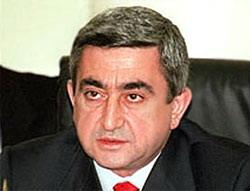
Armenian President Serzh Sarkisian has said.
In an interview with Turkish media, he avoided comparing the conflicts over the Georgian regions of Abkhazia and South Ossetia with the Garabagh problem.
Sarkisian said everyone witnessed the consequences of military intervention in dealing with such issues.
"On such issues, we support discussions. We believe in solving the problem through peace and reconciliation. Let`s put everything aside - over 70% of our trade is done through Georgia. Therefore, most of all, Armenia wishes for the welfare of Georgia. The main thing is that we have to draw a conclusion from what happened there," Sarkisian said.
Georgia launched large-scale military operations to restore its territorial integrity on August 8 in its breakaway republic of South Ossetia.
Moscow retaliated by sending troops to the region, which struck at the Georgian armed forces using overwhelming force.
A ceasefire was, subsequently, reached on August 17 with the mediation of French President Nicolas Sarkozy to end the brief war.
It was noteworthy, said observers, that Sarkisian did not mention the issue of Garabagh`s "independence." Instead, Yerevan said it backed resolution of the long-standing conflict within a set of basic principles as set down last November by the mediating OSCE Minsk Group co-chairs in Madrid.
Armenia and Azerbaijan waged a war over the mountainous region of Upper (Nagorno) Garabagh in the early 1990s, which claimed some 30,000 lives and displaced about one million Azerbaijanis. Armenia has since occupied over 20% of Azerbaijan`s internationally recognized territory. A ceasefire accord was signed in 1994, however, peace talks have been inconclusive, so far.
Sarkisian once again invited his Turkish counterpart, Abdullah Gul, to attend a football match between the two countries` teams in Yerevan this September, saying this would be a good chance to forge ties between Armenia and Turkey.
Asked whether the move was politically motivated, the Armenian leader did not provide a definitive answer, merely saying Yerevan`s goal was to restore ties with its neighbor.
Sarkisian recalled that President Gul and Prime Minister Recep Tayyip Erdogan were among the first leaders to congratulate him on his victory in the February 19 Armenian election, claiming that Ankara`s congratulatory letter cited the need for expanding cooperation.
As for Armenia`s aspiration to participate in large-scale regional projects, he said, "if political aims top economic agendas, such projects turn out to be unsuccessful."
The Turkish leader said Armenia should consider reaching a settlement in the Garabagh conflict if it hopes to participate in regional projects.
Gul noted, however, that Ankara supported neighboring country`s joining such projects.
"This land belongs to all of us. Armenians and Turks have been neighbors throughout history," he said.
Asked what step Ankara intended to take "at a time Armenia is anxiously awaiting the establishment of ties with Turkey," Gul responded diplomatically, unlike his Armenian counterpart, saying that Turkey welcomed the recent efforts being made to ensure stability and cooperation in the region.
"I want to solve problems with all of our neighbors. There have been both sweet and bitter memories in history. Now, the key issue is not to look back at history, but for all regional states to come together and take part in joint projects. Turkey continues to closely follow ongoing developments to make this happen," Gul said.
Armenia and Turkey have been at odds and the border between the two countries has been closed since 1993.
Ankara has repeatedly made it clear that discussions on forging ties with Yerevan could begin only after Armenia relinquishes its policy of occupation against Azerbaijan and the "Armenian genocide" claims.
Here we are to serve you with news right now. It does not cost much, but worth your attention.
Choose to support open, independent, quality journalism and subscribe on a monthly basis.
By subscribing to our online newspaper, you can have full digital access to all news, analysis, and much more.
Subscribe
You can also follow AzerNEWS on Twitter @AzerNewsAz or Facebook @AzerNewsNewspaper
Thank you!