
Will the Georgia conflict set an example?
The outcome of the Russia-Georgia military stand-off is crucial for
talks on settling the Armenia-Azerbaijan conflict over Upper
(Nagorno) Garabagh, an influential international expert says.
The developments in Georgia make the issue of Azerbaijan's territorial integrity extremely relevant, said Zeyno Baran, director of the Washington-based Center for Eurasian Policy at the Hudson Institute.
"Even if Russia does recognize Georgia's territorial integrity, by taking the latest actions it infringed upon all existing international norms. The outcome of Russia's actions against Georgia will set a very important example for those who will decide on actions regarding the Garabagh problem," she said.
Baran said the war with Georgia is "a bad start" for the newly-elected Russian President, Dmitry Medvedev.
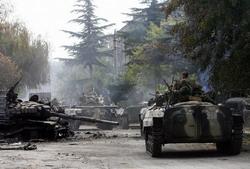
The crisis was sparked when pro-Western Georgia launched a military offensive to retake the pro-Russian region of South Ossetia, which broke away from Georgian rule in the early 1990s. Moscow retaliated on August 8 by sending troops to the region which struck, with overwhelming force, at Georgian positions. In addition to ground troops, Russia used its air force to strike strategic facilities in Georgia. Russian President Medvedev, on August 12, ordered an end to Russia's military actions in Georgia, claiming Moscow said it was seeking "to encourage peace."
Isa Gambar, leader of the Azerbaijani political party Musavat, said developments in the neighboring South Caucasus republic are affecting not only the Garabagh conflict, but also the situation throughout the entire region.
"It is too early to say whether this impact will be positive or negative, as the ongoing process, itself, has yet to reach its final stage. But overall, I believe that what is happening in Georgia will have a positive impact on [the resolution of] the Garabagh conflict."
Gambar said Russian authorities had "completely revealed their essence" by their military actions.
"Moscow once again showed that it has no intention to relinquish its ambitions for an empire and is sticking to its aggressive policy," he said.
Gambar said the free world "now realizes that there is no hope for Russia's contribution to the solution of problems regarding the territorial integrity of South Caucasus states."
"The West has realized that Russia is not an element of stability in the region, but, on the contrary, a destabilizing factor. In keeping with this, I think the impact of the developments in Georgia on the solution of the Garabagh problem will be positive," the party leader said.
Indeed, notes observers, Russia has demonstrated what it stands for, and the point is that Moscow, disregarding international law, is openly supporting separatism. This being said, a valid question arises: how can a country backing the separatist regimes in Georgia's breakaway republics of Abkhazia and South Ossetia be brokering a settlement to the Garabagh conflict?
Russia, along with the United States and France, co-chairs a team of diplomats called the OSCE Minsk Group, which is brokering the peace process.
According to the Musavat chairman, the latest developments have shown that Russia now has no right to act as a mediator in the resolution of any conflicts.
"And, as long as Russia is among the 'peacekeepers', any solution to the Garabagh conflict is out of the question. So, realizing that truth will foster a change in the approach to dealing with the problem," he said.
Azerbaijani analyst Hikmat Hajizada said the developments in Georgia would definitely affect the Garabagh settlement.
"First of all, it has become clear to many Azerbaijanis that we can't just go ahead and launch a war in Upper Garabagh. And this is clear, as Russia and Armenia are behind Upper Garabagh [the self-proclaimed republic], while we don't have anyone behind us. Hence, based on what went on in Georgia, everyone understood that you can't wage a one-on-one war with Russia."
Secondly, Armenia will "feel more comfortable" at peace talks with Azerbaijan if Moscow strengthens its positions in South Ossetia. These are the adverse ramifications.
"But there are also positive sides to these events. The Russia-Georgia conflict has finally drawn the international community's attention to the problems facing the South Caucasus," he said.
Hajizada said the West has realized that these problems "concern it as well, and this should be kept in mind."
"In light of these developments, I believe Azerbaijan has two ways to go: to integrate into NATO or find itself a powerful ally so that it can counter the Russia-Armenia alliance," Hajizada added.
Here we are to serve you with news right now. It does not cost much, but worth your attention.
Choose to support open, independent, quality journalism and subscribe on a monthly basis.
By subscribing to our online newspaper, you can have full digital access to all news, analysis, and much more.
Subscribe
You can also follow AzerNEWS on Twitter @AzerNewsAz or Facebook @AzerNewsNewspaper
Thank you!