
Baku welcomes Khojaly recognition by Bosnia and Herzegovina parliament
By Sara Rajabova
Azerbaijan highly appreciates the recognition and condemnation by the parliament of Bosnia and Herzegovina of the massacre of Azerbaijanis committed by Armenia in Khojaly during the 1990s war, according to Deputy Foreign Minister Khalaf Khalafov.
"The adoption by the parliament of Bosnia and Herzegovina of the resolution condemning the massacre of Azerbaijanis in Khojaly is an important step towards the recognition of these incidents at an international level," Khalafov said, the Foreign Ministry reported on Thursday.
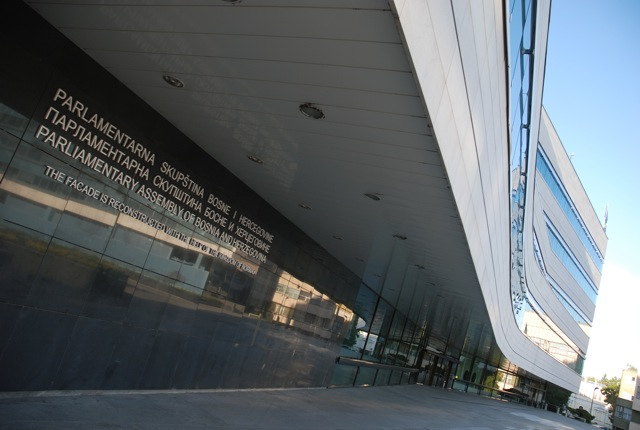
An official document on the aggression of Armenia against Azerbaijan and recognition of Khojaly genocide was adopted at the House of Peoples (upper chamber) of the Parliamentary Assembly of Bosnia and Herzegovina on Tuesday, February 26, the 21st anniversary of the massacre.
The resolution on "recognition and respect for sovereignty and territorial integrity of the Republic of Azerbaijan" was passed by an overwhelming majority at the Bosnia and Herzegovina parliament.
It is the first document of this kind adopted by the parliament of Bosnia and Herzegovina, according to Azerbaijan's diplomatic mission to the country.
This success was achieved due to not only patriots and professional diplomats, but also every Azerbaijani, as a logical result of the foreign policy, forward-looking and humanism policy of President Ilham Aliyev.
Recognition of the Khojaly genocide committed against Azerbaijanis by Armenians is the goal of the Heydar Aliyev Foundation's Justice for Khojaly campaign.
Azerbaijan-Bosnia and Herzegovina relations are developing in all areas including politics, economics, culture and the humanitarian field.
Both countries have an abundant history of cultural ties. Discovery of manuscripts of Azerbaijani poets Nizami Ganjavi and Muhammed Fuzuli in the library of Gazi Khosrov in Sarajevo is evidence of this fact.
As an indicator of friendly bilateral ties, reconstruction and restoration work was carried out at the initiative of President Aliyev on the Baku street in Sarajevo and the street was inaugurated on November 8, 2011.
Also, a park of friendship between Azerbaijan and Bosnia and Herzegovina was laid on February 24, 2012 on the bank of the Dobrinya river at the initiative and with organizational support of the Heydar Aliyev Foundation.
A memorial complex reflecting the genocides in Khojaly and Srebrenica was created in the park. The words In Memory of Victims of the Khojaly Genocide (Azerbaijan, 25-26 February 1992) were engraved on the monument.
What both peoples have in common from the historical point of view is that they suffered aggression and tragedies in Khojaly and Srebrenica.
Creation of the complex at the initiative of Heydar Aliyev Foundation Vice President Leyla Aliyeva in memory of Khojaly genocide victims in the capital of Bosnia and Herzegovina is important from the political and historical points of view.
The adoption of the document in the parliament of Bosnia and Herzegovina will undoubtedly play an important role in shaping a common public opinion in Europe and lead to undertaking similar steps by the parliaments of other countries.
Prior to the Bosnia and Herzegovina Parliament, the parliaments of Turkey, Pakistan, Mexico and Columbia recognized the Khojaly massacre as genocide.
Also, the Czech Republic became the first EU country that has officially condemned Armenia for the massacre of Azerbaijani civilians in Khojaly, and has recognized this as a crime against humanity.
The Foreign Relations Committee of the Chamber of Deputies of the Czech parliament unanimously adopted a document condemning Armenia for the Khojaly genocide on February 7. "It was a crime against humanity condemned by numerous governments around the world," the document says.
Besides, the Romanian Democratic Liberal Party's parliament group has issued a statement on the Nagorno-Karabakh conflict condemning the Khojaly genocide.
Moreover, Arkansas recently became the latest U.S. state to recognize the Khojaly genocide. Following the House of Representatives, the Arkansas Senate labeled the Khojaly massacre as an act of genocide.
Arkansas is the second state after New Mexico where both houses of parliament have adopted resolutions recognizing the Khojaly tragedy.
The U.S. states of Texas, New Jersey, Georgia and Maine have also recognized the Khojaly genocide.
The Khojaly massacre is one of the most heinous and bloodiest events of the 20th century. Late into the night of February 25, 1992, the town of Khojaly came under intensive fire from the town of Khankendi and Askeran already occupied by Armenian armed forces. At night the Armenian forces supported by the ex-Soviet 366th regiment completed the surrounding of the town already isolated due to ethnic cleansing of the Azerbaijani population of the neighboring regions. The joint forces occupied the town, which was ruined by heavy artillery shelling.
Thousands of fleeing civilians were ambushed by Armenian forces. Punitive teams of the so-called Nagorno Karabakh defense army reached the unprotected civilians to slaughter them, mutilating and scalping some bodies. In just a few hours, 613 civilians were killed, including 106 women, 70 elderly and 83 children. A total of 1,000 civilians were disabled. 56 people were killed with outrageous brutality, eight families were exterminated, and 25 children lost both parents, while 130 children lost one parent. Moreover, 1,275 innocent people were taken hostage, while the fate of 150 remains unknown.
Here we are to serve you with news right now. It does not cost much, but worth your attention.
Choose to support open, independent, quality journalism and subscribe on a monthly basis.
By subscribing to our online newspaper, you can have full digital access to all news, analysis, and much more.
You can also follow AzerNEWS on Twitter @AzerNewsAz or Facebook @AzerNewsNewspaper
Thank you!