
Unresolved conflict 'barrier for development of Armenia and region'
By Sabina Idayatova
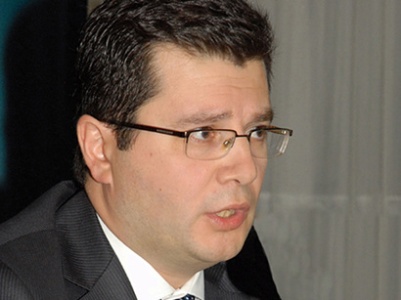
Azerbaijani Foreign Ministry's spokesman has said it is encouraging that Armenian President Serzh Sargsyan acknowledges that the unresolved conflict between the two countries is a barrier to the development of both Armenia and the whole region -- something that has been repeatedly stated by Baku.
Commenting on Sargsyan's recent interview with Radio Liberty during a briefing on Monday, Elman Abdullayev said, "The president of Armenia admits that Armenia spends a lot of money from its already meager budget on military expenditure. Is the occupation of a foreign country really worth the emigration and poverty in Armenia?"
About 2.234 million people left Armenia, while 2.191 million
arrived in 2012, according to the state migration body of the
country, which has population of less than 3.5 million.
In the last three years 5 percent or about 160,000 Armenian
citizens left the country, according to Armenian Report portal.
"Armenian leadership should not sacrifice the future of its people for the sake of political ambitions," Abdullayev said. "The fact that Armenia is occupying part of Azerbaijan is recognized by the entire international community."
The Armenian statistics body released data last December citing an increase of the poverty rate in the country, an indicator of economic predicament which is believed to pose the threat of a social explosion.
The number of people who did not return to their home country increased by 10 percent. With the given dynamic, it can be assumed that the number of the people who stay abroad will be 55,000 per year.
"Meanwhile, the Armenian leadership is trying to avoid responsibility for what is happening. Also, the question arises: what are the Armenian armed forces doing in the occupied Azerbaijani territories?" Abdullayev said.
According to Abdullayev, the current Armenian leadership does not show political will to resolve the conflict.
The status quo in the conflict over Nagorno-Karabakh lasting more than 20 years appears to be beneficial for the Armenian authorities, which are interested in the long-standing dispute remaining unresolved and trying to gain all advantages from the current situation.
In fact, the existing status quo in the conflict does not meet any nation's interest and should be changed in order to achieve a final solution.
Twenty years of diplomacy have not drastically changed the situation with the settlement of the Armenia-Azerbaijan conflict. Despite long efforts, the OSCE Minsk Group, which is brokering the peace process, has failed to achieve a breakthrough. Generally, altering Armenia's foreign policy is very important for any change of realities. But this is not reflected in the actions of Yerevan.
Today, it is not worth expecting "a revolutionary change" in the structure of the Armenian political elite. The presidential elections scheduled for February 18, 2013 are likely to be conducted under the current status quo.
The start of a troop withdrawal will provide opportunities for Armenia and the region, Abdullayev said, adding that the unresolved Nagorno-Karabakh problem stands in the way.
Armenian President Sargsyan said in an interview that Armenia does not have abundant natural resources and there is no easy flow of investments capable of developing the economy.
"That is, the more open our economy is, the more developed is the communication, the easier things will get for us," he said.
The Armenian authorites consider militarization as the only way
to solve the deadlock in the conflict between Azerbaijan and
Armenia.
"In 2012, $350 million (16 percent) of Armenia's budget of $2.2
billion was allocated to military spending, and $451 million from
the $2.5 billion (19 percent) budget was allocated to military
expenses in 2013," Azerbaijani MP Aydin Mirzazade said earlier.
Sargsyan said in his Monday interview, "We are simply compelled to have an army that doesn't correspond to the size of our country. I would also say that our army, for its combat capability and type of weapons, doesn't match the size of our state either. But we must have a strong army equipped with modern weapons of the quantity and size capable of securing objectives."
Azerbaijan and Armenia for over two decades have been locked in conflict which emerged in 1988 when Armenia made territorial claims against the neighboring country. The two South Caucasus countries fought a lengthy war that ended with the signing of a precarious cease-fire in 1994. Armenian armed forces have since occupied over 20 percent of Azerbaijan's internationally recognized territory, including the Nagorno-Karabakh region and seven surrounding districts. Peace talks brokered by the OSCE Minsk Group co-chairs the United States, Russia and France have been largely fruitless so far. Armenia has not yet implemented the U.N. Security Council's four resolutions on its withdrawal from the occupied Azerbaijani lands.
Here we are to serve you with news right now. It does not cost much, but worth your attention.
Choose to support open, independent, quality journalism and subscribe on a monthly basis.
By subscribing to our online newspaper, you can have full digital access to all news, analysis, and much more.
You can also follow AzerNEWS on Twitter @AzerNewsAz or Facebook @AzerNewsNewspaper
Thank you!