
President Aliyev's aide: Conditions provided for democratic election
By Nigar Orujova
Presidential elections are an important social and political development and are therefore always among the most important issues of concern for society, a senior Azerbaijani official said in an interview with the ruling Yeni (New) Azerbaijan Party's (YAP) website on Thursday.
Presidential elections in Azerbaijan are scheduled for the fall of 2013. The ruling party has named President Ilham Aliyev as its candidate for the elections. YAP announced the start of preparations for the elections on Monday.
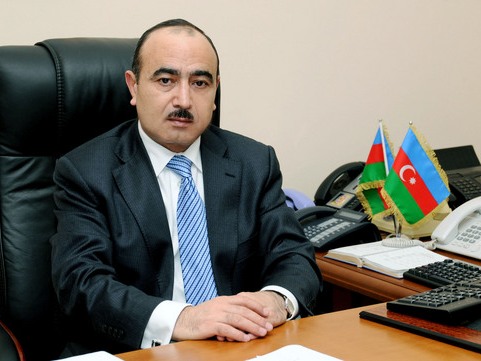
Ali Hasanov, the Presidential Administration's head of social and political affairs, said all the necessary conditions required for holding democratic elections in accordance with international standards and free expression of the people's will have been provided in Azerbaijan.
"The 2013 presidential election in this sense will be no exception," Hasanov said. "Undoubtedly, while making their choice, people are guided by present-day realities and vote for a leader who can ensure the country's development in the forthcoming period. Today's realities are that the people of Azerbaijan strongly support the policy of President Ilham Aliyev, a policy that takes into account national interests, provides for comprehensive development of the country, domestic and foreign policy, and raises the country's international influence."
He noted that Ilham Aliyev consistently relies on the people and their trust in his presidential activity.
"All decisions made by the head of state are approved and appreciated by the people," Hasanov said. "During his tenure from 2003 to the present day, the President fully justified the confidence, expectations and hopes of the people through his work. Public opinion polls conducted by independent centers show that the current policy on the development of Azerbaijan and systematic measures should be continued and implementation of "Azerbaijan 2020: Look into Future" concept of development should be ensured. Considering these realities, we can clearly say that in the coming years the people of Azerbaijan will continue moving toward new victories under the leadership of President Ilham Aliyev."
Hasanov also spoke about the energy sectorin his interview. Despite the rapid development of the non-oil economy, the energy sector remains the leading segment of Azerbaijan's economy, he said.
"The progress achieved today is based on successful implementation of [the national leader, former President] Heydar Aliyev's oil strategy. This is why the unexpected decline in the production on Azeri-Chirag-Guneshli (ACG) [oil] fields in recent years was of concern for the President of Azerbaijan," Hasanov said.
President Aliyev said at a cabinet meeting in October that crude mistakes of the BP-operated international consortium, Azerbaijan International Operating Company, have led to a sharp decline in oil production on Azeri and Chirag fields, which are part of the ACG development, the largest oil fields in the Azerbaijan sector of the Caspian. According to the president, BP failed to meet the production target in 2009-12, which resulted in Azerbaijan's receiving $8.1 billion less in direct revenue.
Hasanov noted that several reasons were cited for the decline in oil production.
"It was noted that the BP company, which suffered major losses after a severe accident in the Gulf of Mexico, refused to do risk management for other projects, including oil production in the Azerbaijani sector of the Caspian Sea," Hasanov said.
Another reason cited, he said, was that after the participating interest in the ACG project changed in Azerbaijan's favor ahead of schedule, production at ACG began to fall without any grounds, resulting in the $8.1 billion loss for Azerbaijan,
"Some other versions were also cited. But in any case, the existing situation could not satisfy Azerbaijan, and that's why the President harshly demanded that BP take appropriate steps to fulfill its obligations, to replace those responsible for the decline in production, and provide stability of production. As a result, the management of BP Azerbaijan was replaced."
After a meeting with BP's CEO Robert Dudley, who recently visited Baku, President Aliyev said that BP is now aware of its responsibilities and will ensure the stability in production starting next year, Hasanov said.
According to Hasanov, currently the main goal of Azerbaijan's energy strategy is supply of the resource-rich country's gas to world markets.
"Earlier, the volume of Azerbaijan's proven gas reserves increased to 2.6 trillion cubic meters due to the discovery of Umid and Absheron deposits, each of which contains 300 billion cubic meters of gas. Experts say the total gas potential of Azerbaijan is estimated at 6 trillion cubic meters," he said.
Hasanov said that along with oil reserves the amount of total reserves in Azerbaijan is estimated at 10 billion tons of oil equivalent. It is believed that in 2025 the export of Azerbaijani gas will increase to 40-50 billion cubic meters, and most of the volume will be transported to Europe and Turkey.
"With the launch of TANAP transnational gas pipeline, which is ranked as one of the main projects for export of energy resources...Azerbaijan with its natural gas reserves will ensure its direct involvement in the European energy market," Hasanov noted.
He said Azerbaijan has become an important partner in ensuring the energy security of Europe. The share of Azerbaijani oil in the energy balance of a number of EU member states is 35-40 percent.
"Once the Trans-Anatolian pipeline is launched, Azerbaijan with its 80-percent share will turn into the most important player in the European gas market," Hasanov said.
The TANAP project envisages the construction of a pipeline from the eastern border of Turkey to the country's western border to supply gas from Azerbaijan's Shah Deniz gas field in the Caspian Sea to Europe through Turkey. Initial capacity of the pipeline is expected to be 16 billion cubic meters a year. About 6 billion cubic meters will be delivered to Turkey, while the rest will go to European markets.
According to preliminary estimates, the cost of the gas pipeline will be around $7 billion. The construction of the pipeline is scheduled to begin in 2014 and finish in 2018.
The state oil company of Azerbaijan, SOCAR, holds 80 per cent in TANAP, while a 20 per cent stake is held by Turkey's Botas and TPAO companies.
Several countries have expressed their intention to participate in TANAP, and their joining the project as partners is possible.
Here we are to serve you with news right now. It does not cost much, but worth your attention.
Choose to support open, independent, quality journalism and subscribe on a monthly basis.
By subscribing to our online newspaper, you can have full digital access to all news, analysis, and much more.
You can also follow AzerNEWS on Twitter @AzerNewsAz or Facebook @AzerNewsNewspaper
Thank you!