
President Aliyev chosen most-trusted Mideast leader
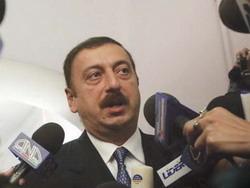
Azerbaijani President Ilham Aliyev has been chosen regional leader
of the Middle East enjoying the most public confidence, according
to an international study.
71% of respondents in the country said they trusted the head of state when asked how much confidence they had in each leader "to do the right thing regarding world affairs".
President Aliyev is also supported by those polled in two other countries - Ukraine (7%) and Russia (23%), says the WorldPublicOpinion.org poll of 19,751 respondents in nations that comprise 60 percent of the world's population.
The survey asked people around the world how much confidence they have in each of seven key leaders. On average, only 23 percent of foreign respondents express "a lot of " or "some" confidence in US President George Bush, and only Iran's Mahmoud Ahmadinejad does worse (at 22). Ban Ki-moon-the U.N. secretary-general-gets 35 percent (but because he's not a national leader, he belongs in a different category). Then comes Putin at 32 percent, Brown at 30, Hu Jintao at 28 and France's Nicolas Sarkozy at 26. The results aren't much different if you tally them country by country: in only two states (Nigeria and India) do a majority of people express at least some confidence in Bush. Putin and Hu each come out ahead in just five nations, and Brown in just six.
Bush has the second largest number of nations expressing negative views of his role in international affairs. Fifteen nations give negative ratings and two give positive ratings. Thailand is divided. On average 67 percent express low confidence.
The one country with a majority expressing a positive view of Bush is Nigeria with 60 percent saying they have some or a lot of confidence. Indians also lean positive (45 to 34%).
The most negative ratings come from the Middle East region. Despite the Bush administration's renewed efforts to address the Israeli-Palestinian conflict, nearly all Palestinians (95%) express low confidence, with 79 percent expressing "no confidence at all." Nearly as many express a lack of confidence in Egypt (92%, 68% no confidence), Jordan (88%, 84% no confidence) and Turkey (83%, 77% no confidence).
Iran, interestingly, gives the mildest negative ratings in the region (80%, 72% no confidence). Nearby Azerbaijan, though, only leans negative (49% negative, 42% positive).
European countries are only slightly less negative on President Bush. Most negative are the French: 85 percent express a lack of confidence (63% no confidence). Among the British, 77 percent give negative ratings (up 7 points from 2007), while 48 percent express no confidence at all.
Interestingly, Russians are relatively moderate with 66 percent saying they lack confidence in Bush to do the right thing and 36 percent saying they have "no confidence at all." Similarly six in ten Ukrainians lack confidence, and 36 percent have none at all.
While Indian views lean positive and Thai views are divided, those of their Asian neighbors are more negative. Majorities in Indonesia and South Korea are negative and China also leans negative, though these publics' negative views are decreasing over time.
The only world leader to elicit largely positive views is UN Secretary General Ban Ki-moon. In nine nations a plurality or majority say they have some or a lot of confidence in him to do the right thing. In eight nations a plurality or majority say they have little or no confidence.
British Prime Minister Gordon Brown, though relatively new to the world stage, gets positive ratings in six nations, more than any other chief of state. Nonetheless, even more publics (11) say they do not trust the British leader.
Pakistani President Pervez Musharraf has the poorest ratings around the world. Only in China do positive views (37%) outweigh negative ones (30%). Nigeria is divided and the other 18 nations lean negative.
Although France gets positive ratings in other international polls, President Nicolas Sarkozy does not. Fifteen out of 19 nations rate his international leadership unfavorably. On average, 25 percent of those surveyed express confidence in Sarkozy to do right thing while 48 percent express little or no confidence.
Iranian President Mahmoud Ahmadinejad gets negative ratings in 13 nations, the most after Bush and Musharraf. Only three nations are slightly positive while one is divided. On average across the 17 nations (excluding Iranians) asked about Ahmadinejad, only 22 percent say they have some or a lot of confidence, while 52 percent say they have little or no confidence.
In the Americas, 71 percent in the United States express a negative view--21 points more than in 2007. In Latin America, a majority of Mexicans (56%) have a negative view, up from 48 percent. Argentines lean negative (47 to 24%).
In Africa, Nigeria is divided, with 40 percent expressing "some" or "a lot of" confidence and 38 percent expressing little or no confidence.
Overall, the poll of 20 nations around the world finds that none of the national leaders on the world stage inspire wide confidence.
WorldPublicOpinion.org, a collaborative research project involving research centers from around the world, is managed by the Program on International Policy Attitudes (PIPA) at the University of Maryland.
Here we are to serve you with news right now. It does not cost much, but worth your attention.
Choose to support open, independent, quality journalism and subscribe on a monthly basis.
By subscribing to our online newspaper, you can have full digital access to all news, analysis, and much more.
Subscribe
You can also follow AzerNEWS on Twitter @AzerNewsAz or Facebook @AzerNewsNewspaper
Thank you!