
OSCE chair calls for quick solution to Karabakh conflict
By Aynur Jafarova
Tensions on the contact line between Azerbaijani and Armenian armed forces necessitate prompt response to the settlement of the long-running Nagorno-Karabakh conflict, which is harmful to regional nations, OSCE chairperson Eamon Gilmore has said.
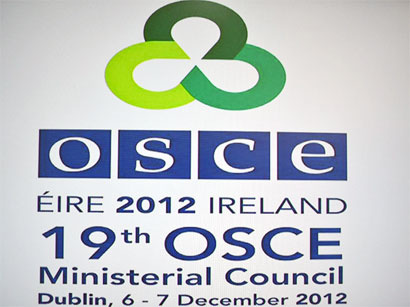
"I want to express gratitude to my personal representative Andrzej Kasprzyk for his hard work in the region," Gilmore noted at the 19th OSCE foreign ministers conference in Dublin on Thursday.
The Nagorno-Karabakh conflict emerged in 1988 when Armenia made territorial claims against Azerbaijan. The two South Caucasus neighbors fought a lengthy war that ended with the signing of a precarious cease-fire in 1994. Armenian armed forces have since occupied over 20 percent of Azerbaijan's internationally recognized territory. OSCE-brokered peace talks have been largely fruitless so far. Armenia has not yet implemented the four UN resolutions on a pullout from Nagorno-Karabakh and the seven surrounding regions.
Azerbaijani Foreign Minister Elmar Mammadyarov, who took the floor at the OSCE ministerial, said that despite the OSCE efforts, Armenia continues to occupy neighboring Azerbaijan's territories and does not withdraw its troops. He noted that the negotiations on the conflict settlement have yielded no result to date, though they have been ongoing for a long time.
Mammadyarov said Azerbaijan is interested in rapid continuation of the talks on a peaceful settlement of the Karabakh conflict.
Azerbaijan stands for intensifying the mediating OSCE Minsk Group's activity in support of the MG co-chairs' work and is ready to begin drafting a comprehensive peace agreement that would lead to a phased settlement of the conflict, the minister said.
He said further that the Karabakh conflict remains a major challenge to international security. Armenia is strengthening the status quo in the Azerbaijani occupied territories and violating the OSCE charter, using force to keep control over the occupied territories. Armenia prevents refugees displaced during the 1990s war from returning home, trying to erase all signs of Azerbaijani culture in the occupied lands. Not a single cultural site has been left intact in the occupied territories. Armenia is also rejecting inter-community dialogue and hinders economic development of the region, Mammadyarov said.
Baku also expressed concern about Armenia's attempts to use the opening of the Khojaly airport in Nagorno-Karabakh.
"This is a provocative step that undermines the process of conflict settlement and aggravates the situation in the region," Mammadyarov said.
He said Baku believes there is no alternative to peace in the Nagorno-Karabakh process and hopes for support of the OSCE countries in this respect.
EU foreign policy chief Catherine Ashton said problems facing the OSCE member states, including the Nagorno-Karabakh conflict, hamper economic development of the region and the EU is providing the necessary support to resolve the problem.
Russian Foreign Minister Sergei Lavrov during his speech said Russia will continue promoting a rapprochement in the positions of the parties to the conflict jointly with the other OSCE Minsk Group co-chairs.
The co-chairs from the United States and France are mediating the conflict settlement as well.
"We see no other option of resolving the Nagorno-Karabakh conflict except peace negotiations between the parties to the conflict," Lavrov said. "The co-chairmen's proposals on this issue are known."
Here we are to serve you with news right now. It does not cost much, but worth your attention.
Choose to support open, independent, quality journalism and subscribe on a monthly basis.
By subscribing to our online newspaper, you can have full digital access to all news, analysis, and much more.
You can also follow AzerNEWS on Twitter @AzerNewsAz or Facebook @AzerNewsNewspaper
Thank you!