
Baku cites its basic requirements for OSCE Minsk Group
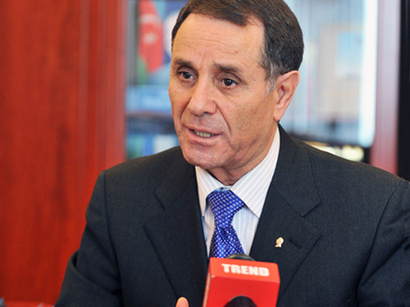
A senior Azerbaijani official says the current situation with the Nagorno-Karabakh conflict is unacceptable and status quo must be changed. To that end, there are certain decisions and resolutions of international and regional organizations, including the European Union, the Council of Europe, the Organization of Islamic Cooperation, and four statements of presidents of the U.S., Russia and France -- the OSCE Minsk Group co-chairs brokering the settlement of the conflict, Novruz Mammadov, head of foreign relations at the Presidential Administration, told journalists on Tuesday.
"Our position is that the Armenian side should not seek delays
of the negotiations by periodically finding excuses. Our
requirements for the co-chairs and desire are not to delay the
solution to this conflict. They have been conducting negotiations
for many years in this regard, but these talks have not yielded any
real results," Mammadov said.
The Minsk Group co-chairs have recently visited the region and
discussed new ideas for the peaceful resolution of the
Nagorno-Karabakh conflict.
According to Mammadov, it is impossible for the conflict to remain
unsolved.
"Azerbaijani occupied territories must be liberated. If this
happens, then the future fate of Armenia as a state, and the future
of the Armenian people can get a guarantee to a definite sense. If
the situation remains unchanged, the future of Armenian state and
the Armenian people will be indefinite," he said.
Regarding the co-chairs' new proposals, Mammadov underscored that
there are "Madrid principles", and certain documents have been
adopted in this regard.
"Within these principles, it is necessary to achieve a constructive
solution to the conflict, instead of looking for excuses. In this
regard, Armenian leadership must demonstrate its will. One cannot
hold the fate of this nation and this country as hostages. The
Armenian leadership, by sacrificing fate of the Armenian people and
the state, finds certain excuses and prolongs the negotiation
process in an effort to stay in power longer. It is their tragedy,"
Mammadov said.
The conflict between the two South Caucasus countries began in 1988
when Armenia made territorial claims against Azerbaijan. Armenian
armed forces have occupied 20 per cent of Azerbaijan since 1992,
including the Nagorno-Karabakh region and seven surrounding
districts.
Azerbaijan and Armenia signed a ceasefire agreement in 1994. The
co-chairs of the OSCE Minsk Group - Russia, France and the U.S. -
are currently holding peace negotiations.
Armenia has not yet implemented the U.N. Security Council's four
resolutions on the liberation of the Nagorno-Karabakh and the
surrounding regions.
Here we are to serve you with news right now. It does not cost much, but worth your attention.
Choose to support open, independent, quality journalism and subscribe on a monthly basis.
By subscribing to our online newspaper, you can have full digital access to all news, analysis, and much more.
You can also follow AzerNEWS on Twitter @AzerNewsAz or Facebook @AzerNewsNewspaper
Thank you!