
Presidential talks on Garabagh conflict seen as successful
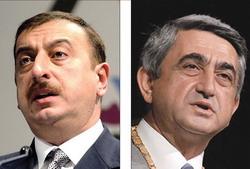
Azerbaijani and Armenian Presidents Ilham Aliyev and Serzh
Sarkisian on Friday held talks on settling the Upper (Nagorno)
Garabagh conflict in Russia that were described as successful.
The two leaders met for the first time since the new Armenian president was elected in February.
The broad meeting that took place at the Konstantinovsky Palace outside St. Petersburg was attended by the two countries' foreign ministers as well as co-chairs of the OSCE Minsk Group brokering the peace process. It was followed by a one-on-one meeting of the two heads of state which lasted nearly two hours.
In a joint statement of the two ministers issued after the talks, Azerbaijani Foreign Minister Elmar Mammadyarov said the presidential dialog was successful and the sides decided to continue peace talks.
"The meeting was constructive and positive. The presidents instructed their foreign ministers to cooperate with the Minsk Group in order to continue the talks."
Mammadyarov said the timing of the mediators' next visit to the region was being determined. During the visit that is likely to take place late in June, the intermediaries will hold discussions with the sides on basic principles of the conflict settlement.
The Minsk Group co-chairs from the United States, Russia and France submitted a set of basic principles for the peaceful settlement of the dispute in writing to Baku and Yerevan in the Spanish capital Madrid on November 28. The intermediaries believe the proposals are fair and balanced. But the two countries' governments have yet to issue their feedback on the proposals.
The two foreign ministers said the Madrid proposals were not discussed at the St. Petersburg meeting as both sides have their own approaches that require further consideration.
Asked whether Azerbaijan was intent on transferring the format of Garabagh settlement to other international organizations and whether or not Baku saw the prospect of further negotiations within the OSCE, Mammadyarov said the Minsk Group format was in place and would be preserved.
After the UN General Assembly passed a resolution in March demanding unconditional pullout of the Armenian armed forces from the occupied territories, Azerbaijan put forth the initiative to continue peace talks based on that document.
Armenian Foreign Minister Eduard Nalbandian said the negotiating process continues and the fact that Presidents Aliyev and Sarkisian had met for the first time "does not mean that the process is starting from a scratch".
The mediators positively assessed the presidential talks as well. US co-chair Matthew Bryza said the talks were successful although it was a familiarization meeting. "The dialog between Presidents Aliyev and Sarkisian proceeded in a favorable atmosphere." Bryza emphasized that it was necessary to improve the mediators' proposals to meet the needs of both parties to the long-standing dispute.
Russian co-chairman Yuri Merzlyakov said the intermediaries were ready for further cooperation with a view to achieving tangible results in the conflict resolution.
The Azerbaijani President's Upper (Nagorno) Garabagh negotiator, Deputy Foreign Minister Araz Azimov said Baku would continue peace talks but Armenia should not assume that it will meet its political interests by extending the current situation and dragging time.
"We will not make it easy for them," the deputy minister said, adding that Azerbaijan would be consistently divulging reports about Armenian occupation.
As for prospects of the peace process, Azimov said neither of the conflicting sides could meet its needs to the fullest.
"To receive something, it is necessary to be agile and make compromise. Baku is ready for that. However, it is unknown at this point in which shape or form the negotiations will continue. One or two issues remain, but these are not simple but very important ones."
The conflict between the two South Caucasus republics reared up in the late 1980s due to Armenia's territorial claims. Armenia has been occupying over 20% of Azerbaijan's internationally-recognized territory since the early 1990s, in defiance of international law. The ceasefire accord was signed in 1994, but peace talks have been fruitless so far.
Although the sides have reached rapprochement on a number of issues since peace talks began, substantial differences of opinion remain on the future status of Upper Garabagh, which lies at the core of the dispute. Armenia calls for the status determination without the region's being inferior to the central government in Azerbaijan. This would be tantamount to granting Upper Garabagh independence, a claim repeatedly brushed off by Baku as a violation of international law. Azerbaijan says that granting broad self-administration, or autonomy, is the biggest concession it could make, and the country's territorial integrity is not a subject of discussion.
Throughout the lengthy period of peace talks, the sides were close to reaching agreement only once - in 1997 - when a stage-by-stage plan was on the table. Armenia then gave its preliminary consent to granting Upper Garabagh the status of self-administration within Azerbaijan's borders that was close of actual independence. However, the efforts were derailed after Armenian President Levon Ter-Petrosian had to step down.
The St. Petersburg talks could be seen as the start of a new, fourth stage in the peace process. In 1993-1997, Presidents Heydar Aliyev and Levon Ter-Petrosian had over 10 meetings to discuss Garabagh settlement. In 1999-2002, Presidents Heydar Aliyev and Robert Kocharian met about 20 times. Finally, Presidents Ilham Aliyev and Robert Kocharian had nine meetings - one in 2003, two in 2004 and 2005 each, three in 2006, and one in 2007. In a nutshell, although over 40 meetings have been held between the two countries' leaders in the 15 years of Garabagh talks, it is difficult to assess the overall progress achieved in the negotiating process so far.
Here we are to serve you with news right now. It does not cost much, but worth your attention.
Choose to support open, independent, quality journalism and subscribe on a monthly basis.
By subscribing to our online newspaper, you can have full digital access to all news, analysis, and much more.
Subscribe
You can also follow AzerNEWS on Twitter @AzerNewsAz or Facebook @AzerNewsNewspaper
Thank you!