
Oil poisoned lake
By Seymur Aliyev
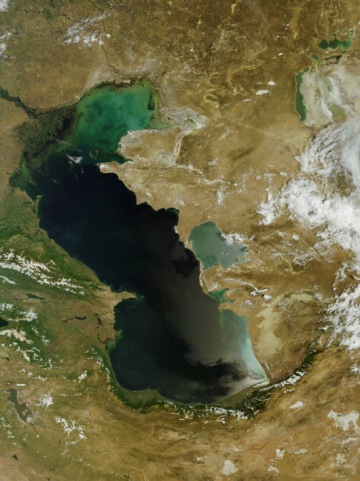
Azerbaijan has undertaken solution of the resource-rich Caspian Sea's environmental problems. About $1 billion has been allocated from the state budget for restoration and purification of the Caspian's stretch along the densely populated Absheron Peninsula -- which encompasses the Azerbaijani capital Baku and its surrounding regions, the head of Department of Ecology and Nature Protection at the Ministry of Ecology and Natural Resources, Rasim Sattarzade, told AzerNews.
"Major Caspian Sea polluters are rivers which throw in dangerous discharges to this lake," Settarzade noted. "Most of these discharges come from the Volga River, which supplies the Caspian Sea with water by 80 percent. The fact is that a lot of Russian industrial cities are located on the bank of this river. Industrious activities in the sea are the second reason contributing to pollution."
The Framework Convention for the Protection of the Marine Environment of the Caspian Sea, signed in 2003 in Tehran, is the only international convention enforced among the coastal countries -- Azerbaijan, Kazakhstan, Russia, Turkmenistan and Iran, according to Settarzade.
During a recent multimedia teleconference Baku-Moscow-Astana dedicated to the 19th anniversary of the Tehran convention, scholars from the coastal countries discussed the importance of resolute measures to prevent Caspian Sea pollution. Azerbaijan emphasized that the country has done extensive work on the modernization of existing and construction of new sewage treatment plants along the Caspian coast. Furthermore, a new wastewater treatment plant is under construction in Sumgayit, an industrial city located 30 km north of Baku. Treatment facilities will be set up in all parts of the country. Russia offers to create a common monitoring system of the Caspian states and each coastal country should conduct its own local cosmic analysis. They assert that this initiative could be capital intensive but it will open up new opportunities for research in the Caspian Sea region.
Immediately after the teleconference, an Azerbaijani delegation took part in the Avaz forum, which was held in the framework of the convention in Turkmenistan. During the forum the coastal countries discussed Caspian environmental problems and noted the progress achieved in the protection of Caspian environment, Konul Ahmadova, the leading expert of the Department of Ecology and Nature Protection, who attended the forum, told AzerNews.
With regard to fluctuations in the sea level, Rasim Sattarzade said it is a natural phenomenon and has nothing to do with human activity. Stabilizing the sea level is almost impossible.
Oil production and refining has adversely affected the environmental condition of the sea. The history of commercial oil and gas exploration and production in the region goes back nearly 150 years, so, oil pollution is not simply a hazard posed by current activity. Each year some 1.5 billion barrels of that resource, pumped from wells around the sea coast and in the sea itself, are extracted, refined and transported. Major pipelines are routed from Kazakhstan to China and from Azerbaijan to tanker terminals in the Black Sea and the Mediterranean. Tankers also travel via the Volga River and the Volga-Don Canal to the Sea of Azov and beyond.
Now the Caspian Sea is in serious environmental danger. Turkmenistan has a small share in the sea's pollution, because of poor development of the nearby coastal areas. Russia is the biggest polluter, as was mentioned above, accounting for 80 percent of the Caspian pollution. The biggest source of pollution from the Russian side falls to Volga River. The remaining 20 percent is divided among Iran, Kazakhstan and Azerbaijan. In Azerbaijan, the Caspian Sea is polluted from two sources: Absheron Peninsula and Kura River. Oil industries are drastically upgrading in the Absheron area and new rigs which are reducing pollution are applied. Of note, only 15-20 percent of waste from Kura River falls to Azerbaijan. The remaining huge part of the waste is discarded by Armenia and Georgia, the neighboring South Caucasus republics.
The near-shore marine environment of the Caspian Sea is a major repository for toxic metals originating from various natural and anthropogenic sources. The metals are not easily degraded or destroyed, and tend to accumulate in coastal soils and sediments. Since the persistent toxic metals pose serious health risks, researches have focused on studying the concentrations and spatial distribution of metals in the near-shore sediments along the Iranian coast of the Caspian.
Owing to its large size, its long isolation, and its brackish waters, the sea has an unusual variety of organisms. Among them are at least 331 endemic species - from zooplankton to mollusks and vertebrates. Most notably, the Caspian boasts five species of sturgeon, including the beluga, prized for their caviar. That population comprises 90 percent of the world's sturgeon stock. Such valuable aquatic resources, as well as lands suitable for agriculture, have attracted dense human settlement to the coastal areas. Scholars studying the ecosystem are becoming increasingly engaged in protecting the basin from industrial pollution and other damaging effects of human habitation.
Finally, a famous slogan of Greenpeace is remembered: "We did not inherit the nature from our fathers, we borrowed it from our children." People must realize that they are responsible for their healthy future. There are many other treasures hidden under and over the sea surface: the rich fauna and flora, the precious sea air and finally, a beautiful landscape that one needs to be proud of and admire. So let's protect what was given to us in the name of global health.
Here we are to serve you with news right now. It does not cost much, but worth your attention.
Choose to support open, independent, quality journalism and subscribe on a monthly basis.
By subscribing to our online newspaper, you can have full digital access to all news, analysis, and much more.
You can also follow AzerNEWS on Twitter @AzerNewsAz or Facebook @AzerNewsNewspaper
Thank you!