
Regional leaders join ECO summit in Azerbaijan
By Nigar Orujova
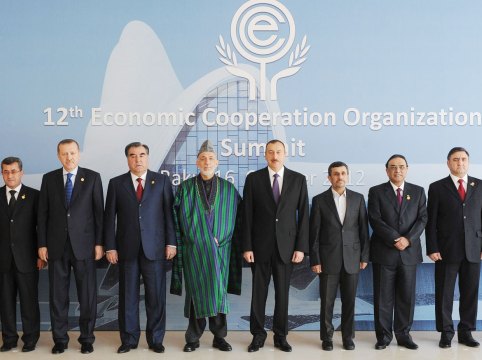
A summit of the Economic Cooperation Organization (ECO), an intergovernmental economic body, was held on Tuesday in Baku and joined by a number of regional states' leaders. Discussions focused on economic cooperation in transport, agriculture, energy sectors and environmental protection, as well as deepening the ECO member states' integration, social, cultural and scientific and technological development.
The summit was attended by Presidents Ilham Aliyev of Azerbaijan, Mahmoud Ahmadinejad of Iran, Asif Ali Zardari of Pakistan, Hamid Karzai of Afghanistan, Emomali Rahmon of Tajikistan, Turkish Prime Minister Recep Tayyip Erdogan, as well as officials of the ECO member states.
The top-level meeting of ECO -- which was established in 1985 by the countries of Central Asia and the Middle East -- followed the 20th meeting of its Council of Foreign Ministers, which had discussed the agenda of talks between leaders on Monday.
President Aliyev, in his opening remarks at the summit, which took place at the Heydar Aliyev Center, said Azerbaijan as the chair of the ECO will do its utmost for further development of the organization, work on specific projects and contribute to further development of friendly relations among the member countries.
Azerbaijan assumed the ECO chairmanship from Turkey during the 12th summit of the ECO leaders held in its capital, Baku.
The Azerbaijani president thanked Turkey for the successful activities during its two-year chairmanship in the organization.
Aliyev said Azerbaijan, on its end, has always attached great importance to the ECO's activities.
"We believe that all ECO members are interested in the organization's successful activity, because we share a common history, economic and political interests," he said.
The president also noted that Baku was declared the capital of Islamic culture in 2009.
"Our traditions, the sacred religion of Islam unite us, and we try to make every effort to promote Islamic culture," Aliyev said.
He said Azerbaijan is very concerned over the growing trend of Islamophobia in some countries.
"Insulting Islamic values enrages us, and in turn, we should present Islam as a religion of peace, brotherhood and charity even more broadly in the world," Aliyev said, noting that this issue should be one of the directions in the ECO's activity.
President Aliyev emphasized that Azerbaijan appreciates the ECO member states' position on its conflict with Armenia over Nagorno-Karabakh, which is the most painful and biggest problem facing the country, and said this stance is reflected in the documents that would be discussed at the summit.
"As you know, for many years Azerbaijan's internationally recognized territorial integrity has been violated," Aliyev said. "Armenia committed military aggression against Azerbaijan, and as a result, the Armenians occupied 20 percent of our territory and more than one million Azerbaijanis became refugees and IDPs in their homeland. A policy of ethnic cleansing was pursued against us. In 1992, the Armenians committed Khojaly genocide, killing hundreds of innocent people, including women, elderly people and children."
President Aliyev reminded that the UN Security Council has adopted four resolutions on the resolution of the conflict, which call for an unconditional withdrawal of Armenian troops from the neighboring country's occupied territories, but they have not been enforced to date.
Further, Aliyev praised Azerbaijan's rampant economic development.
"Over the past eight to nine years, the gross domestic product has tripled, industrial production increased about three-fold, i.e. 300 percent, and commercial production also increased. Great success has been achieved in the fight against poverty," the president said.
Aliyev said that over the past years, the poverty rate in Azerbaijan fell from 49 percent to 7 percent, the unemployment rate is 5.3 percent and the external debt is only 7 percent of GDP.
He also praised the fact that Azerbaijan's trade turnover with the ECO member countries is increasing.
"The trade turnover increased by 38 percent in 2011, while over nine months of 2012 it grew 20 percent. It indicates that we have very efficient economic relations with the organization's member countries. This is natural, because our political relations are at a very high level, and the economic sector, of course, should match this level," Aliyev said.
Aliyev said that in addition, Azerbaijan is implementing a number of infrastructure projects important for the region, including projects aiming to create energy infrastructure.
"Our activities in the energy sector, of course, ensure our national interests, and at the same time strengthen energy security and open up new opportunities in this sphere," Aliyev said.
He said Azerbaijan is "taking progressive and practical measures" for a successful implementation of the North-South and East-West transport corridor projects.
"The Baku-Tbilisi-Kars railway, construction of which will be completed soon, will serve all ECO countries. This railway links not only Azerbaijan and Turkey, but continents, too. This is a strategic project which will improve geopolitical and geo-economic situation to a great extent," Aliyev said.
According to the president, great economic potential of the
member countries further increases confidence that work on specific
projects will further strengthen the ECO, and
the organization's initiatives in the political, economic and
cultural fields will serve to strengthening mutual trust.
In his speech at the summit, Turkish Prime Minister Erdogan said Turkey hopes that the ECO will strengthen its power and clout and become an organization with a high potential for cooperation among the member states.
"The global financial crisis has demonstrated once again that the regional countries must work together and cooperate in economic, energy and transport sectors," he noted. "The countries must work together to maximally avoid the consequences of the crisis."
Erdogan said total GDP of the [10 ECO] member states amounts to $1.7 trillion, which equals 2.4 percent of the total GDP of world countries.
"This is a very modest figure. The income per capita amounts to $4,000. The total turnover of ECO countries makes up $768 billion or 2 percent of the total world trade turnover," Erdogan said, noting that the figures do not reflect the economic potential of the ECO countries.
He added that removing all barriers for trade among the ECO countries and abolishing or simplifying some tax and customs duties could be a good opportunity for developing trade among the member states.
"ECO countries have set out a goal of creating a free trade zone by 2015," he said. However, even a small part of this project has not been carried out yet. After creating a free economic zone, the trade turnover between ECO countries will increase eight-fold."
Turkey also invited all ECO member states to join ECOBANK.
"It is necessary to stimulate joint and bilateral investments and cooperation in the agriculture sector to develop the economies of the ECO countries," he said. "With this purpose, Antalya will host a conference of agriculture ministers of ECO member states on November 13-16."
He added that it is necessary to restore the historic Silk Road to develop the ECO countries, and great responsibility for these efforts rests with ECO.
Erdogan also noted the importance of the Baku-Tbilisi-Kars railway project for the Silk Road restoration. The project will stimulate the development of the region and strengthen the cooperation between Asia and Europe, he said.
Iranian President Ahmadinejad noted the importance of improving rail, sea, land, air transport networks, as well as joint use of the potential of the Persian Gulf, Gulf of Oman, the Caspian Sea, the Mediterranean Sea, the Black Sea and the Aegean Sea.
Ahmadinejad put forward an initiative to create a political forum within ECO to coordinate actions in the international arena, to help the member states on disputable issues, to protect the rights and interests of ECO member states in international organizations, and to take joint steps for reforming international organizations, including the UN.
Taking into account the rich heritage of ECO member countries, President Ahmadinejad proposed to develop cultural cooperation and hold weeks of culture, to strengthen and institutionalize the scientific and technological cooperation among the ECO countries and to establish a relevant organization.
The Iranian president said it was important for the summit agenda to include cooperation in economics, industry, agriculture, energy, trade, barter trading and use of national currencies in trade transactions. Among other priority issues he mentioned developing unified customs legislation and economic security of the member states.
Ahmadinejad also considers it necessary to create the ECO Economic Forum, providing regional international senior managers, authorities, experts and representatives of the private sector with a platform for holding annual consultations and offering solutions to various issues.
"Proceeding from the unlimited potential and opportunities of our peoples, we can do a lot," he said. "All this can be done if there is unanimity and promotion of cooperation and coordination of action within the organization. We must take collective action to defend the independence, progress and prosperity of our countries."
Pakistani President Asif Ali Zardari, in his remarks at the summit, voiced three "clear and present dangers" for the region.
"No other region shares as much as we do, but also no other region is under as much threat as we are," Zardari said in his speech, citing terrorism, poverty and illiteracy, abuses of fundamental peoples' rights as three major threats to the region.
The Pakistani president said that regional cooperation is very important, as countries must face their challenges with courage and collective action.
Speaking of combating terrorism and human rights, Zardari condemned the attack on Malaya Yousafzai, a Pakistani schoolchild that has been shot in the head by Taliban gunmen for speaking out about suffering under the regime. The girl's life was saved by neurosurgeons in a Pakistani military hospital and she has since been in intensive care.
Elsewhere in his remarks, Zardari said that regional countries must put into action a vision of real cooperation between themselves.
"There are areas, such as energy, transport and trade, where we should work together, and we also must assist the private sector to increase investment in the member states," Zardari noted.
The Baku Declaration was adopted at the end of the ECO summit on Tuesday. ECO awards were presented to 24 people from eight countries.
The next ECO summit will be held in Pakistan in 2013.
Here we are to serve you with news right now. It does not cost much, but worth your attention.
Choose to support open, independent, quality journalism and subscribe on a monthly basis.
By subscribing to our online newspaper, you can have full digital access to all news, analysis, and much more.
You can also follow AzerNEWS on Twitter @AzerNewsAz or Facebook @AzerNewsNewspaper
Thank you!