
Baku turning into center of humanitarian debate
By Nigar Orujova
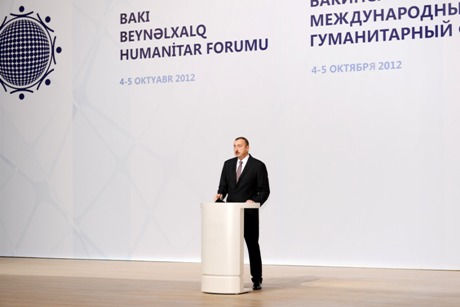
The Azerbaijani capital Baku hosted an international humanitarian forum on October 4-5 that brought humanitarian issues to the forefront of global agenda.
The opening ceremony was held at the Heydar Aliyev Center and attended by President Ilham Aliyev and First Lady Mehriban Aliyeva.
The International Humanitarian Forum is a high-profile global scientific and political platform for tackling the challenges facing humanity in the 21st century, holding discussions and exchange of views on a wide range of issues of humanitarian cooperation.
With its rich traditions of co-existence among different cultures, civilizations and religions, Azerbaijan is an ideal venue for holding such events.
The second Baku International Humanitarian Forum was attended by 694 people representing 70 countries and seven international organizations. These include 10 former heads of state, 11 Nobel Prize winners, five honorary professors of the world (Emeritus professor), 10 senior officials from authoritative international organizations, 55 prominent public and political figures.
One of the main goals of the second such forum was to create humanitarian and integration incentives.
The Baku declaration was adopted following discussions on various issues both at the plenary and departmental meetings, which were held as part of the two-day event.
Outcomes of the forum were reflected in the recommendations and calls made to international organizations and countries.
President Aliyev made a speech at the opening of the Baku forum.
"Organization of the Second Baku International Humanitarian Forum suggests that the first forum was very successful," the president said.
According to the president, multiculturalism is one of the
topics of the forum. "I believe that Azerbaijan's experience is
very significant and valuable for promoting multiculturalism. For
centuries, representatives of different religions and nationalities
have lived in Azerbaijan like one family."
"Azerbaijan has never had and I am sure never will have
confrontations and disagreements on religious or ethnic grounds.
One of the goals of the Baku International Humanitarian Forum is
precisely to increase multiculturalism trends," Aliyev said.
The president said education would be one of the focal points of the forum.
"I know that education will be one of the topics of the forum. Other areas of the humanitarian field are also of great importance. For example, sometimes we see sports-related issues only as a sporting event. But the truth is that it is difficult to find another event of such significance that would unite people as much as the Olympic Games," he said.
President Aliyev also spoke about the Nagorno-Karabakh conflict, the most disturbing problem of Azerbaijan.
"Azerbaijan has been faced with a humanitarian catastrophe for 20 years. For 20 years, the internationally recognized ancestral lands of Azerbaijan in Nagorno-Karabakh and surrounding seven regions have been under Armenian occupation. This occupation continues. Azerbaijanis have been subjected to a policy of ethnic cleansing. All the Azerbaijanis have been driven out of Nagorno-Karabakh and surrounding regions. Currently, the world's biggest number of refugees per capita is registered in Azerbaijan. We have over a million refugees and IDPs who can't return to their homes because of the ongoing Armenian aggression."
Armenian armed forces have occupied 20 per cent of Azerbaijani territory since a ceasefire was signed between the two South Caucasus neighbors in 1994 following a brutal war. OSCE-brokered peace talks have been largely fruitless so far.
"Our people have seen great tragedies," Aliyev said. "The Khojaly genocide [committed by Armenians during the Karabakh war] was perpetrated when a massacre was unleashed against innocent people, including women and children. The Armenians have destroyed our cultural monuments. So, a genocide has been committed against our people and against our culture. Those who carried out this genocide, this crime have yet to be adequately condemned by the international community."
The president noted that the world's leading international organizations have passed many decisions and resolutions on the Armenia-Azerbaijan Nagorno-Karabakh conflict. However, there is no mechanism for enforcing these decisions and resolutions, which diminishes respect and credibility of these decisions, he said.
Aliyev recalled that 20 years ago the UN Security Council passed four resolutions on an unconditional withdrawal of the Armenian forces from the occupied Azerbaijani lands, but none of them has been executed to date.
"All the other reputable international organizations, such as the Council of Europe, the European Parliament, the Organization of Islamic Cooperation, NATO, etc., have also adopted similar resolutions. Azerbaijan's territorial integrity is recognized by the international community.
"But the conflict remains unresolved. The main reason is that Armenia is interested in maintaining the status quo. But they have to realize that the status quo can't remain unchanged, it will be changed and we want it to happen soon and peacefully. Because we have already started playing a stabilizing role in the region and, of course, strive to ensure that the stability of the region is not compromised. But on the other hand, it is impossible to come to terms with occupation.
"So I believe that it is time to resolve the conflict. Armenia must fully comply with international law and resolutions of international organizations and unconditionally withdraw from the occupied lands. In this case, real peace and cooperation can be achieved in the region."
Further, the president spoke of Azerbaijan's economic achievements.
"Our country has covered a long and successful road in the years of independence. Over the past few years, Azerbaijan has been the fastest growing economy in the world. Over the last seven to eight years our economy has tripled. The poverty rate has dropped from 49 to 7 per cent. The problem of unemployment has been practically resolved. Of course, there are still unemployed but their share is 5.4 per cent. Azerbaijan's foreign debt amounts to only 7 per cent of the GDP. This suggests that by pursuing economic reforms and initiatives, we focused our work on internal resources. We didn't borrow much. So we can fully repay our foreign debt at any time. I believe that Azerbaijan is in one of the top places in the world in this respect."
The president said the steps taken towards economic diversification are yielding fruit.
"As you know, Azerbaijan is a country rich in oil and gas. But our economic indices for the first six months of this year show that our non-oil sector grew by more than 10 per cent. So, diversification is already a reality. There are all the possibilities for achieving long-term and sustainable economic development in the future. First of all, there is political will. There is also a suitable financial situation," he said.
Aliyev expressed confidence that the country's economic development will be "stable and rapid".
"We have ambitious plans regarding the application of scientific and technological progress and high technology in the coming years. Of course, at the heart and in the center of all our work is the human factor. I believe that this is the most important approach for any state."
"Overall, there is a very positive atmosphere in society -- an atmosphere of creation and development. Of course, there is a great need for international cooperation to enhance this positive trend," Aliyev said.
Aliyev said that Azerbaijan plays a role in enhancing the dialogue among civilizations.
"I am sure that this role will only grow in the future. There are natural reasons for that because we are located at the crossroads of continents. There are political reasons because it is our political conviction that has historical basis. Azerbaijan is a member of both the Council of Europe and the Organization of Islamic Cooperation. There are several countries in the world that are members of both. Sometimes, when Azerbaijan is viewed from Europe, it is presented to the Europeans as an Asian country. And when we are viewed from Asia, we are portrayed as a European country," the Azerbaijani leader stressed.
"As a natural geographic bridge, we also strive to serve as a bridge in the humanitarian sphere. This is the main objective of the forum," the president noted.
Russian President's Special Representative for International Cultural Cooperation Mikhail Shvydkoi also made a speech and read out President Vladimir Putin's statement to the forum participants.
"The forum expands its boundaries every year, becoming a significant and much anticipated event in the social life of Russia, Azerbaijan and other countries," President Putin said in his letter. "It attracts the attention of prominent politicians, scholars and intellectuals and makes an important contribution to the dialogue on key aspects of international humanitarian cooperation."
The president of the UNESCO General Conference, Katalin Bogyay, said the Baku forum on humanitarian cooperation was an excellent opportunity for taking steps towards peace and security on the planet.
"Azerbaijan is a valuable partner of UNESCO," Bogyay said, noting that humanitarian aid is the foundation of progress in a free society.
UNESCO Director General Irina Bokova addressed the forum participants through a video message. Bokova said that UNESCO as a humanitarian organization would continue to make an effort to achieve cultural diversity, advance innovations and sustainable development.
Addressing the forum, Abdulaziz Othman Altwaijri, the Islamic Educational, Scientific and Cultural Organization (ISESCO) Director General, emphasized that the forum brought together political, intellectual, scientific and academic personalities, and elite groups from all walks of life and from different countries.
"This event aims to strengthen the dialogue between cultures and civilizations, promote a proper culture of peace," Altwaijri said. "In this case, special attention should be paid to the problems of people affected by occupation. As an example, we can refer to the Nagorno-Karabakh conflict. Therefore, a new rationalization of international relations is an important issue. In this regard, we truly need to give a new impetus to international politics."
The forum featured roundtable meetings on themes including humanitarian aspects of economic growth models; converging technologies and outlines of the future; modern mass media and new challenges; the traditional system of values in a post-modernist culture; new approaches to the processes of globalization in the 21st century. Discussions also covered technologies, modern medicine, and molecular biology, as well as multiculturalism.
The final declaration adopted in conclusion of the Baku humanitarian forum calls for the public, politicians and scholars to fully support Azerbaijan's initiative to set up a special research center covering multicultural problems of the world.
"A comprehensive and multilevel dialogue held within the Baku Forum gives us hope of the possibility of an effective resistance to the current challenges of our time," the declaration said.
Participants of the Baku forum stressed the increasing importance of rethinking the concept of multiculturalism and its role in modern society.
They stressed the need for using multiculturalism as an integral part of state policy and its significance for the development of different cultures and the enhancement of the cultural achievements of mankind.
They also emphasized the need for further development of the multiculturalism-related philosophical and ethical issues along with media coverage -- to prevent xenophobia, racism and intolerance.
The participants expressed their belief in the need for holding such annual forums and expressed deep gratitude to the Azerbaijani president, the government and all organizers of the Baku International Humanitarian Forum for such a large scale campaign that turned Baku into the center of discussions on humanitarian issues.
Tours to the capital city and regions of Azerbaijan were organized for the participants of the forum. They were also familiarized with the Azerbaijani people's abundant cultural legacy and art.
The first Baku International Humanitarian Forum under the slogan "21st century: hopes and challenges" took place in October 2011. The forum was organized by Presidents Ilham Aliyev and Vladimir Putin.
Here we are to serve you with news right now. It does not cost much, but worth your attention.
Choose to support open, independent, quality journalism and subscribe on a monthly basis.
By subscribing to our online newspaper, you can have full digital access to all news, analysis, and much more.
You can also follow AzerNEWS on Twitter @AzerNewsAz or Facebook @AzerNewsNewspaper
Thank you!