
Aliyev, Sargsyan pledge to speed up Karabakh settlement
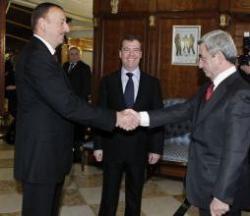
The Azerbaijani and Armenian presidents voiced their readiness to accelerate reaching agreement on basic principles of the Nagorno Karabakh conflict settlement after their Russian-brokered talks on Monday.
Azerbaijani, Armenian and Russian Presidents - Ilham Aliyev, Serzh Sargsyan and Dmitry Medvedev - held the tenth trilateral meeting in the Russian city of Sochi.
A joint statement issued as a result of the meeting said progress has been reached in agreeing the basic principles of Karabakh settlement. The statement does not elaborate, but says that "taking into account the importance of passing to the development of a peace agreement, the Azerbaijani and Armenian presidents expressed their willingness to accelerate the agreement on basic principles."
Presidents Aliyev and Sargsyan appreciated the mediation of Russia and other countries co-chairing the OSCE Minsk Group - France and the U.S. They expressed hope that the three countries will continue playing an active role in the conflict settlement until lasting peace and stability are established in the region, according to the statement.
Aliyev and Sargsyan confirmed that one of the confidence-building measures in the context of the Nagorno Karabakh conflict settlement is the development of humanitarian contacts between the parties. In this regard, the Azerbaijani and Armenian presidents pledged to promote further dialogue among intellectuals, scholars and the public, the statement said.
The presidents of the three countries took into account the report on the mechanism to investigate the situation along the contact line of Azerbaijani and Armenian troops and ordered to continue these efforts. The report has been developed by the Minsk Group co-chairmen and the personal representative of the OSCE chairman.
Russian Foreign Minister Sergey Lavrov told reporters after the presidential meeting that the Azerbaijani and Armenian leaders had acknowledged the need to refrain from "hard-line positions" on Nagorno Karabakh.
"The parties reached a common understanding that it is necessary to move away from maximalist positions to attain further progress," Lavrov was quoted by RIA Novosti news agency as saying.
The minister said the whole host of issues that remain to be agreed in the draft of the Karabakh conflict basic principles was discussed during the meeting of Aliyev, Sargsyan and Medvedev. He said the presidents had exchanged views on specific complex issues, and a conclusion was made that "it is necessary to continue working".
"The participants [of the meeting] expressed their willingness to accelerate the work on the basic principles and then to proceed on this basis to the development of a legally binding peace agreement," Lavrov said.
He said further that the Azerbaijani and Armenian presidents had asked Russia to mediate in establishing humanitarian ties between the two countries.
"Baku and Yerevan appealed for Russia to be the initiator of these contacts," Lavrov said. "Of course, President Medvedev agreed."
Lavrov added that Russia has always supported this kind of humanitarian ties and is ready to fulfill the mediator's role for this purpose.
Mubariz Ahmadoghlu, the head of Azerbaijan’s Center for Political Innovation and Technology, said the Sochi meeting is a turning point in Karabakh settlement, stressing that the Armenian side did not put forward any conditions there.
Ahmadoghlu said the fact that the presidents’ joint statement envisions establishing humanitarian ties implies future discussions between the Azerbaijani and Armenian communities of Nagorno Karabakh, which is "a positive step" toward a peaceful settlement of the conflict.
But Elkhan Shahinoglu, the head of Baku-based Atlas research center, believes that the Sochi meeting was "the most hopeless" of all Medvedev-brokered meetings held so far. He said it was unlikely that Medvedev, whose term in office is about to expire, would be able to foster a turning point on such a complicated dispute as Nagorno Karabakh.
"If there was any success, it would have been achieved at the previous meetings," the analyst said. "The Kremlin is simply trying to keep the West away from the Karabakh conflict. Medvedev has accomplished that, but no major steps have been taken on the path of resolving the conflict."
Shahinoglu said that even with the Russian president’s goodwill in past years, Moscow’s "political and military elite defending Armenia" would not have allowed to reach a breakthrough in the conflict resolution.
Azerbaijan and Armenia waged a brutal war in the early 1990s that displaced up to a million Azerbaijanis. About 20 percent of Azerbaijani territory, including Nagorno Karabakh, has been under the occupation of Armenian armed forces since the 1994 ceasefire.
Peace talks are underway on the basis of the Basic Principles, a peace outline proposed by the Minsk Group co-chairs. The principles include the return of the territories surrounding Nagorno Karabakh to Azerbaijani control; determining the final legal status of Nagorno Karabakh; a corridor linking Armenia to the region; and the right of all internally displaced persons to return home.
This story is published by AzerNEWS Weekly under a project funded by the Foundation for State Assistance to the Development of the Media under the President of the Azerbaijan Republic.
Here we are to serve you with news right now. It does not cost much, but worth your attention.
Choose to support open, independent, quality journalism and subscribe on a monthly basis.
By subscribing to our online newspaper, you can have full digital access to all news, analysis, and much more.
You can also follow AzerNEWS on Twitter @AzerNewsAz or Facebook @AzerNewsNewspaper
Thank you!