
Baku details differences with CoE over law on political parties
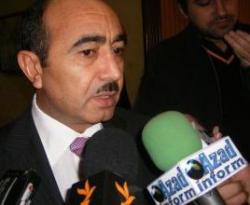
The Azerbaijani government has announced the key issues on which it disagrees with a Council of Europe legal advisory body regarding the amendments to the draft law on political parties.
During two rounds of discussions with the Venice Commission, held last month and recently, Azerbaijan submitted general text of the Law on Political Parties, Ali Hasanov, the Presidential Administration official in charge of social and political affairs, told Trend news agency.
"According to our logic, the law, which was adopted in 1992 and meets neither the Azerbaijani Constitution's norms nor the subsequent political development, should be more dynamic and be brought into line with today's requirements," Hasanov said.
He said that amendments to the law stem from the fact that the Azerbaijani government has put forward the will to finance political parties from the state budget.
"The government of Azerbaijan, like [those of] other developed countries, demonstrates its desire to rid political parties of outside influences, including foreign financial influence. In this case, of course, we are not currently satisfied with the funding of political parties by foreign countries or with foreigners' membership in political parties. Therefore, we initially stated that the standards considered appropriate by the Venice Commission for the European Union member states cannot be considered suitable for other Council of Europe members. So far, none of these countries has passed a law that allows foreign citizens to establish and fund political parties, as well as struggle for power," Hasanov said.
He said Azerbaijan had stated in advance that this norm is not appropriate for the country, and, regardless of the CoE body’s conclusions, parliament cannot adopt such a law.
Hasanov noted that another issue discussed pertained to political parties that oppose the constitutional order.
"And it became a serious topic of discussion between us and the Venice Commission," he said. "The points we raised indicate that if a political party struggles to change the constitutional order by violent means, then a question arises over its shutdown, and it is closed…The Venice Commission somewhat hesitates on this issue and expresses opinions about other forms of struggle against the constitutional order," Hasanov said.
Another matter of disagreement is that Azerbaijan considers that political parties must unite gradually, that there should be some consolidation among them, and if they are funded by the state budget, the number of parties should be adequate to the country's political life, he said.
"In this case we offered to increase to 5,000 the previous minimum number [of political party members], which is currently 1,000 people – one of the criteria for establishing political parties. If any political party wants…to participate in the elections, to be financed by the state, the number of its members must not be less than 5,000."
Hasanov said the Venice Commission considers that this issue may cause some difficulties, but the government believes it will not cause any problems.
"I have not heard any party stating that the number of its members is less than 5,000. Every party believes that this number is much more than 5,000, therefore, this issue will not create any problems for Azerbaijan."
Hasanov said another issue is related to the procedure of suspending parties' activity.
"The question is -- who and under what conditions may suspend a political party's activity. We have defined a specific approach to these questions in the amendments to the law: in which cases the Ministry of Justice may initiate closure of a political party… The Ministry is the body registering political parties. But in any case, a court decides on shutting down a party. A court is an independent authority. Therefore, no one should doubt its independence. So, on this issue, we do not understand the remarks or recommendations made by the Venice Commission to a certain extent," Hasanov said.
The Commission said in its conclusions released on Monday that regulations of the Law relating to the disbandment of political parties do not specify which of the executive authority bodies will ensure compliance with the law, adding that this body must be independent of the government.
Hasanov said another issue that was discussed pertained to trade union organizations’ attitude towards political parties and their participation in political events.
"In this regard we have come to an agreed position that trade unions do not participate in politics generally, but each union may be a member of a political party, may provide financial assistance to political parties and participate in the establishment of a political party," Hasanov added.
Here we are to serve you with news right now. It does not cost much, but worth your attention.
Choose to support open, independent, quality journalism and subscribe on a monthly basis.
By subscribing to our online newspaper, you can have full digital access to all news, analysis, and much more.
You can also follow AzerNEWS on Twitter @AzerNewsAz or Facebook @AzerNewsNewspaper
Thank you!