
Mediating states call for peaceful Karabakh settlement
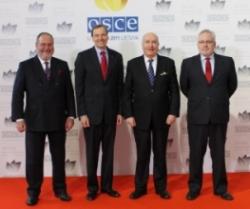
Presidents ready to meet again
Top officials of Azerbaijan and Armenia as well as the countries brokering settlement to the Nagorno Karabakh conflict have issued a statement calling for a peaceful settlement of the long-standing dispute.
Azerbaijani Foreign Minister Elmar Mammadyarov, Armenia’s Edward Nalbandyan and Russia’s Sergei Lavrov, the United States’ Secretary of State Hillary Clinton, and France’s Minister for European Affairs Jean Leonetti agreed on the need to continue the OSCE Minsk Group-mediated negotiations and to improve the climate for making progress towards a peaceful resolution, says the statement, posted on the OSCE website on Tuesday. As one of the steps in this direction, the five countries’ officials agreed that further efforts should be made to work on the details of the mechanism to investigate ceasefire violations on the contact line of Azerbaijani and Armenian troops.
The Minsk Group co-chair countries’ officials reiterated in the statement that there can be no military solution to the Nagorno Karabakh conflict.
In light of the intensive negotiations conducted since the 2007 OSCE Ministerial Council in Madrid, including at the highest level, the three heads of delegation urged the parties to give further "careful consideration" to the proposals that the co-chair countries have provided to them.
The Azerbaijani and Armenian foreign ministers informed the mediating countries’ officials that their presidents are ready to meet again jointly in the near future under the auspices of the co-chair countries to continue their direct dialogue, building upon recent experience, on how to bring peace, stability, and prosperity to their peoples, according to the statement, issued on the occasion of the OSCE Ministerial Council meeting in the Lithuanian capital Vilnius.
Ministers Mammadyarov and Nalbandyan met on the sidelines of the Ministerial Council on Monday with the participation of the Minsk Group co-chairs. The Karabakh conflict was on the agenda of the Council meeting on Tuesday as well.
US Secretary of State Clinton said in her remarks that only a negotiated settlement of the conflict is possible. Its solution, she said, would help to restore "the climate of trust" and stability in the region.
Russian Foreign Minister Lavrov called on Azerbaijan and Armenia to capitalize on the proposals developed as a result of President Dmitry Medvedev’s recent contacts with the conflict parties.
"Those proposals were supported in the joint statement issued this May in Deauville by the Minsk Group co-chair countries’ presidents," Lavrov said.
In their statement, issued at the G8 summit in the French resort city on May 26, Presidents Barack Obama, Nicolas Sarkozy and Dmitry Medvedev strongly urged the sides to prepare their populations for peace, not war, and called on the leaders of Azerbaijan and Armenia to finalize the basic principles of a peace agreement dubbed the Madrid principles.
Leonetti, the French minister, said that despite the mediators’ efforts, progress was not achieved in Karabakh settlement in 2011. "However, the results accomplished should allow to invigorate the dynamic of the negotiating process in 2012," he said.
Leonetti said it is time to pass a decision on the Karabakh problem.
"We want the sides to avail of this chance and approve the updated Madrid principles," he added.
Turkish Foreign Minister Ahmet Davutoglu, addressing the OSCE ministerial, called on the Minsk Group to step up its mediating efforts. Davutoglu said talks on resolving the Karabakh conflict have been failing to produce the anticipated results.
He added that the fact a number of conflicts in the OSCE region remain unresolved diminishes confidence in this organization.
Yerzhan Kazykhanov, the foreign minister of Kazakhstan, which chaired the OSCE in 2010, suggested expanding cooperation of the parties to the ongoing peace talks with international institutions and mediators.
Audronius Azubalis, Lithuania's foreign minister and OSCE chairman-in-office, said the OSCE should step up efforts in investigating the incidents on the troops’ Line of Contact.
Lucinda Creighton, the European affairs minister of Ireland, which will chair the OSCE in 2012, said her country intends to closely cooperate with the Minsk Group in the process of Karabakh conflict resolution. Creighton said the settlement of the region’s protracted conflicts will be a priority for Ireland during its OSCE chairmanship.
"In conflict resolution, Ireland intends to focus on its own experience in the settlement of the conflict with Northern Ireland," the minister added.
The Karabakh conflict emerged during the last few years of the Soviet Union. 20 percent of Azerbaijan’s territory, including the Nagorno Karabakh region, has been under Armenian occupation since the two South Caucasus republics signed a precarious cease-fire in 1994 following a brutal war.
Peace talks are underway on the basis of the Madrid principles, a peace outline proposed by the mediators. The Madrid Document covers a return of the Armenia-occupied territories surrounding Nagorno Karabakh to Azerbaijani control, a future determination of the region’s legal status and the right of internally displaced persons and refugees to return to their homes.
Here we are to serve you with news right now. It does not cost much, but worth your attention.
Choose to support open, independent, quality journalism and subscribe on a monthly basis.
By subscribing to our online newspaper, you can have full digital access to all news, analysis, and much more.
You can also follow AzerNEWS on Twitter @AzerNewsAz or Facebook @AzerNewsNewspaper
Thank you!