
EU calls to agree roadmap on Karabakh by year-end
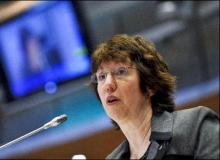
BAKU – The European Union calls on Azerbaijan and Armenia to redouble their efforts to reach agreement on a roadmap for settling the Nagorno Karabakh conflict before the end of this year, EU foreign policy chief Catherine Ashton has said.
Ashton said during discussions on the conflict at the European Parliament session on Wednesday that the May 26 statement of the US, Russian and French presidents made clear that the time has come for an agreement.
"Regrettably, despite strong messages at the highest level, the expected breakthrough at Kazan on 24 June did not materialize. President Aliyev of Azerbaijan and President Sargsyan of Armenia did not take this opportunity to reach a compromise," Ashton said.
Russian President Dmitry Medvedev hosted Presidents Ilham Aliyev and Serzh Sargsyan in the Volga city of Kazan for another round of talks seeking to end the two-decade conflict. The leaders of the mediating OSCE Minsk Group’s co-chairing countries - the United States, France and Russia – in their statement made in Deauville, France urged to "take a decisive step" to finalize the basic principles of a peace agreement during the Kazan summit. But such a document was not signed, and the parties even traded accusations after the meeting.
The EU official admitted that relations between Azerbaijan and Armenia are "difficult". Ashton said she recently met the foreign ministers of the two countries in Bratislava, and has "no illusions" about the complexity of the negotiations.
She said that nevertheless, efforts to find an agreement on the basic principles of the conflict settlement must continue, and welcomed both parties’ pledge to continue the diplomatic process and to find a peaceful solution.
"But we need to see more than that in the coming months. The parties need to redouble their efforts to find an agreement before the end of this year. This would then happen before domestic priorities take over in 2012: elections in Armenia in 2012, and in Azerbaijan in 2013.
"Indeed, a continuation of the status quo is unacceptable, as is any effort to resolve the conflict or influence the negotiations by using force, or even the threat of force," Ashton said.
Azerbaijan and Armenia waged a brutal war in the early 1990s. About 20 percent of Azerbaijani territory, including Nagorno Karabakh, has been under the occupation of Armenian armed forces since a ceasefire was signed in 1994. Peace talks are underway on the basis of a peace outline proposed by the Minsk Group co-chairs dubbed the Basic Principles. The principles include the return of the territories surrounding Nagorno Karabakh to Azerbaijani control; determining the final legal status of Nagorno Karabakh; a corridor linking Armenia to the region; and the right of all internally displaced persons to return to their homes.
The EU foreign policy chief said further that the peaceful settlement of the Karabakh conflict is "a key strategic interest" of the European Union. She said a settlement of the conflict would pave the way towards political and regional stability, and new economic opportunities.
"Borders could open not only between Armenia and Azerbaijan, but also between Armenia and Turkey. Roads, railways and pipelines could take the shortest route, and tie the countries of the region more closely together."
Ashton said the South Caucasus could finally become "a gateway" between Europe and Asia, which is clearly in the EU’s interest.
She said the EU is ready to step up its efforts in support of the work of the Minsk Group co-chairs.
"The nature of the additional support that we can provide is of course a matter for consultation with the Minsk Group co-chairs and the parties. And I can assure you that we are holding regular consultations with them on this subject."
Ashton made clear that the course of peace talks "matters greatly" to the EU, and will play a role in the way the bloc shapes its policy towards Azerbaijan and Armenia.
"We hope to see progress by the time of the planned Eastern Partnership Summit in September in Warsaw," Ashton said.
She also cited possibilities for enhanced EU engagement outside the negotiations on Karabakh settlement. She said the bloc is already supporting confidence building and outreach activities to people on both sides, often through civil society organizations, but it "can do more".
For instance, the EU needs to work closely with regional actors like Turkey, Ashton said.
Speaking after Ashton’s address, the European Parliament’s Estonian lawmaker Kristiina Ojuland said a settlement to the Nagorno Karabakh conflict must be based on the principle of Azerbaijan’s territorial integrity, and Armenian armed forces must be pulled out of the country’s occupied territories, in accord with the EP resolution passed in 2010.
Austrian MP Ulrike Lunacek also called on Armenia to withdraw from Azerbaijan’s land and on Azerbaijan to scale down its armament.
Latvian parliament member Inese Vaidere said the EU is not making enough effort toward a Karabakh settlement, though the bloc has the required experience and resources to facilitate a solution.
Bulgarian lawmaker Kristian Vigenin, co-president of Euronest, the newly established parliamentary assembly of the EU’s Eastern Partnership program, expressed concern with the rising tension over the Karabakh conflict.
"The failure of the Kazan meeting, perhaps, indicates that the Minsk Group has run out of its potential," Vigenin said. "However, the conflict parties should step up effort for peace talks to be a success."
Here we are to serve you with news right now. It does not cost much, but worth your attention.
Choose to support open, independent, quality journalism and subscribe on a monthly basis.
By subscribing to our online newspaper, you can have full digital access to all news, analysis, and much more.
You can also follow AzerNEWS on Twitter @AzerNewsAz or Facebook @AzerNewsNewspaper
Thank you!