
Regional states' event 'to rile Russia'
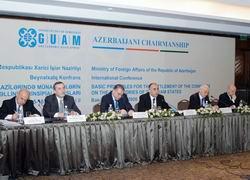
Representatives of Georgia, Ukraine, Azerbaijan and Moldova
gathered in Baku on Tuesday to seek ways of settling "frozen"
conflicts in their territories.
The conference of the GUAM group's member states focusing on the
Armenia-Azerbaijan conflict over Upper (Nagorno) Garabagh, and
those over the Georgian republic of Abkhazia and Dnestr, Moldova
comes amid abating diplomatic efforts to resolve outstanding
regional disputes.
The event is attended chiefly by the countries friendly to GUAM,
while Russia and other mediating states are essentially not
represented. The participants include officials and experts from
Turkey, Georgia, Britain, Germany, Israel, Poland, Romania, Austria
and Baltic states.
Azerbaijani Foreign Minister Elmar Mammadyarov said the goal of the
GUAM states was to break the ice in settling the lingering
conflicts. These disputes, he said, are impeding economic
development.
"All conflicts existing in the GUAM territory emerged from
aggressive separatism. Double standard approaches to their
resolution create a lack of confidence. We believe that the
international legal system should be strengthened," the minister
said.
Georgian Deputy Minister for Reintegration, Dmitry Mandjavidze,
said GUAM countries should have their own priorities in resolving
conflicts.
"The conflicts in Georgia will find their solution in line with the
country's territorial integrity and the interests of all ethnic
groups involved.
"There is a Russian factor in the resolution of conflicts. But the
interference of any foreign factor here is unacceptable,"
Mandjavidze said.
He added that no talks were under way in his country to settle the
conflicts and that the process "has to be started from a
scratch".
Moldovan Deputy Minister for Reintegration Ion Stavila said the
world community was not paying enough attention to the settlement
of conflicts. "Compared to other conflicts, solving the Dnestr
problem would be easier, but no one is doing that. GUAM should
therefore strive to achieve results on its own."
But local pundits are somewhat skeptical about the prospect of
solving conflicts by holding such conferences.
Political analyst Ilgar Mammadov says the only factor bringing
together the GUAM states is their problems with Russia.
"Their gathering in such a format primarily riles Russia. From this
standpoint, no matter what is being said at the conference, in my
opinion, the format itself is more significant than the essence of
the event," he said.
But another analyst, Rasim Musabayov, says that by coordinating
effort, GUAM is capable of drawing international attention. "The
group's member states have the needed resources for this."
Recommendations on the settlement of conflicts will be adopted in
conclusion of the two-day conference. But experts charge that these
recommendations could yield results only provided that they are
followed by further steps and applied in practice. Some critics say
that GUAM has already convened in the past to moot outstanding
issues but then hushed up and backtracked.
Three years have gone by since the GUAM states submitted to the UN
General Assembly a draft resolution on international support to the
resolution of the Garabagh, Abkhazia and Dnestr conflicts based on
the territorial integrity principle, but the document has yet to be
put on discussion. Azerbaijani Deputy Foreign Minister Araz Azimov
does not rule out that the sides will consider the issue following
the Baku conference.
GUAM was established in Strasbourg in 1999. Uzbekistan entered the
organization later, but seceded four years thereafter. At a summit
in the Ukrainian capital Kiev in 2006, the member states declared
GUAM as the Organization For Democracy and Economic
Development.
The group's next summit will take place in Tbilisi, Georgia July
1-2.
Mediators miss event
The OSCE Minsk Group co-chairmen brokering settlement to the
Garabagh conflict missed the GUAM conference, Azerbaijani Deputy
Foreign Minister Araz Azimov has said.
He said the event was a response to the unsuccessful activity of
the international mediators in settling "frozen" conflicts.
"Unfortunately, the co-chairs did not attend, although they had
been invited…If they had come, they could have stated their
positions, along with hearing alternate views on the [conflict]
settlement," Azimov said.
Russian co-chair Yuri Merzlyakov has told Radio Liberty that the
intermediaries did not visit Baku as they are scheduled to meet in
Vienna on Wednesday.
Here we are to serve you with news right now. It does not cost much, but worth your attention.
Choose to support open, independent, quality journalism and subscribe on a monthly basis.
By subscribing to our online newspaper, you can have full digital access to all news, analysis, and much more.
You can also follow AzerNEWS on Twitter @AzerNewsAz or Facebook @AzerNewsNewspaper
Thank you!