
Baku, Yerevan point fingers after leaders’ Deauville statement urging peace
BAKU – Both Azerbaijan and Armenia believe that the United States, French and Russian leaders’ statement urging them to move toward a peaceful resolution of the Nagorno Karabakh conflict is addressed to the other party to the long-standing dispute.
Azerbaijan’s Foreign Ministry has said that based on the premise of the statement, issued on Thursday by the presidents of the three countries co-chairing the mediating OSCE Minsk Group, Armenia must begin a pullout of its armed forces from the Azerbaijani territories it has occupied since a war in the early 1990s.
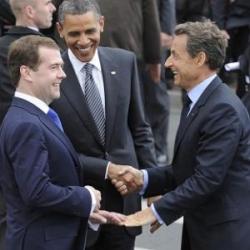
The ministry said Presidents Barack Obama, Nicolas Sarkozy and Dmitry Medvedev, in their statement released at the G8 summit in the French resort of Deauville, deemed as unacceptable the status-quo in the Nagorno Karabakh conflict, which Baku has repeatedly pointed out before.
The three leaders’ statement called on the presidents of Azerbaijan and Armenia "to demonstrate political will and finalize...the basic principles (of a peace agreement)" during the forthcoming meeting of the Azerbaijani, Armenian and Russian presidents in June, adding that a further delay would put the commitment of the parties to reach agreement under a question mark.
"The documents and principles referred to by the three countries’ leaders have been repeatedly discussed, and all of them firmly lay down the issue on the need for a withdrawal of the Armenian forces from Azerbaijani territories," the Azerbaijani foreign ministry said. "Thus, the Armenian side must realize that the world community does not accept the occupation of Azerbaijani territories by Armenia."
"Azerbaijan's position remains unchanged," the ministry said. "Withdrawing the Armenian armed forces and returning the internally displaced persons [ousted during the war] to their homes will allow us to move to the next step to create favorable conditions for the co-existence of Armenian and Azerbaijani communities of Nagorno Karabakh with the purpose of a further determination of the region’s status within Azerbaijan."
Baku deplored the fact that despite a firm stance of the world community calling for an Armenian pullout, Armenia has availed of various means to drag out the process, thus impeding a peaceful settlement of the Nagorno Karabakh conflict.
Armenia, which occupies 20 percent of Azerbaijan’s territory, including Nagorno Karabakh, claimed that the US, French and Russian leaders’ statement was actually addressed to Azerbaijan.
"Armenia has always been committed to a strictly peaceful settlement of the conflict and has repeatedly proven this in practice," Armenian Foreign Minister Eduard Nalbandian said in a statement. "Therefore, it is clear to everyone whom the calls made in that statement are addressed to. We have issued our clear-cut response to the basic principles [of the conflict settlement] proposed by the [Minsk Group] co-chairs, and if Azerbaijan unequivocally provides its consent too, it will be possible to reach progress in the conflict settlement."
The Karabakh conflict emerged in 1988 due to Armenia’s territorial claims. Azerbaijan and Armenia waged a brutal war which claimed some 30,000 lives and displaced about a million Azerbaijanis. A ceasefire accord was signed in 1994, but OSCE-brokered peace talks have been largely fruitless so far.
Peace talks between Baku and Yerevan are underway on the basis of the Madrid principles, a peace outline proposed by the OSCE mediators. The Minsk Group co-chairs initially proposed the document in the Spanish capital in November 2007. In Athens in November 2009, the updated version of the Madrid Document was submitted to the sides. Azerbaijani officials, including President Ilham Aliyev, have repeatedly said Baku accepts the renewed Madrid Document with some exceptions. But Armenia has yet to state formally whether or not it accepts the peace outline. Though Armenian officials have stated the country’s approval of the Madrid principles in a number of verbal statements, they have not yet officially voiced their approval to the OSCE mediators or international organizations.
Novruz Mammadov, the Azerbaijani Presidential Administration official in charge of foreign relations, says Armenia "should make conclusions" from the statement of the US, French and Russian leaders.
"In response to the presidents’ statement, the Armenian side should no longer look for pretexts to drag out talks, but to the contrary, put forth political will to take a step forward by voicing agreement to the latest version of the basic principles laid down by the co-chairs and now underlined by the three presidents," Mammadov said.
Russian Deputy Foreign Minister Sergei Ryabkov said while commenting on the Deauville statement that Moscow was convinced that "chances for a peaceful settlement of the Nagorno Karabakh conflict are higher than ever".
"If we compare the resolutions on the issue issued at all recent G8 summits, we can make an unequivocal conclusion: the chances for a peaceful resolution today are much higher than before," he said. "We are no longer at the brink of new conflict, but are significantly closer to a solution."
According to Ryabkov, "laborious and coordinated work" has been done on Karabakh settlement, fostering opportunities to make progress and reach compromise.
MP Rasim Musabayov, an Azerbaijani analyst, said the Minsk Group co-chairing countries’ statement was an important call that aims to set the stage for the June 25 talks between the Russian, Azerbaijani and Armenian leaders due in the Russian city of Kazan, the next in a series of trilateral meetings on the Karabakh conflict.
Ali Hasanov, Azerbaijani Deputy Prime Minister and head of the state committee for IDPs, believes that it is impossible to reach a solution to the Karabakh problem with the incumbent authorities in Armenia in place. He said that as long as President Serzh Sargsyan and other Armenians who come from Nagorno Karabakh are in power, Armenia will not sign a peace accord with Azerbaijan.
"This is so because signing a peace accord would bring an end to their rule in Armenia. Therefore, the best way out is for them to go.
"If international organizations, the U.S., France and Russia want this conflict to be resolved, they should help to change the fake regime in Armenia. Let a normal administration come to power and cooperate with Azerbaijan," Hasanov said.
Here we are to serve you with news right now. It does not cost much, but worth your attention.
Choose to support open, independent, quality journalism and subscribe on a monthly basis.
By subscribing to our online newspaper, you can have full digital access to all news, analysis, and much more.
You can also follow AzerNEWS on Twitter @AzerNewsAz or Facebook @AzerNewsNewspaper
Thank you!