
Baku lauds Russia’s efforts on Karabakh
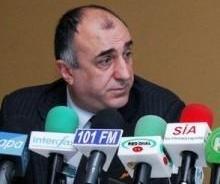
BAKU – Azerbaijani Foreign Minister Elmar Mammadyarov has praised Russia’s role in settling the country’s two-decade-long conflict with Armenia, saying President Dmitry Medvedev is "sincerely" trying to bridge differences between the two South Caucasus neighbors.
Mammadyarov said in an interview with Russia’s Moskovskiye Novosti newspaper that Azerbaijan and Russia are closely cooperating in resolving the Nagorno Karabakh conflict "on various levels".
"I am in close contact with [Russian Foreign Minister] Sergei Lavrov. There is a close contact between the presidents as well, especially now that Mr. Dmitry Medvedev has become personally involved in the conflict settlement efforts.
"Our meetings are regular, and the conflict resolution is on agenda every time. Mr. Medvedev knows in detail both countries’ [Azerbaijan and Armenia’s] positions and the way we react to any given discrepancy, and he is very sincere in trying to find points of commonality for the peace process not to freeze or drag on, but to move forward," Mammadyarov said.
Azerbaijani, Armenian and Russian foreign ministers held a closed-door meeting in Moscow last Friday to discuss the current stage of the Karabakh conflict settlement.
The Karabakh conflict emerged in 1988 due to Armenia’s territorial claims. Azerbaijan and Armenia waged a brutal war which claimed some 30,000 lives and displaced about a million Azerbaijanis. About 20 percent of Azerbaijani territory, including Nagorno Karabakh and seven adjacent regions, has been under the occupation of the Armenian armed forces since a ceasefire was signed in 1994. Peace talks, brokered by the United States, Russia and France through the OSCE Minsk Group, have been largely fruitless so far.
Minister Mammadyarov said Moscow’s vigorous efforts in Karabakh settlement are now yielding fruit. He noted that at the latest meeting in Sochi on March 5, "a ray of hope" for progress discerned, though in January 2010, after the updated peace outline dubbed the Madrid principles was proposed by the OSCE mediators, it appeared that "we are dragging our feet".
"Dmitry Medvedev succeeded in finding points of commonality and in the adoption of unconventional decisions," Mammadyarov said.
After the talks held in Russia’s Black Sea resort of Sochi with President Medvedev’s mediation, Presidents Ilham Aliyev and Serzh Sargsyan issued a joint statement pledging to "resolve all controversial issues by peaceful means". They agreed to investigate skirmishes along the contact line of the Azerbaijani and Armenian troops with the aid of the mediators and to swiftly finalize the exchange of prisoners of war.
Mammadyarov said "no one is satisfied" with the current relations between Azerbaijan and Armenia.
"We would like for a breakthrough to take place sooner than we expect. Because the [Madrid] principles are not a peace accord yet. Efforts need to be not just redoubled, but tripled here. The Karabakh conflict is a complicated dispute that hinges on many factors. And even if we draft a peace agreement, that won’t do, but it will be light at the end of the tunnel."
According to the minister, the status quo in the Karabakh conflict holds back the development of both the region and relations between countries.
"There is a great number of refugees and internally displaced persons. Moreover, the military factor is very serious. In this context, we should move forward more and more. More precisely, we must realize that the status quo could bring about bitter ramifications."
Mammadyarov said the Karabakh conflict could not be deemed "frozen".
"If there are armed forces on the contact line [of the two countries’ troops], if there are skirmishes and explosions, how can we call it ‘frozen’? The occupation of [Azerbaijani] territory, the stationing of armed forces, build-up of the military, including heavy machinery and the air force, is a dead-end road. It leads only toward a shift from sporadic shootings to a more active phase, and that is a dead end indeed.
"On the other hand, Azerbaijanis have been ousted from their permanent places of residence, the places where Armenians had never even lived. We now have over 700,000 people who are demanding to resolve the issue once and for all -- and that is an explosive mass."
Mammadyarov said the brief war fought by Georgia and Russia in 2008 had prompted speeding up of talks on the Karabakh problem. He stressed that in November 2009 the Minsk Group co-chairs submitted to the conflict parties the updated version of the Madrid Document, which was initially proposed in the Spanish capital two years earlier.
"The peace outline reinforced the notion that the occupation of territory cannot persist, therefore, [Armenian] forces must be pulled out from the occupied territories around Nagorno Karabakh in stages and in line with the outlined timetable. Certainly, the status of Nagorno Karabakh has always been on agenda. This is an issue that is important for the Armenian side. But it is also important for us, because like all other countries, excluding Armenia, we consider the region as being part of Azerbaijan; the lack of Karabakh’s status today is a serious problem, and we accept that."
Baku says the occupied districts must be freed and Azerbaijani refugees returned home, and only after that could the region’s status be determined within Azerbaijan’s territorial integrity, while Armenia insists that self-determination is the core principle for a settlement of the dispute. International mediators are seeking a solution based simultaneously on both principles.
Mammadyarov said that while an Armenian pullout opens up a wide range of opportunities -- from strengthened confidence-building measures to the reopening of communications -- it will positively affect the security issue. He said that "a decision of principle" has been passed that international peacekeepers will be sent to locations designated "from not only political but also the military viewpoint". This will allow IDPs to begin returning to their homes, and the rural economy will be revitalized; efforts will begin to be made to build confidence among people, mitigating the impact of strongly worded rhetoric on Azerbaijan-Armenia relations, Mammadyarov said.
"We should be guided by the undeniable fact that people cannot always live amidst hostility. You can’t choose your neighbors sometimes. And we have a full brunt of responsibility in our foreign policy to find points of commonality. But when your territory is occupied, what can you tell the people? I am deeply convinced that a withdrawal of Armenian troops, or at least, a beginning of their withdrawal, will drastically and dramatically change the situation on the ground."
Here we are to serve you with news right now. It does not cost much, but worth your attention.
Choose to support open, independent, quality journalism and subscribe on a monthly basis.
By subscribing to our online newspaper, you can have full digital access to all news, analysis, and much more.
You can also follow AzerNEWS on Twitter @AzerNewsAz or Facebook @AzerNewsNewspaper
Thank you!