
Azeri ruling party sweeps vote amid mixed responses
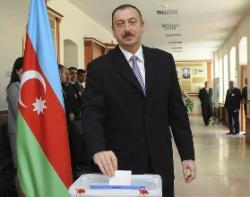
BAKU – Azerbaijan`s ruling party led by President Ilham Aliyev swept the November 7 parliamentary elections, amid mixed responses from international observers.
The Central Election Commission said that with 90 percent of the vote counted, Aliyev`s Yeni Azerbaycan (New Azerbaijan) Party increased its share in the 125-seat parliament to more than 70 seats. YAP had only half of the seats in the previous parliament.
12 candidates representing 10 other parties were elected to the Milli Majlis. Pro-government Ana Vatan party and opposition-leaning Civil Solidarity Party each gained two seats. Eight other small parties will be represented with one member each in the newly elected parliament. Independent candidates claimed the remaining 41 seats in the legislature.
The Central Election Commission said ``no serious violations were registered that could affect the result.``
The ruling party`s deputy chairman Ali Ahmadov said the parliamentary election was a successful step taken on the path of democratic development in Azerbaijan. ``The number of election candidates from opposition parties exceeds those running from YAP. This shows that the necessary conditions were ensured for political parties.``
Election monitors from the Commonwealth of Independent States (CIS), regional group GUAM and Turkic countries` Parliamentary Assembly (TurkPA) declared the vote free and fair.
But Western observers said that the elections, though ``peaceful`` and with opposition participation, were marred by ``serious violations``. The monitors, led by the Organization for Security and Cooperation in Europe (OSCE), said that ``despite all the efforts made, the country needs to do much more to make progress in developing a truly pluralist democracy.``
Wolfgang Grossruck, who led the short-term OSCE observer mission, told a press conference in Baku on Monday that while the vote was ``characterized by a peaceful atmosphere and all opposition participated in the political process, these elections overall were not run in a way to constitute meaningful progress in the democratic development of the country.``
The leaders from the main opposition Azerbaijan Popular Front/Musavat bloc went even further.
They deemed the vote illegitimate, saying it was marred by massive fraud aimed at consolidating the ruling party`s near-total dominance of the country`s political life.
``Our general opinion is that these elections were not free and fair, were not transparent and democratic,`` Isa Gambar, the leader of the Musavat Party, told a press conference on Monday.
``Taking into consideration all these facts, the APFP-Musavat bloc does not recognize the election results and we denounce as illegitimate the parliament to be formed on the basis of these elections,`` he continued. ``We demand to annul the election results and to hold new free and fair elections in order to form a legitimate parliament.``
At the same press conference, the chairman of the Azerbaijan Popular Front Party Ali Karimli claimed that Sunday`s vote undermines people`s confidence in the possibility of changing their government through elections.
``Only 15 percent of the population participated at yesterday`s elections. If so few people in the country go to the polls, this means they don`t believe elections can change anything.``
Karimli believes that the latest poll was even more undemocratic than the previous elections held in Azerbaijan.
The ruling party has accused opposition representatives of attempting to convince observers of a poor conduct of the elections. It said in its statements on election day that authorized representatives, observers and in many cases candidates of opposition parties, particularly APFP-Musavat, were trying to impede the work of electoral commissions in the presence of international monitors, and availed of specially trained persons to commit major irregularities that would be further blamed on the authorities.
The ruling party`s press service said that the hard-line opposition`s primary goal was to discredit the elections, form a negative opinion about the elections among observers and create an environment of low confidence in the electoral process.
According to official tallies, the opposition bloc, which ran for the election with 37 candidates, failed to win a single seat in the legislature.
Just over 50 percent of the 4.95 million eligible voters took part in the election.
A total of 1,024 international observers representing 20 international organizations and diplomatic missions followed the polling, along with over 48,000 local monitors.
`No meaningful progress`
In their assessment on Monday, observers from the OSCE, the Council of Europe, and the European Parliament said limitations of media freedom and freedom of assembly and a deficient candidate-registration process ``further weakened the opposition and made vibrant political discourse almost impossible.``
They noted problems with vote-counting, with almost a third of polling stations observed rated ``bad`` or ``very bad,`` and problems like ballot-box stuffing noted in a number of places.
These shortcomings led Anneli Jaatteenmaki, head of the monitoring delegation of the European Parliament, to issue a warning.
``The economic growth and stability are evident in your country,`` she said. ``But sustainability of this situation can only be reinforced by greater political liberalization and democratization of the country.``
On the positive side, the observers noted that the election commission overall administered the technical aspects of the electoral process ``well.`` They said voting on election day was assessed ``positively in almost 90 percent`` of the polling stations visited, while ``serious problems were noted in 10 percent.``
``In a welcome departure from the past, the run-up to the elections and election day were peaceful and not marred by violent incidents, all opposition parties opted to participate in the political process, sometimes running as part of electoral blocs, rather than to boycott it, as was the case in the past,`` said Paul Wille, head of the delegation of the PACE. ``A positive environment was created by good co-operation between the authorities, international institutions and the domestic actors.``
Head of the OSCE/ODIHR long-term election observation mission, Audrey Glover, said two aspects should be considered in evaluating the elections held in Azerbaijan. Glover said the vote was conducted technically well for the most part, but this does not hold true for the polling itself.
``Regrettably, our observation of the overall process shows that the conditions necessary for a meaningful democratic election were not established. We are particularly concerned about restrictions of fundamental freedoms, media bias, the dominance of public life by one party, and serious violations on election day.``
Glover said the violations reported during the elections will be studied and the outcomes of this analysis reflected in the final report of the election observation mission to be issued in two months.
Here we are to serve you with news right now. It does not cost much, but worth your attention.
Choose to support open, independent, quality journalism and subscribe on a monthly basis.
By subscribing to our online newspaper, you can have full digital access to all news, analysis, and much more.
You can also follow AzerNEWS on Twitter @AzerNewsAz or Facebook @AzerNewsNewspaper
Thank you!