
OSCE mediators make proposals
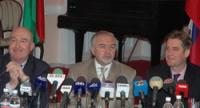
Co-chairs of the OSCE Minsk Group brokering talks on the
Armenia-Azerbaijan Upper (Nagorno) Garabagh conflict have issued
written proposals on ways of resolving the long-running
dispute.
The proposals, forwarded to Foreign Ministers Vardan Oskanian and Elmar Mammadyarov at a meeting in Madrid on Thursday, were the first document outlining in writing the suggestions on core principles of the peace process since the start of the Prague process (phased conflict resolution) many years ago.
Prior to the opening of the OSCE Ministerial Council, the co-chairs - Bernard Fassier of France, Yury Merzlyakov of Russia and Matthew Bryza of the United States - as well as US Undersecretary of State Nicholas Burns, Russian Foreign Minister Sergei Lavrov and French Foreign Minister Bernard Kouchner met with the ministers "to demonstrate political-level support for the OSCE Minsk Group co-chair countries' effort to forge a just and lasting settlement of the conflict", the Minsk Group said in a statement.
The representatives of the three countries formally presented a set of basic principles for the peaceful settlement of the conflict to the Armenian and Azerbaijani ministers for further transmission to the two presidents.
"It was noted that over the last three years of talks the two sides had significantly narrowed their differences through the mediation of the co-chair countries and that only a few differences remained to be settled. As noted by the representatives of the three countries, the joint proposal that was transmitted today to the parties offered just and constructive solutions to these last remaining differences.
"The parties to the conflict were strongly urged to bring to a close the current stage of negotiations by endorsing the proposed Basic Principles and commencing as soon as possible to draft a comprehensive Peace Agreement," the statement said.
The Azerbaijan Foreign Ministry spokesman Khazar Ibrahim said the package included 10 proposals, of which one remained to be agreed. He did not elaborate, citing confidentiality of the talks.
Azerbaijani Foreign Minister Elmar Mammadyarov said in Madrid that the OSCE mediators' proposals aimed "to prevent possible attempts to avoid responsibility in the future".
"The proposals were formulated in writing to ensure durability of talks in the future, after the presidential elections in both countries," he said.
Mammadyarov said the parties to the conflict were already familiar with the Minsk Group's proposals that have been under discussion for three years running "and contain nothing new".
At the same time, he confirmed that Baku has agreed with Yerevan most of the mediators' proposals on the Garabagh settlement. "The problem, in our view, dwells upon two, or I would even say, one issue."
He went on to say that the status of Upper Garabagh, an Azeri region under Armenian occupation, was currently not on the agenda.
"To get to that issue, the negotiating table should be cleared off problems that are in the way - the occupied land must be freed, Azerbaijanis who lived in Garabagh prior to the eruption of the conflict must return home, communications restored and security issues solved," the minister said.
But the Armenian Foreign Ministry spokesman Vladimir Karapetian maintained that the status issue was included in the intermediaries' proposals.
Armenian Foreign Minister Vardan Oskanian said the document submitted by the mediators was "fair and balanced" and reflected all issues.
"The proposals we received today will be the basis for further negotiations after the elections in Azerbaijan and Armenia.
"We had a very important meeting today. Our countries have great hopes for a peaceful resolution of the conflict," Oskanian said.
Russian Foreign Minister Sergei Lavrov said the meeting of Azeri and Armenian ministers was "a step forward", adding that the Garabagh problem could be resolved strictly in peace.
US co-chairman Matthew Bryza said the presented document reflected a compromise on key principles of the conflict resolution. "We submitted to the sides the best draft on concessions regarding the fundamental principles of the conflict settlement."
The mediator regarded the latest proposals as "the most logical ones" in the past 10-15 years.
He said the intermediaries hoped to attain at least a verbal agreement between the conflicting sides ahead of Armenia's elections. "It seems to me that this is absolutely possible," he added.
The presidential ballot in Armenia has been scheduled for February 2008, while in Azerbaijan it will take place in October that year.
Bryza said statements suggesting that the outcome of the polls would substantially affect the peace process did not appear convincing.
"The positions of all presidential hopefuls in Armenia on the Garabagh problem are similar. We have made the best proposals to reach compromise and are now awaiting a response from the Azerbaijani and Armenian presidents," Bryza said.
French co-chair Fassier said the mediators would pay their next visit to the region in late January to examine the sides' feedback on the proposals. He said the key objective was to complete as soon as possible the phase of basic negotiations on unresolved issues and tackle details of the conflict settlement.
The diplomat called for a speedy solution of the dispute. "The conflict must be resolved soon. Let's not wait 50 more years."
The leader of the Azerbaijani community of Upper Garabagh Nizami Bahmanov has said the document outlining the intermediaries' latest proposals "merely serves their own interests".
"They developed and submitted it in order not to stay in the background," he told local ANS TV channel.
Bahmanov added that if these proposals are not in line with the Azerbaijani side's stance, signing the paper is out of the question.
Russia's influential Kommersant newspaper reported that the plan envisions Armenia's gradual withdrawal from the seven districts of Azerbaijan around Upper Garabagh. Armenian armed forces are required to pull out of the strategic Kalbajar district in the long run, although their limited contingent will remain there for some time.
If the scheme materializes, the transport corridor from the main part of Azerbaijan to its enclave of Nakhchivan will open up and Armenia's transport blockade will end. A special international body will be established in Kalbajar under the OSCE's leadership, and the district will be subsequently transferred to Azerbaijan's full control. The freed Azerbaijani regions will be further demilitarized and international peacekeepers stationed there.
The plan also envisions the use by Armenia of the Lachin corridor, which is a road connecting the occupied Upper Garabagh region with Armenian territory. Finally, the world community will propagate the return of Armenians settled in the occupied Azerbaijani territories to Armenia, while Azerbaijani refugees will be able to go back to Kalbajar in a few years. The UN Security Council will act as a guarantor of the peace accord, Kommersant said.
The publication did not elaborate on the way Upper Garabagh's status will be determined in the future.
Azerbaijan and Armenia have been locked in conflict for over a decade. Some 30,000 people had been killed, and about 1 million driven from their homes as a result of hostilities. Peace talks that kicked off after the lengthy war ended with the signing of a cease-fire in 1994, but have brought little tangible result so far.
Following Thursday's discussions, foreign ministers Mammadyarov and Oskanian had a working meeting on Friday with the Minsk Group co-chairs attended by the OSCE Chairman-in-Office Miguel Angel Moratinos. Moratinos pointed out the importance of continuing the peace process during the discussions that focused on future steps to be taken by the conflicting sides.
The governments of the OSCE member states have welcomed the commitment of Azerbaijan and Armenia to keep on seeking a negotiated settlement to the Garabagh conflict.
In a statement, the OSCE Foreign Ministers Council welcomed the two countries' willingness to continue peace talks next year. It also voiced support for the Minsk Group's mediating efforts and its latest proposals. The Council also urged the sides to iron out outstanding differences.
The OSCE chairman has said it was necessary to display political will and courage to settle 'frozen conflicts'.
"There must be political will in order to solve the conflicts in Moldova, Georgia and Upper (Nagorno) Garabagh. Besides, the sides must have a desire to hold decisive talks on peaceful coexistence," Moratinos, who is also Spanish Foreign Minister, told the OSCE ministerial.
Moratinos said that settlement of 'frozen conflicts' would allow ensuring the security of the OSCE member countries.
Addressing the meeting, President of the OSCE Parliamentary Assembly Goran Lennmarker said a "golden opportunity" has emerged for the Garabagh settlement.
He praised the efforts of the Minsk Group as well as the foreign ministers of Azerbaijan, Armenia and Russia.
Here we are to serve you with news right now. It does not cost much, but worth your attention.
Choose to support open, independent, quality journalism and subscribe on a monthly basis.
By subscribing to our online newspaper, you can have full digital access to all news, analysis, and much more.
Subscribe
You can also follow AzerNEWS on Twitter @AzerNewsAz or Facebook @AzerNewsNewspaper
Thank you!