
Yerevan claims Baku ‘questions’ Russian-brokered talks
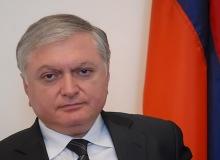
YEREVAN - Azerbaijan is questioning the talks on Upper (Nagorno) Karabakh conflict held in St. Petersburg among the Azerbaijani, Armenian and Russian presidents, Armenian Foreign Minister Eduard Nalbandian claimed Thursday, Armenia Today news agency reported.
Nalbandian was addressing participants of a youth organization’s
summer camp.
Armenia said earlier that Russia had made new proposals on Karabakh
settlement during the June 17 meeting in St. Petersburg and that
Yerevan was taking them as a basis and awaiting Azerbaijan’s
response.
Elkhan Polukhov, the spokesman for the Azerbaijan Foreign Ministry, commented that the meeting held between the Armenian and Azerbaijani leaders was joined by only one mediating country, Russia, therefore, the proposals made there could not be considered as the mediating OSCE Minsk Group’s initiative.
"Generally adopting the proposals made in St. Petersburg may completely alter the ideology and environment of the negotiating process and deal a huge blow to the fragile structure that has been created over six years," Polukhov said.
Armenian Minister Nalbandian believes that much in Karabakh settlement depends today on Azerbaijan’s response to the calls made during the recent five-lateral ministerial in Almaty July 17.
The statement issued by the co-chairing countries - the U.S., Russia and France - indicates that a conflict settlement is to be based on three key principles – territorial integrity, self-determination of nations and non-use of force.
Nalbandian reminded that in November 2007 the co-chairs of the Minsk Group proposed the Madrid Document to the parties, and it was submitted as a formal proposal to the Vienna-based OSCE Secretariat.
"After that, over twenty working proposals were put forward based on the Madrid Document. And when Azerbaijan stated that it is ready to accept the working proposals of December 2009 [when the document was updated] with some amendments, it became clear that there are actually more of these changes than the parts that Azerbaijan agrees upon.
Today, Azerbaijanis are saying that they are thankful to Russia and appreciate its efforts on one hand, while on the other they are questioning the importance of the St. Petersburg meeting.
Let me remind that six meetings have recently taken place on Russia’s initiative."
The Karabakh conflict flared up in the late 1980s due to Armenia's territorial claims. Armenia has been occupying over 20 percent of Azerbaijan's territory since the early 1990s.
The ceasefire accord was signed in 1994, but years of peace talks have brought few tangible results.
Peace talks are ongoing based on the Madrid principles, an outline for a conflict settlement proposed by the mediators.
The updated Madrid Document envisions an Armenian withdrawal from five out of the seven occupied regions surrounding breakaway Nagorno Garabagh after the signing of a peace accord, while the strategic Kalbajar and Lachin regions must be returned within five years thereafter.
Azerbaijan stated that it generally accepts the renewed Madrid principles early this year, while the Armenian stance remains unclear.*
Here we are to serve you with news right now. It does not cost much, but worth your attention.
Choose to support open, independent, quality journalism and subscribe on a monthly basis.
By subscribing to our online newspaper, you can have full digital access to all news, analysis, and much more.
You can also follow AzerNEWS on Twitter @AzerNewsAz or Facebook @AzerNewsNewspaper
Thank you!