
OSCE-brokered talks on Garabagh fruitless (UPDATED)
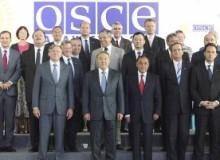
ALMATY - The OSCE-brokered talks on settling the Upper (Nagorno)
Garabagh conflict between Azerbaijani and Armenian foreign
ministers last weekend brought no results.
The heads of delegations - Russian and French Foreign Ministers
Sergei Lavrov and Bernard Kouchner, and US Deputy Secretary of
State James Steinberg - held talks with Ministers Elmar Mammadyarov
and Eduard Nalbandian during an informal OSCE meeting in Almaty,
Kazakhstan.
The mediating OSCE Minsk Group released a statement on Saturday
encouraging a peaceful settlement to the Nagorno Garabagh conflict,
the OSCE website said.
A long-standing dispute over Nagorno Garabagh, a breakaway region
inside Azerbaijan, has been the cause of two decade-long hostility
between Azerbaijan and Armenia.
"The Heads of Delegation ... reminded the sides of their commitment
to seek a peaceful settlement to the Nagorno Garabagh conflict
based on the principles contained in the Helsinki Final Act,
particularly those related to refraining from the threat or use of
force, the territorial integrity of states, and the equal rights
and self determination of peoples," the Minsk Group’s statement
said.
The co-chairs said the elements articulated by the Russian, French
and US presidents on June 26 must be the foundation of any fair and
lasting settlement to the conflict. These proposed elements have
been conceived as an integrated whole, and any attempt to select
some elements over others would make it impossible to achieve a
balanced solution, they said.
The ministers stressed that the efforts made so far by the parties
to the conflict have been insufficient to overcome existing
differences and expressed regret over recent developments that have
exacerbated tensions in the region "including the serious armed
incident of June 18-19, 2010 and inflammatory public
statements."
An armed clash between Armenian and Azerbaijani armed forces
resulted in the death of five soldiers on both sides.
The ministers warned that the use of force has caused the current
situation, and its use again would only lead to suffering,
devastation, and a legacy of conflict and hostility that would last
for generations. The co-chairs urged a greater spirit of compromise
to reach agreement on a common basis for continuing the
negotiations. Additional actions by the sides are needed to
reinforce the 1994 ceasefire and to create a more favorable
atmosphere for further political dialogue and reaching agreements.
The ministers renewed their commitment to support the sides in
reaching a peace accord, but reiterated that the primary
responsibility to put an end to the Garabagh conflict still remains
with Azerbaijani and Armenian leaders.
The Garabagh conflict flared up in the late 1980s due to Armenia's
territorial claims. Armenian troops have been occupying over 20
percent of Azerbaijan's territory, including Nagorno Garabagh and
seven other regions surrounding it, since the early 1990s. Years of
peace talks have brought few tangible results. The mediating Minsk
Group co-chairs, which include Russia, France and the United
States, initially proposed a peace outline in Madrid in November
2007. In Athens in November 2009, the updated version of the Madrid
Document was submitted to the sides. The document stipulates a
stage-by-stage resolution of the Armenia-Azerbaijan conflict, which
should start with "the return of the territories surrounding
Nagorno Garabagh to Azerbaijani control" and a future determination
of the legal status of Nagorno Garabagh "through a legally binding
expression of will" and the right of "internally displaced persons
and refugees to return to their former places of residence."
Azerbaijan stated that it accepts the renewed Madrid principles
early this year, while the Armenian stance remains unclear.
"Armenia unwilling to reach progress"
Azerbaijani Foreign Minister Mammadyarov said after talks with his
Armenian counterpart that "no advances were reached" at the meeting
in Almaty.
Speaking to reporters, Mammadyarov questioned Yerevan’s willingness
to move the peace process forward.
"Personally, I have developed an opinion that Armenia does not want
any progress to be reached, stability to be restored, though they
are saying that they do want to achieve progress," he said.
The Azerbaijani minister noted that Armenia is raising "issues
working on which is impossible at the current stage".
"For example, the issue of Nagorno Garabagh’s status. The co-chairs
are proposing a stage-by-stage solution while putting forward their
principles. First, the most complicated issue needs to be resolved.
This is the issue of freeing our lands from occupation. Only after
that could we talk about any relations between the two countries’
peoples."
Mammadyarov said that Armenia "created a problem" with Garabagh
settlement "at the last moment" by failing to accept a withdrawal
of its troops from the occupied Azerbaijani territories.
Prior to his visit to Kazakhstan, Mammadyarov told journalists in
Baku that discussions would focus on an Armenian pullout from the
Lachin and Kalbajar regions around Nagorno Garabagh, voicing hope
that the two strategic regions would be returned to Azerbaijan
within five years after the signing of a peace accord.
Mammadyarov emphasized that Baku was ready to open up all
communications if the regions surrounding Nagorno Garabagh are
liberated. "This time it didn’t work, but we should be patient and
keep working on it."
Armenian Minister Nalbandian was also pessimistic about the Almaty
meeting. "Due to Azerbaijan’s position, we did not succeed in
adopting a five-lateral statement in the course of the OSCE Foreign
Ministers Council’s informal meeting," he claimed in a statement on
Armenia’s public TV channel, but added that the talks in Kazakhstan
were beneficial overall.
Referring to the joint statement issued by the Russian and French
foreign ministers and the US deputy secretary of state, Nalbandian
said the Garabagh conflict is to be resolved based on non-use of
force, territorial integrity of states and self-determination of
nations. Nalbandian maintained that Azerbaijan was taking as a
basis only the territorial integrity principle.
According to the Armenian minister, the Minsk Group co-chairing
countries underlined that the elements of a conflict settlement
submitted to the parties are inseparable, and separating any of
them from the whole would make a balanced solution impossible.
Early last week, Nalbandian claimed that the Azerbaijani and
Armenian presidents were presented a new document on settling the
Garabagh conflict during their meeting in Russia on June 17. He
termed the document "a new version" of the Madrid Document.
But the Azerbaijani government said Baku does not recognize such a
document. The Foreign Ministry reminded that Azerbaijan has agreed
to the updated Madrid Document and that talks are underway based on
it.
Though the Almaty meeting was fruitless, the Minsk Group co-chairs
plan to visit the region again by September. The mediators are
seeking to arrange the next meeting of the Azerbaijani and Armenian
foreign ministers, Mammadyarov said. He added that Baku supports
the co-chairs’ putting forward new initiatives.
Here we are to serve you with news right now. It does not cost much, but worth your attention.
Choose to support open, independent, quality journalism and subscribe on a monthly basis.
By subscribing to our online newspaper, you can have full digital access to all news, analysis, and much more.
You can also follow AzerNEWS on Twitter @AzerNewsAz or Facebook @AzerNewsNewspaper
Thank you!