
Analysts cautiously optimistic on Garabagh ministerial
BAKU - The format of the meeting planned between the Azerbaijani
and Armenian foreign ministers on Saturday in Almaty has increased
attention and expectations about the upcoming talks on the Upper
(Nagorno) Garabagh conflict.
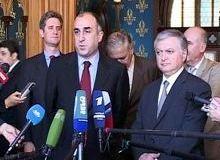
According to Kazakhstan’s Foreign Ministry, besides Elmar
Mammadyarov and Eduard Nalbandian, the ministerial will be attended
by the top diplomats of the three countries co-chairing the OSCE
Minsk Group - the foreign ministers of Russia and France, Sergei
Lavrov and Bernard Kouchner, and US Deputy Secretary of State James
Steinberg. Also in attendance will be the OSCE Chairman-in-Office,
Kazakh Foreign Minister Kanat Saudabayev, as well as the foreign
ministers of the former OSCE chair Greece and of Lithuania, which
will take over chairmanship in the organization next year.
The meeting between the Azerbaijani and Armenian ministers will
take place on the sidelines of a two-day informal OSCE
ministerial.
Ilgar Mammadov, an Azerbaijani analyst, has told AssA-Irada that
the expanded format of Garabagh talks could be the result of the
recent statement issued by the Russian, US and French presidents.
Mammadov said there is an opportunity to reach progress in Almaty
on the points articulated by Presidents Dmitry Medvedev, Barack
Obama and Nicolas Sarkozy during the G8 summit in Canada.
The three leaders’ statement, issued during the summit, called on
the Armenian and Azerbaijani leaders to finalize the main
principles of Garabagh settlement in order to begin drafting a
peace accord.
The statement referred to several key principles of the peace
process, including the return of the territories surrounding
Nagorno Garabagh to Azerbaijani control, an interim status for
Nagorno Garabagh providing guarantees of security and
self-government, the determination of the future legal status of
the Azerbaijani region through a legally binding expression of will
and the right of refugees and IDPs to return home, as well as
international guarantees of security, including peacekeeping
operations.
Mammadov was not inclined to make projections on the forthcoming
talks in Kazakhstan and only said that if the sides achieve
progress on the principles laid out by the mediating states’
leaders, this could foster a breakthrough in peace talks.
Aydin Mirzazada, a lawmaker representing the ruling Yeni (New)
Azerbaijan Party (YAP), says expanding the format of the Almaty
talks should be welcomed.
"It could also be considered as an example of the Minsk Group
co-chair countries’ being more interested in the conflict
settlement."
Mirzazada said a positive trend has lately been seen in the
negotiating process, and the fact that the latest statement of the
mediating states’ presidents reflected Armenian occupation of
Azerbaijani territories should be applauded.
At the same time, Mirzazada said he does not have great
expectations from the Almaty meeting. He said both advances and
lack of progress could be expected from this meeting, which is
expected to discuss a time frame for the liberation of the
strategic Lachin and Kalbajar regions of Azerbaijan around Nagorno
Garabagh. This progress, Mirzazada said, depends more on the
positions of the Minsk Group co-chair countries.
Analyst Gabil Huseynli, who represents the opposition Musavat
party, believes that holding the Almaty meeting in such a format
indicates the mediating states’ intention to give an impetus to
Garabagh settlement talks.
"Holding the meeting in a broad format might bring about a change
of principle in the course of negotiations," he said.
Huseynli also predicted that the sides involved will work to
convince Armenia to accept the peace outline called the Madrid
principles, saying "certain glimmers of this are discerned".
The Garabagh conflict flared up in the late 1980s due to Armenia's
territorial claims. Armenia has been occupying over 20 percent of
Azerbaijan's territory since the early 1990s. The ceasefire accord
was signed in 1994, but years of peace talks have brought few
tangible results. The mediating Minsk Group co-chairs initially
proposed a peace outline on settling the conflict in the Spanish
capital in November 2007. In Athens in November 2009, the updated
version of the Madrid Document was submitted to the sides.
Azerbaijan stated that it accepts the renewed Madrid principles
early this year, while the Armenian stance remains unclear.*
Here we are to serve you with news right now. It does not cost much, but worth your attention.
Choose to support open, independent, quality journalism and subscribe on a monthly basis.
By subscribing to our online newspaper, you can have full digital access to all news, analysis, and much more.
You can also follow AzerNEWS on Twitter @AzerNewsAz or Facebook @AzerNewsNewspaper
Thank you!