
Baku urges to ‘swiftly draft peace accord’
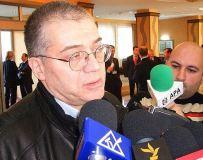
Azerbaijani Deputy Foreign Minister Araz Azimov has said Baku was
interested in swiftly drafting an accord to settle its
long-standing conflict with Armenia over Upper (Nagorno)
Garabagh.
Azimov said that the latest joint statement by the presidents of the three countries co-chairing the mediating OSCE Minsk Group essentially creates a basis to begin preparing an agreement on a peaceful conflict settlement.
"I think that considering the UN Security Council resolutions, the decisions and documents passed by the OSCE, the Council of Europe, and European Parliament and other international organizations, as well as the Meindorf Declaration, and given the existing substantive legal framework consisting of the statements by the OSCE Minsk Group co-chairing states’ leaders, the need for preparing some type of transitional basic principles for drafting the main peace accord is ruled out. I believe that, in principle, taking into account that the international community’s position has been expressed accurately and clearly, the parties, without wasting extra time and energy, may immediately shift – with the co-chairs’ assistance - to agreeing the provisions of a draft agreement on a peaceful settlement of the conflict. Otherwise, the process will drag on further, because having worked out the basic principles is still not yielding any actual results in terms of a settlement."
Azimov said the statement issued by Russian, US and French Presidents Dmitry Medvedev, Barack Obama and Nicolas Sarkozy, just like the one made a year ago in L’Aquila, "formulates the highest-level stance of principle of the co-chairing countries" regarding Garabagh settlement issues and "determines the main principles of a settlement on the macro-level".
The three leaders’ statement, issued during a G8 summit in Canada, called on the Armenian and Azerbaijani leaders to finalize the main principles of Garabagh settlement in order to begin drafting a peace accord. The statement referred to several key principles of the peace process, including the return of the territories surrounding Nagorno Garabagh to Azerbaijani control, an interim status for Nagorno Garabagh providing guarantees of security and self-government, the determination of the future legal status of the Azerbaijani region through a legally binding expression of will and the right of refugees and IDPs to return home, as well as international guarantees of security, including peacekeeping operations.
Azerbaijan and Armenia fought a lengthy war that ended with the signing of a cease-fire in 1994, but Armenia continues to occupy Upper Garabagh and seven other Azerbaijani districts in defiance of international law. Years of peace talks have brought few tangible results.*
Here we are to serve you with news right now. It does not cost much, but worth your attention.
Choose to support open, independent, quality journalism and subscribe on a monthly basis.
By subscribing to our online newspaper, you can have full digital access to all news, analysis, and much more.
Subscribe
You can also follow AzerNEWS on Twitter @AzerNewsAz or Facebook @AzerNewsNewspaper
Thank you!