
Former US envoy unruffled by Azerbaijan cool-down
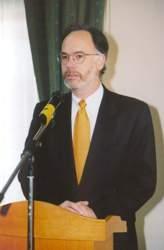
Ross Wilson, the former US Ambassador to Azerbaijan,
has said the recent cool-down in U.S.-Azerbaijan relations was not
"a crisis" and that he sees vast potential for expanding bilateral
ties. He made the statement in his media interviews during his
three-day visit to Baku paid in the past days.
Wilson, the Director of the Dinu Patriciu Eurasia Center at the Atlantic Council, a Washington-based non-governmental organization, said the main goal of his visit was to invite Azerbaijan to the Black Sea cooperation forum on economic and energy issues to be held in Istanbul in September and to assess the current state of bilateral relations.
A U.S.-backed push for a historic rapprochement between Azerbaijan's foe Armenia and its historic ally Turkey has damaged ties between Washington and Azerbaijan. Baku in April accused the United States of siding with Armenia over Upper (Nagorno) Garabagh, an Azerbaijani region that has been under Armenian occupation since a 1994 ceasefire in a war, and threatened to "reconsider" its relationship with Washington.
Recalling US Defense Secretary Robert Gates’ recent visit to Baku, Wilson said news about the expected visit by US Secretary of State Hillary Clinton was "a pleasant surprise" for him.
"This is the first visit to Azerbaijan by the US Secretary of State in the past 18 years. This is good. We could expand our relations that way. This is crucial now, I mean, at a time there is no US ambassador to Azerbaijan."
Wilson said the delay in appointing the US ambassador should not affect bilateral relations. He said that based on his own experience, this was merely a technical issue.
According to him, Matthew Bryza, a senior State Department official who is US President Barack Obama’s choice for the ambassadorial post, maintains a good relationship with Azerbaijan, Armenia, Georgia, Russia as well as Turkey. This will help Bryza, a diplomat who previously co-chaired the OSCE group brokering Armenia-Azerbaijan peace talks, to undertake his job as the US envoy in Baku.
"The president has formally nominated his candidacy, however, it has to be approved by the US Senate. If everything goes well, the Senate will endorse it in July.
"What I can say from my experience is that my candidacy had been nominated in February, but I was appointed ambassador in October. Things like that take some time to go through. And this shouldn’t affect the relations between Azerbaijan and America, because this is America’s domestic policy."
Wilson did not rule out that Bryza will be closely involved in the ongoing efforts to settle the Upper Garabagh conflict. The experienced diplomat said patience and persistence were pivotal to reach a final solution to the long-standing dispute. He pointed out that no results or an accord, or even agreement on the basic principles of the conflict settlement have been achieved in recent years.
"I am very disappointed with this, because over three years that I worked here and during another three years that I worked at the US State Department, I dealt with the Nagorno Garabagh problem. I know that last year much was done in this regard, some steps forward were taken, but there is still no result. This problem needs to be resolved, and this is crucial both for Azerbaijan and Armenia.
"The sides have the [political] will to settle the conflict. The will is there in Moscow, in Paris and in Washington…I hope that the two presidents will come to a specific agreement on the issue in 2010," Wilson said.
The OSCE Minsk Group, co-chaired by the United States, Russia and France, is brokering Armenia-Azerbaijan peace talks.
Wilson declined to comment on the situation with democracy in Azerbaijan, saying it would be challenging to evaluate it during a short visit. But he said that "just like elsewhere in the region and the whole world, there are some problems in Azerbaijan". According to him, democracy means not reaching a certain level, but "always moving toward the goal, advancing".
Having met with various people in Azerbaijan, Wilson confined to a brief overview of the state of democracy in the country, concluding that "there are problems, but prospects are there for democratic development as well".
Wilson said, further, that he was impressed with the rampant economic development in Azerbaijan in the past seven years – since he completed his diplomatic tenure in the country. He said numerous buildings have been constructed in Baku, the number of expensive cars on the streets has increased, roads have significantly improved, and people have grown wealthier. Wilson emphasized, however, that these were his visual observations made on a short visit and that he was not inclined to provide a profound assessment of the overall economic situation in Azerbaijan.
While in Baku, the former ambassador held discussions with Foreign Minister Elmar Mammadyarov and Novruz Mammadov, the head of the Presidential Administration international relations department.*
Here we are to serve you with news right now. It does not cost much, but worth your attention.
Choose to support open, independent, quality journalism and subscribe on a monthly basis.
By subscribing to our online newspaper, you can have full digital access to all news, analysis, and much more.
Subscribe
You can also follow AzerNEWS on Twitter @AzerNewsAz or Facebook @AzerNewsNewspaper
Thank you!