
Clinton to visit Azerbaijan: Gates
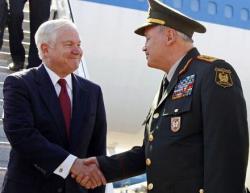
US Secretary of State Hillary Clinton is expected to visit
Azerbaijan, Defense Secretary Robert Gates visiting Baku said
during a meeting with Azerbaijani Defense Minister Safar Abiyev on
Monday, according to the Azerbaijan Defense Ministry.
Gates said the letter sent by President Barack Obama to his
Azerbaijani counterpart Ilham Aliyev, Secretary Clinton’s expected
visit and his current visit to Baku were graphic examples of the
United States and Azerbaijan being strategic partners.
Minister Abiyev said Baku was attaching great importance to its
cooperation with Washington.
Speaking about combat against international terror and other
security issues being jointly addressed by the two countries,
Abiyev said the situation in the South Caucasus region remains
tense and complicated due to the lingering Armenia-Azerbaijan
conflict over Upper (Nagorno) Garabagh. He highly assessed the role
played by the U.S. as a co-chair of the mediating OSCE Minsk Group
and said more vigorous steps were being expected from Washington in
this respect.
Abiyev also said the infamous Section 907, which bans direct US aid
to the Azerbaijan government, was adversely affecting
US-Azerbaijani relations.
Gates pledged to convey to President Obama upon return home the
magnitude of the Upper Garabagh problem for Azerbaijan. He also
said he would spare no effort toward canceling Section 907.
On Sunday, the US defense secretary was received by President
Aliyev. The parties exchanged views on issues of military
cooperation between the two countries, according to the
presidential press-service.
Gates handed President Obama’s letter to the Azerbaijani leader. He
stressed that as a US senator, Obama had paid his first foreign
visit to Azerbaijan.
According to the BBC Radio correspondent who accompanied Gates, the
Pentagon chief had arrived in Azerbaijan to convince its leaders
that it is playing an important role in the international
coalition, despite a perception that the United States is not
paying enough attention to the country.
"I wanted to come through and meet with President Aliyev and
reassure him that's not the case," Gates said. "I think there's
going to be other visits [between U.S. and Azerbaijani officials]
in the future. … It's important to touch base and let them know
that, in fact, they do play an important role in this international
coalition."
This is the US defense secretary’s first official visit to
Azerbaijan. He is the most high-ranking official delegated by the
US government to Baku in the past four years.
Since 2001, tens of thousands of flights for the war effort in
Afghanistan have passed through Azerbaijan's airspace, a senior
Defense Department official speaking on background told reporters,
and about 100,000 troops have flown through Azerbaijani airspace in
the past year en route to Afghanistan. About 25 percent of the
coalition's supplies bound for Afghanistan pass through what's
known as the Caucasus Spur, which includes Azerbaijan.
90 Azerbaijani peacekeepers are serving in Afghanistan as part of
the NATO-led International Security Assistance Force (ISAF).
Director of the Central Asia-Caucasus Institute at the John Hopkins
University, Dr. Svante Cornell, says the Obama administration "has
realized that it could lose Azerbaijan".
He told Radio Liberty that the US government under President Barack
Obama has never paid due attention to Azerbaijan.
"They have accepted the fact that Azerbaijan is there and it is our
ally. But they don’t need attention. They have now realized that,
should this policy persist, they could lose Azerbaijan."
Cornell said that consecutive visits to Baku by US Special Envoy
for Eurasian Energy, Richard Morningstar, and Defense Secretary
Robert Gates aim to ease tension that has emerged in
U.S.-Azerbaijan relations. "The American government has realized
that bilateral relations’ staying as they are could trigger some
problems."
Regarding Turkey-Armenia relations, Cornell said Washington’s
policy on the reconciliation process appears different from Baku’s
stance.
"They say that these issues are inter-linked. But the U.S. was not
accepting that. The Obama administration thought that the
Turkish-Armenian normalization could be achieved without
Azerbaijan’s consent. But they have now realized that it is
challenging to foster development in the Caucasus without
Azerbaijan."*
Here we are to serve you with news right now. It does not cost much, but worth your attention.
Choose to support open, independent, quality journalism and subscribe on a monthly basis.
By subscribing to our online newspaper, you can have full digital access to all news, analysis, and much more.
You can also follow AzerNEWS on Twitter @AzerNewsAz or Facebook @AzerNewsNewspaper
Thank you!