
Mediators, Azeri FM discuss ‘next steps’ on Garabagh
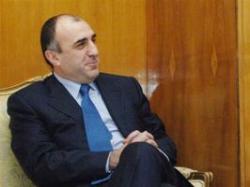
OSCE mediators brokering settlement to the Armenia-Azerbaijan
conflict over Upper (Nagorno) Garabagh have issued a short
statement about the meeting they held with Azerbaijani Foreign
Minister Elmar Mammadyarov in Venice last Friday.
The Minsk Group co-chairs - Bernard Fassier of France, Robert Bradtke of the United States and Igor Popov of Russia - discussed with Mammadyarov the current stage of negotiations on the conflict settlement, says the statement, posted on the OSCE website.
"As they did in their May 12 meeting in Brussels with Armenian Foreign Minister Eduard Nalbandian, the co-chairs also assessed next steps in the near future to restore momentum to the peace process," the statement said.
The personal representative of the OSCE Chairman-in-Office, Andrzej Kasprzyk, also participated in the talks.
Mammadyarov told reporters after the meeting that the points cited in the updated Madrid principles for settling the Upper Garabagh conflict, which was submitted to Baku and Yerevan by the Minsk Group co-chairs, had been touched upon.
"At the meeting we outlined the opportunities as to on which level we can move forward. The co-chairs, while submitting this document in Athens, were expecting both sides’ positive approach to it. Thus, this document had emerged as an outcome of two-year-long work, meetings and discussions held between Azerbaijan and Armenia both on the level of foreign ministers and presidents. But, unfortunately, at the last moment the Armenian side stated that there were certain difficulties in accepting some of those principles."
The conflict between the two South Caucasus republics flared up in the late 1980s due to Armenia's territorial claims. Armenia has been occupying over 20 percent of Azerbaijan's territory since the early 1990s. The ceasefire accord was signed in 1994, but years of peace talks have brought few tangible results. The Minsk Group co-chairs representing the United States, Russia and France initially proposed a peace outline on settling the conflict in the Spanish capital in November 2007. In Athens in November 2009, the updated version of the Madrid Document was submitted to the sides. The Madrid Document covers "the return of the territories surrounding Upper Garabagh to Azerbaijani control" and a future determination of the legal status of Upper Garabagh "through a legally binding expression of will" and the right of "internally displaced persons and refugees to return to their former places of residence." Azerbaijan stated that it accepts the renewed Madrid principles early this year, while the Armenian stance remains unclear.
Mammadyarov said Azerbaijan has already stated that it was ready, in principle, to continue working on the renewed Madrid Document to achieve lasting peace.
"Now, it is basically clear to us what points the problem is about. If the Armenian side indeed agrees to begin withdrawing its military from the territories it occupies and to pursue a stage-by-stage settlement of the conflict, and if a decision is conceputally passed to that end, then, certainly, this issue can find its solution. However, if the Armenian side, distorting the concept put forward by the co-chairs in any way it can, will try to discontinue this process, then, I believe that there will be certain challenges on the path of a peaceful conflict resolution."
As for the next meeting of the Azerbaijani and Armenian leaders, the minister said that during the latest presidential talks held in Sochi, Russia this January, a proposal was made to take a break in negotiations. "This is because after the updated Madrid principles were submitted in Athens, this meeting, unfortunately, did not produce the expected results. Everyone thought that this document, which had been worked on for over two years, would pave the way for tackling work on the main document [a peace accord], but I have to note with disappointment that it was not possible to secure the Armenian consent."
Mammadyarov said that, with the exception of some points that are believed to require reworking, one may say using the popular expression used for soccer matches that "the ball is now on the Armenian side."
"I therefore believe that now they are to clarify their stance. The overall situation is currently that the co-chairs should convey the messages they received from Azerbaijan today to the Armenian side. Afterwards, they will review the overall situation and, most likely, will further make new proposals."
Russian mediator Igor Popov has told Azerbaijan’s APA news agency that the co-chairs plan to visit the region soon. "This visit will most likely take place in late June or early July."*
Here we are to serve you with news right now. It does not cost much, but worth your attention.
Choose to support open, independent, quality journalism and subscribe on a monthly basis.
By subscribing to our online newspaper, you can have full digital access to all news, analysis, and much more.
Subscribe
You can also follow AzerNEWS on Twitter @AzerNewsAz or Facebook @AzerNewsNewspaper
Thank you!