
Baku lauds European Parliament resolution; Yerevan indignant
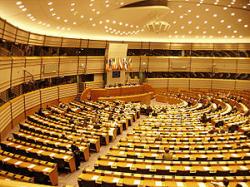
Azerbaijan’s Foreign Ministry has said it welcomes the adoption by
the European Parliament on Thursday of the resolution on the need
for an EU strategy for the South Caucasus, stating its approval of
the European lawmakers’ stance on the Armenia-Azerbaijan Upper
(Nagorno) Garabagh conflict.
In a statement, the ministry commended the clear and unequivocal position of the European Parliament with regard to the Upper Garabagh conflict and its bitter consequences. It pointed out that the Parliament calls for "an increasingly active role of the EU to transform the South Caucasus into a region of sustainable peace, stability and prosperity with a view to enhancing the integration of these countries into the European policies."
The EP resolution, passed on the basis of Bulgarian parliament member Evgeni Kirilov’s report, called on Armenia to withdraw its armed forces from the occupied Azerbaijani territories. The resolution also said the "frozen" conflicts are the biggest hurdle to economic and social development.
Baku noted that, while calling for more vigorous efforts to settle the long-standing conflict in the coming months, the European Parliament demands the withdrawal of Armenian forces from all occupied territories of Azerbaijan. The European parliamentarians also expressed their utter concerns over the fact that hundreds of thousands of refugees and IDPs who fled their homes during or in connection with hostilities waged with Armenia in the early 1990s remain displaced.
The conflict between the two South Caucasus republics reared up in the late 1980s due to Armenia's territorial claims. Armenia has been occupying over 20 percent of Azerbaijan's internationally-recognized territory since the early 1990s in defiance of international law. The ceasefire accord was signed in 1994, but over a decade of efforts by US, Russian and French mediators have been fruitless so far.
Considering the "parliamentary elections" to be organized in the Upper Garabagh region of Azerbaijan Sunday, the ministry upheld the EU position recognizing as unconstitutional and illegal the framework in which the elections in the breakaway territories take place, while defending the political rights of the displaced persons.
The statement said that, despite the desperate attempts of the Armenian side to thwart its adoption, the European Parliament resolution was strongly supported by all main political groups of the legislature.
"The Ministry believes that this timely and clear statement by the European Parliament on the Upper Garabagh conflict is a signal to Armenia to stop its policy aimed at prolongation of the settlement process and finally to take a constructive position in the negotiations, on the basis of the principles mentioned in the Resolution."
Armenia has strongly opposed the European Parliament resolution. Foreign Minister Eduard Nalbandian claimed that the document is not in line with three documents adopted on Garabagh settlement – the Moscow Declaration, the L’Aquila statement and the Madrid principles, an outline for settling the Garabagh conflict proposed by the OSCE mediators.
Nalbandian claimed that the MP who drafted the resolution had failed to amply study the Garabagh issue.
"The person who prepared it probably never visited Garabagh and the region and did not consult with the French co-chairman of the [mediating] OSCE Minsk Group. It is for this reason that the resolution contradicts the position repeatedly stated by the European Union," the Armenian minister maintained.*
Here we are to serve you with news right now. It does not cost much, but worth your attention.
Choose to support open, independent, quality journalism and subscribe on a monthly basis.
By subscribing to our online newspaper, you can have full digital access to all news, analysis, and much more.
Subscribe
You can also follow AzerNEWS on Twitter @AzerNewsAz or Facebook @AzerNewsNewspaper
Thank you!