
Armenia delaying peace talks - Azeri minister
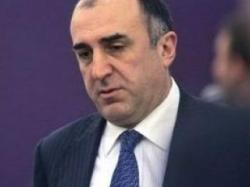
Azerbaijani Foreign Minister Elmar Mammadyarov has said Armenia is
delaying the ongoing talks on settling the Upper (Nagorno) Garabagh
conflict by failing to state its position on the updated Madrid
principles, an outline for the Garabagh settlement submitted by the
countries co-chairing the mediating OSCE Minsk Group.
"Azerbaijan has announced that it accepts this document in principle," he told a news conference Friday. "We are ready to tackle work on a comprehensive peace accord based on this document. However, Armenia has not issued a clear-cut response to date. Therefore, unfortunately, work is stalling."
The Minsk Group co-chairs representing the United States, Russia and France initially proposed the peace outline in the Spanish capital in November 2007. In Athens in November 2009, the updated version of the Madrid Document was submitted to the sides, and it is presently under discussion. Baku supports the updated Madrid Document with some exceptions, while Armenia has yet to put forth a clear-cut stance on the peace outline.
Mammadyarov said he would meet with the Minsk Group co-chairs on June 5 in Venice on the sidelines of an event marking the 20th anniversary of the Council of Europe Venice Commission.
On Wednesday in Brussels, the OSCE mediators held a meeting with Armenian Foreign Minister Eduard Nalbandian to discuss the current stage of the ongoing peace talks. The Minsk Group co-chairs - Bernard Fassier of France, Robert Bradtke of the United States and Igor Popov of Russia – issued a statement on the following day saying they intend to further conduct a similar meeting with the Azerbaijani foreign minister in early June. Mammadyarov said he would be informed at the meeting about the outcomes of the co-chairs’ discussions with Nalbandian.
Commenting on the possibility of a meeting between the two ministers, Elkhan Polukhov, the spokesman for the Azerbaijan Foreign Ministry, said Mammadyarov’s meeting with his Armenian counterpart in the Italian city is not expected at this point, "but there could be changes in the visit program."
Armenia and Azerbaijan waged a war over the mountainous region of Upper Garabagh in the early 1990s,
which claimed some 30,000 lives and displaced about a million Azerbaijanis. Armenia has been occupying over 20% of Azerbaijan’s internationally-recognized territory since then. The ceasefire accord was signed in 1994, but the OSCE-brokered peace talks have been fruitless so far.*
Here we are to serve you with news right now. It does not cost much, but worth your attention.
Choose to support open, independent, quality journalism and subscribe on a monthly basis.
By subscribing to our online newspaper, you can have full digital access to all news, analysis, and much more.
Subscribe
You can also follow AzerNEWS on Twitter @AzerNewsAz or Facebook @AzerNewsNewspaper
Thank you!