
Azeri, Armenian and Russian clerics vow to join effort on Garabagh
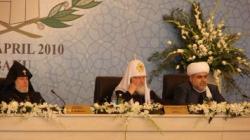
Azerbaijani, Armenian and Russian clerical
leaders on Monday signed a statement at the conclusion of their
meeting in Baku that focused on ways of settling the
Armenia-Azerbaijan conflict over Upper (Nagorno) Garabagh.
Patriarch of the Russian Orthodox Church Kirill said the trilateral
meeting was very successful. ``In my view, this was the right and
contemporary initiative for a trilateral meeting, which took place
and concluded with the successful signing of a declaration,``
Patriarch Kirill told reporters.
According to Kirill, clerical leaders do not wield political power
and cannot ``move troops in one direction or another``, but they
have a unique opportunity to capitalize on the values embraced by
believers. ``And the fact that representatives of different creeds
have met and agreed upon many important things is an important
signal to all pious people.``
The patriarch expressed hope that those signals would promote
reconciliation, defuse tension in the region and create a solid
basis for political leaders who, having assumed the entire brunt of
responsibility for a negotiated settlement of the Upper Garabagh
conflict, would achieve a negotiated solution.
Azerbaijan and Armenia fought a lengthy war that ended with the
signing of a cease-fire in 1994, but Armenia continues to occupy
Upper Garabagh and seven other Azerbaijani districts in defiance of
international law. Peace talks have been largely fruitless so far
but are still ongoing. Mediators from Russia, France and the United
States are brokering the peace process through the OSCE Minsk
Group.
Azerbaijan`s top cleric, the Caucasus Muslims Office chairman,
Sheikhulislam Allahshukur Pashazada, Armenian Catholicos Garegin II
and Russian Patriarch Kirill held their meeting on the sidelines of
the two-day summit of world religious leaders, which was held in
the Azerbaijani capital early this week.
In the declaration, co-signed by the clerics, they voiced
confidence that their joint efforts would facilitate overcoming
inter-ethnic hostility. ``Through our peacemaking efforts we will
nurture people`s hope for eliminating enmity, because war, if it
persists, will never end,`` the joint declaration says.
The three clerical leaders also voiced their support for
international efforts aimed at a Garabagh settlement and stressed
the need to step up communication among those involved to promote
confidence-building and thus achieve peace and good relations
between neighbors.
``Supporting efforts of the Azerbaijani and Armenian presidents, we
intend to assist in their aspirations and, in this connection, we
deem it important to continue holding dialog between clerical
leaders with an aim to facilitate a conflict settlement.``
The declaration emphasizes, however, that the road to peace will be
challenging. ``This requires a lot of effort and a powerful will.
But our hopes for success are very strong.``
The Baku summit, which brought together nearly 250 delegates from
35 countries, was attended by President Ilham Aliyev. Participants
- Christian, Muslim, Jewish, Buddhism and Hindu leaders - discussed
the impact of globalization on religion and traditional values.
The summit of world religious leaders ended Tuesday with the
adoption of a final declaration. The declaration said
``globalization has not eradicated threats to the security of
states, peoples and individuals.``
President Aliyev said in his remarks at the summit`s opening
ceremony: ``It is not accidental that this meeting is being held in
Baku. Meetings of world religious leaders in Baku have already
become regular. For centuries, various nations and representatives
of religions have lived in Azerbaijan in a fraternal and brotherly
atmosphere, as one family.``
``I have no doubt that this meeting will bring good results and
help to reach better concordance among religions, nations and
countries. I want to reiterate: we are hopeful Baku will grow into
a kind of a center for inter-religious dialogue.``
``Azerbaijan is a natural bridge between Europe and Asia,`` Aliyev
underscored. ``I hope a day will come when Baku will be selected
the capital of European culture. Thus, Azerbaijan will make a
greater contribution to the development of relations between the
Christian and Muslim worlds.``
``Azerbaijan ensures all freedoms, including religious ones. Over a
thousand mosques are daily functioning in Azerbaijan. Eleven
churches, six synagogues and other shrines are operating here. It
makes us stronger.``
Of note, despite the summit`s being a top-level event considering
the high ranks of its participants, it has drawn the attention of
Azerbaijanis mostly due to the Armenian Catholicos` visit to
Baku.
Garegin II said in his address that the paramount task facing
clerical leaders was to promote settlement of inter-ethnic
conflicts in the region and the whole world, noting that all issues
should find their solutions in line with international law and the
rights of nations.
Regarding the Garabagh conflict, Garegin II said the dispute should
be settled peacefully.
``The main duty of religious leaders is, while supporting the
presidents, to achieve the advancement of talks and a solution of
the conflict. As the Catholicos of all Armenians, I will step up my
efforts in this direction together with the Caucasus Clerical
Office chairman, Sheikhulislam Allahshukur Pashazada. This is our
duty.``
Garegin II also suggested holding the next summit of clerical
leaders in Yerevan and invited Sheikh Pashazada to attend the
event.
``What a happy day it would be if all borders in the region opened
up and conflicts were resolved,`` Garegin II added.
Protest
Women members of the hard-line Garabagh Liberation Organization
(GLO) protested at Garegin II`s visit to Baku outside the Gulustan
Palace where the world clerics` summit was held.
Holding photos of the women and children slain during the Khojaly
massacre committed by Armenians against Azerbaijanis in 1992, the
protesters chanted slogans such as ``The Armenian Catholicos is a
criminal``, ``The Armenian Catholicos` hands are soaked in
Azerbaijani women and children`s blood`` and ``Down with Armenian
criminals``. The protesters attempted to meet with the Armenian
cleric and voice their outrage, but they were blocked by security
officers.
Approaching Ali Hasanov, the head of the Presidential
Administration socio-political department who was leaving the
summit, the pickets insisted that inviting Garegin II to Azerbaijan
was unacceptable.
The police then prompted the protesters to leave the area.
President Aliyev received Armenian Catholicos Garegin II on Monday.
The Armenian Apostle Church said in a statement that the one-hour
meeting proceeded ``in a sincere and calm atmosphere`` and focused
on the Garabagh conflict.
Garegin II and the accompanying delegation visited the Armenian
church in Baku on Monday. The Armenian clerics paid tribute to the
shrine and read prayers, the statement said. The police surrounded
the area to assure the clerics` safety.
Here we are to serve you with news right now. It does not cost much, but worth your attention.
Choose to support open, independent, quality journalism and subscribe on a monthly basis.
By subscribing to our online newspaper, you can have full digital access to all news, analysis, and much more.
You can also follow AzerNEWS on Twitter @AzerNewsAz or Facebook @AzerNewsNewspaper
Thank you!