
U.S. ‘anticipated’ Armenia’s move on Turkey accords
The United States has said it is not surprised with Armenia’s
decision on Thursday to suspend ratification of the 2009
reconciliation accords with Turkey. State Department spokesman
Philip Crowley said Washington had "anticipated" the decision, but
the Obama administration still hopes that ties between the two
estranged countries can be normalized.
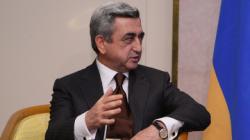
Armenian President Serzh Sarkisian said Yerevan was suspending the parliamentary approval of the deal until Ankara is ready to ratify the documents unconditionally, though he noted that his country had decided "not to exit the process for the time being, but rather, to suspend the procedure of ratifying the protocols." He claimed in an address to the nation that Armenia would keep its signature to the accords, "because we desire peace."
Crowley emphasized that the Armenian leader’s statement says Yerevan is not terminating the normalization process but suspending it until Turkey is ready to move forward. "We welcome Sarkisian’s decision to continue working toward peace, stability and mutual understanding. We believe the normalization process will benefit the Caucasus region as much as it will benefit Turkey and Armenia."
Crowley told a news briefing on Thursday that it was reassuring that neither Armenia nor Turkey have pulled out of the normalization process.
"I think we're encouraged that neither side has walked away from the process, but I think we all recognize that we'll just need some time to perhaps create some new momentum that allows the process to move forward," Crowley said. "This is something that the Armenians had hinted to us that they were prepared to do, so we're not surprised by the announcement."
Turkey and Armenia signed protocols to establish diplomatic relations and reopen their borders in Zurich on October 10, 2009, after decades of hostility. The documents require ratification in both countries’ parliaments. Turkish officials have assured Azerbaijan, Turkey’s ally, that the protocols will not pass in the country’s parliament until progress is made in resolving the Armenia-Azerbaijan Upper (Nagorno) Garabagh conflict.
The State Department spokesman said the U.S. calls on the sides to stay committed to the normalization process.
"That was our message to both Turkey and Armenia during the sidelines of the Nuclear Security Summit: Keep the process going; if you don’t think that this is the right time, that’s fine, we’ll step back and reevaluate how to move forward. So that’s why Phil Gordon made the comments in Tallinn today that these are encouraging steps in the sense that both sides remain committed to seeking normalization because it is in – they recognize, I think, that it is in, ultimately, their collective interest to do this. We just have to continue to find a way to move forward."
Crowley said the U.S. had intensive meetings with the Armenians and the Turks in Washington and had ongoing contacts with Azerbaijan as well. "And we understand that there’s – we had – that both sides had reached a – I won’t say impasse, but kind of reached a hurdle in the process regarding the ratification of the protocols," he said.
Asked if there is "any other formula in your agenda" to move the process forward, Crowley said the U.S. "had invested a great deal of energy in this" and would continue its ongoing discussions with the parties, but advised to "stay tuned" on Azerbaijan.
French President Nicolas Sarkozy has also welcomed Sarkisian’s stating Armenia’s readiness to normalize its relations with Turkey, despite challenges with ratifying the protocols. Sarkozy called on Yerevan and Ankara to continue their dialog and redouble their efforts to enforce the Zurich protocols, Armenia’s News.am news website said.
Russia has also commented on Sarkisian’s statement. The Russian Foreign Ministry’s spokesman, Andrei Nesterenko, said Moscow hopes Armenia and Turkey will succeed in overcoming the current deadlock and foster suitable conditions for full-scale normalization, which is in the best interest of all regional states.
"We affirm that at this point Armenia and Turkey have not managed to reach a result that would allow to restore ties between the two neighboring countries and thus foster a healthy political environment in trans-Caucasia and create pre-conditions for strengthened stability in this region."
Nesterenko pointed out, however, that Yerevan was suspending ratification of the normalization agreements, not recalling its signatures, adding that "the prospects for forging ties between Armenia and Turkey started a year ago are still there."
Vafa Guluzada, an Azerbaijani former state adviser and political analyst, believes it was, in fact, Russia that has hampered Turkish-Armenian normalization, saying Moscow will never allow a rapprochement between the two countries.
"Armenia, following Russia’s orders, did not seek opening the border. And the Russian geo-political interests require maintaining the current "neither war nor peace" situation in the region. Russia wants to own the entire Caucasus," Guluzada opined.
Azerbaijani Deputy Foreign Minister Araz Azimov says that Sarkisian’s announcement was a tactical step aimed at getting the US president more closely involved in the process. He told Public TV channel that Baku was confident Ankara would stick to its position of principle despite all the pressure it is facing. "Now Ankara should step up its diplomatic efforts to show Armenia’s real face to the world."*
Here we are to serve you with news right now. It does not cost much, but worth your attention.
Choose to support open, independent, quality journalism and subscribe on a monthly basis.
By subscribing to our online newspaper, you can have full digital access to all news, analysis, and much more.
Subscribe
You can also follow AzerNEWS on Twitter @AzerNewsAz or Facebook @AzerNewsNewspaper
Thank you!