
Baku says discontent with US policy on Garabagh
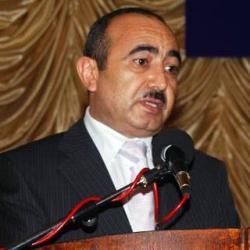
An Azerbaijani presidential administration official has said Baku
was not content with the United States’ policy on the settlement of
the Armenia-Azerbaijan conflict over Upper (Nagorno) Garabagh.
Ali Hasanov, the head of the Presidential Administration socio-political department, said this discontent is primarily due to the lack of an impartial position that the U.S. should adhere to as one of the mediators in Garabagh settlement.
Hasanov noted that Azerbaijan has repeatedly raised - on different levels – the issue of the violation of its territorial integrity. "But, unfortunately, some US institutions and circles, under pressure from the Armenian lobby, are failing to display neutrality and are openly giving support to Armenia."
Armenia and Azerbaijan waged a war in the early 1990s, which claimed some 30,000 lives and displaced about one million Azerbaijanis. Armenia has been occupying over 20% of Azerbaijan’s internationally recognized territory since then. Peace talks, brokered by the OSCE Minsk Group co-chaired by the United States, Russia and France, have largely accomplished no result so far.
Hasanov emphasized that Washington’s policy has lately been aimed at extricating Armenia from a socio-economic predicament, and the neighboring states and other countries have come under pressure to forge political, economic and social relations with Armenia.
"We believe that this is not in line with the US mission, particularly that carried out within the OSCE Minsk Group.
"If the U.S. indeed supports the emergence of peace in the region, a solution to the conflict, improvement of Armenia’s economic situation and its joining the trans-national projects being implemented in the region, it should force this country to relinquish its policy of occupation.*
Here we are to serve you with news right now. It does not cost much, but worth your attention.
Choose to support open, independent, quality journalism and subscribe on a monthly basis.
By subscribing to our online newspaper, you can have full digital access to all news, analysis, and much more.
Subscribe
You can also follow AzerNEWS on Twitter @AzerNewsAz or Facebook @AzerNewsNewspaper
Thank you!