
Turkish president replies to Sarkisian’s call on ‘decisive steps’
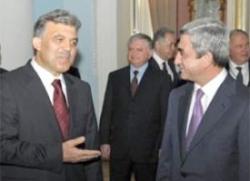
Turkish President Abdullah Gul has replied to his Armenian
counterpart Serzh Sarkisian’s letter sent a few days ago that
called on Gul to take "decisive steps" toward normalizing the two
countries’ relations that have been strained for decades.
According to the Turkish president's website, Gul indicated that the key objectives in efforts to normalize bilateral relations were "overcoming long-established prejudices and nurturing mutual understanding and trust among our two neighboring peoples."
"You should have no doubt that our determination to move these objectives forward is intact, provided this resolve and commitment remains reciprocal," Gul said after the two countries accused each other of trying to rewrite the accords on mending bilateral ties signed in late 2009.
He emphasized that Ankara will continue the process of normalizing its relations with Yerevan based on the agreement reached. "I will keep on dealing with this process with hope to achieve result satisfying our countries."
President Sarkisian had sent his letter to Gul on a plane heading to Britain while flying over Turkey’s territory on Monday.
Sarkisian’s letter also said Turkey and Armenia’s initiative seeking to achieve reconciliation is in the spotlight of the world community. He also wrote that a historic chance has emerged to move forward the process of Turkish-Armenian reconcliation, and efforts of world powers are crucial for mending bilateral relations.
On Wednesday, Sarkisian said the accords must be voted on by the Turkish parliament before Armenia`s parliament would approve them, and warned that Armenia could break off the effort to normalize relations if Turkey dragged its feet.
Armenia and Turkey have been at odds for decades and maintain no diplomatic ties. Ankara and Yerevan signed two protocols on normalizing their relations in Switzerland in October 2009 in a bid to end decades of hostility. The United States, Russia and France facilitated the signing of the Turkish-Armenian protocols. However, the documents require ratification in both countries’ parliaments. Turkish officials have assured Azerbaijan, Turkey’s ally, that the protocols will not pass in the country’s parliament until progress is made in resolving the Armenia-Azerbaijan conflict. Also, the Armenian Constitutional Court issued a ruling in January that Ankara labeled as containing pre-conditions. While saying the protocols signed in Zurich were in line with the introductory part of the country’s Constitution, the ruling still allows Armenia to pursue international recognition of the alleged World War I-era genocide in Ottoman Turkey.*
Here we are to serve you with news right now. It does not cost much, but worth your attention.
Choose to support open, independent, quality journalism and subscribe on a monthly basis.
By subscribing to our online newspaper, you can have full digital access to all news, analysis, and much more.
Subscribe
You can also follow AzerNEWS on Twitter @AzerNewsAz or Facebook @AzerNewsNewspaper
Thank you!