
Armenian FM warns Turkey, cools Garabagh peace talk
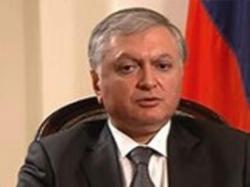
Armenian Foreign Minister Eduard Nalbandian has claimed Turkey will
risk reversing its unprecedented rapprochement with Armenia if it
persists in linking the process with a resolution of the
Armenia-Azerbaijan conflict over Upper (Nagorno) Garabagh.
In a videotaped studio interview on Sunday with RFE/RL's Armenian Service, Nalbandian also sought to cool talk of an imminent settlement of Upper Garabagh, alleging that Baku is "not prepared for mutual concessions in 2010."
Commenting on the continuing Turkish linkage of the two issues, Nalbandian reiterated his government's arguments that Ankara and Yerevan set no preconditions when they embarked in 2008 on an intensive dialogue culminating in the signing in October of two agreements to normalize bilateral relations. He also argued that neither "protocol" makes any mention of the Garabagh dispute.
"Had there been preconditions, we would not have started this process and reached agreements in the first place," said Nalbandian.
"If one of the parties is creating artificial obstacles, dragging out things, that means it is assuming responsibility for the failure of this process," he warned.
Armenian President Serzh Sarkisian, who was to meet Monday in Moscow with Russian President Dmitry Medvedev, explicitly threatened last month to walk away from the agreements if the Turkish side fails to ratify them unconditionally and "within a reasonable time frame." But he did not set any concrete deadlines for Turkish ratification.
Nalbandian also avoided mentioning any dates, stressing instead the fact that Western powers and Russia also stand for an unconditional normalization of Turkish-Armenian relations.
"If Turkey takes a step back, then this will be not only a violation of the agreements with Armenia but will demonstrate that it is not respecting the international community’s opinion, with all resulting consequences and the loss of credibility in the first instance," he maintained.
"Armenia, on the other hand, will -- let’s not say win -- not lose anything that we had before this process," Nalbandian added.
Turkey and Armenia have faced differences for decades. Turkey closed its border with Armenia in 1993 due to Armenian occupation of Azerbaijani territory and genocide claims. In a bid to normalize ties, Turkey signed protocols to establish diplomatic relations and reopen its border with Armenia in Zurich on October 10, 2009. However, Turkish officials have pledged that Ankara could normalize its relations with Yerevan only after the Garabagh conflict has been fairly settled.
Nalbandian went on to dismiss domestic opposition criticism of the protocols and, in particular, a clause envisaging the creation of a Turkish-Armenian "subcommission" of history experts to research the alleged genocide.
"If we were to believe in what opponents of the protocols have said, then Turkey should have rushed to ratify these protocols a long time ago," he said.
Nalbandian insisted that the Sarkisian administration will not stop campaigning for international recognition as "genocide" of the 1915 developments in the Ottoman Empire, despite agreeing to what is expected to be a joint Turkish-Armenian study of the issue. The subcommission in question, he said, would be tasked with "restoring mutual understanding and trust between the two peoples," rather than determining whether or not the World War I events constituted genocide.
Turning to the Garabagh conflict, Nalbandian denounced Azerbaijani President Ilham Aliyev’s latest warnings on regaining the country’s occupied territory by force.
"Such statements show that Azerbaijan is not prepared for mutual concessions in 2010 as well, and that Azerbaijan remains a threat to the security of the Garabagh people," he claimed, adding that they "cannot make any impact on or intimidate Armenia or Garabagh."
Aliyev issued the warning in a New Year’s address to his nation. He also said Azerbaijan had secured broad international support for Garabagh’s return under Azerbaijani rule.
Azerbaijan and Armenia fought a lengthy war that ended with the signing of a cease-fire in 1994, but Armenia continues to occupy Upper Garabagh and seven other Azerbaijani districts in defiance of international law. Despite numerous rounds of OSCE-brokered negotiations, peace talks have been fruitless so far and refugees remain stranded.
Nalbandian cautioned against excessive expectations from the negotiating process in the coming months. "I see no point in artificially accelerating the process, and I think everybody agrees with that."
"Of course, some progress in bringing the parties’ positions closer to each other was registered last year," he added. "But that was not enough to achieve a breakthrough. If we are able to maintain the positive dynamic of 2009, then it will be possible to improve prospects for the conflict’s resolution."*
Here we are to serve you with news right now. It does not cost much, but worth your attention.
Choose to support open, independent, quality journalism and subscribe on a monthly basis.
By subscribing to our online newspaper, you can have full digital access to all news, analysis, and much more.
Subscribe
You can also follow AzerNEWS on Twitter @AzerNewsAz or Facebook @AzerNewsNewspaper
Thank you!