
Aliyev says 2009 ‘less positive’ than expected for Garabagh
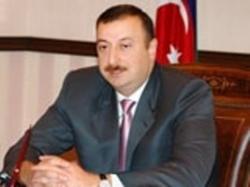
Azerbaijani President Ilham Aliyev has described the year 2009 as
positive for the settlement of the Armenia-Azerbaijan conflict over
Upper (Nagorno) Garabagh, but said it was "less positive than it
could have been."
"On some issues the positions are drawing closer, while on others they are not," President Aliyev told Russia’s Vesti (News) TV channel.
Aliyev noted that as early as in 2008 the Azerbaijani and Armenian presidents held talks, and a joint declaration outlining ways of resolving the long-lasting dispute was adopted and co-signed by Russia.
"It clearly indicates that the conflict must be resolved on the basis of international law, the decisions and resolutions of international organizations. These are four resolutions of the UN Security Council demanding an immediate withdrawal of the Armenian occupying forces from the Azerbaijani territory. They have not been implemented for nearly 20 years," the Azerbaijani president said.
The Azerbaijani and Armenian leaders signed a declaration after talks in Moscow in November 2008 that took place on the initiative of Russian President Dmitry Medvedev. The first document inked by the two heads of state in the past 16 years, it called for settling the Garabagh conflict in line with the principles of international law and respective decisions and resolutions passed so far.
President Aliyev stressed the importance of restoring Azerbaijan’s territorial integrity, bringing an end to the occupation of Azerbaijani land and repatriating refugees and internally displaced persons.
"Unfortunately, hopes for 2009 have not been justified to the extent we had expected, because the joint declaration of the presidents of Azerbaijan, Russia and Armenia was a landmark event, and it became the first after the signing of a ceasefire agreement in 1994. There were hopes that we will be able to solve the issue in 2009, at least to solve the basic principles, but they were not justified, and it is not our fault," President Aliyev said.
Aliyev said there is certain optimism for 2010, because the Garabagh conflict has become one of the core issues on the international agenda.
"It became clear to many - those who did not understand it perfectly - that it will be impossible to solve any regional problem without settling the Armenia-Azerbaijan conflict. We believe we will succeed in coordinating the main positions in 2010, but we are strongly opposed to turning this into a permanent negotiating process," the president underscored.
Aliyev reminded that talks to resolve the Garabagh dispute have been ongoing since 1992, when the mediating OSCE Minsk Group was established.
"A ceasefire agreement was concluded in 1994. Fifteen years have passed since then, advances have been made, but there is no result. Therefore, we cannot allow this process to become frozen, I mean, literally, frozen," Aliyev added.
Armenia and Azerbaijan waged a war in the early 1990s, which claimed some 30,000 lives and displaced about a million Azerbaijanis. Armenia has been occupying over 20% of Azerbaijan’s internationally-recognized territory since then. Peace talks, brokered by the OSCE Minsk Group co-chaired by the United States, Russia and France, have been largely fruitless so far.*
Here we are to serve you with news right now. It does not cost much, but worth your attention.
Choose to support open, independent, quality journalism and subscribe on a monthly basis.
By subscribing to our online newspaper, you can have full digital access to all news, analysis, and much more.
Subscribe
You can also follow AzerNEWS on Twitter @AzerNewsAz or Facebook @AzerNewsNewspaper
Thank you!