
Aliyev: Chisinau meeting is unfortunately fruitless
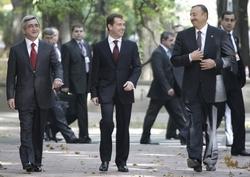
Azerbaijani and Armenian Presidents Ilham Aliyev
and Serzh Sarkisian held talks on the Upper (Nagorno) Garabagh
conflict in Chisinau on Friday along with participation by their
Russian counterpart, Dmitry Medvedev, following their meeting in
the Moldovan capital a day earlier.
Azertag, Azerbaijan`s official news agency, reported that the
meeting had taken place but did not elaborate on the gist of the
discussions. It said President Aliyev had given an interview to the
state television channel afterwards in which he answered questions
about the outcome of his discussions with Sarkisian, as well as the
state of ongoing peace talks overall.
Aliyev also laid out his views on the future of the protocols
normalizing ties between Turkey and Armenia signed on Saturday to
influence the status quo situation in the volatile region.
He also clarified the course of talks with Ankara on transporting
Azerbaijan`s gas to the European Union states through Turkey and
other issues.
AzerNEWS presents the interview to our readers.
Q. Mr. President, your regular meeting with the
president of Armenia has taken place. At the summit of the Turkic
states in Nakhchivan you noted that peace talks are now in their
final stage. From this point of view, what can you tell us about
the results of today`s meeting?
A. As you know, negotiations have been underway for many years. And
unfortunately, without any result so far. I noted that negotiations
are already in the final stage during which crucial decisions
should be made. Our position remains unchanged. The
Armenia-Azerbaijan Upper (Nagorno) Garabagh conflict must be
resolved within the territorial integrity of Azerbaijan. The
Armenian armed forces must be withdrawn from all our occupied
lands. Our compatriots, who have become internally displaced
persons, are to return to their native lands. Our position, at the
same time, is based upon the norms of international law. As you
know, the UN Security Council passed four resolutions on this
matter. There are decisions and resolutions of other international
organizations as well. In short, our position is very strong in
terms of international law.
As to negotiations, I can tell that there are positive dynamics.
Otherwise, these negotiations would not have continued thus far.
The main reason for our adherence to negotiations is that there is
progress in the negotiating process, though with difficulty. In the
last five to six years very important questions have been
coordinated. First of all, Armenian forces must be unconditionally
withdrawn from all occupied territories around Upper Garabagh. I
can tell you that this represents significant progress in
negotiations, because four to five years ago it was a question of
vacating four, and then - five districts. However, as a result of
the steps undertaken in the negotiating process, today I can tell
you that this has been agreed upon.
The peculiarity of talks is that as long as everything has not been
coordinated, nothing is considered coordinated at all. It means
that we have to solve all outstanding issues. Only in this case can
we draw nearer to a major peace accord. The territorial integrity
of Azerbaijan should be completely restored, and Armenians who live
in Upper Garabagh and Azerbaijanis who will return there should
live within the arrangement of a high-level autonomy in the future.
This is the approach which builds on the most positive
international experience. It is also a very democratic approach,
and the problem can be solved only this way.
In the world and region, there had been tremendous interest in the
Chisinau talks, as it is already clear to all that negotiations are
in their final stage and, especially, if Armenians take a
constructive position, it can lead to positive results in
negotiations. I reiterate: our position remains invariable. We have
been defending this position throughout all the processes. But,
unfortunately, the Chisinau meeting turned out fruitless. Yes, I
have to emphasize again, that on certain questions there is
certain, but not such major progress. But, unfortunately, the
parties could not come to an agreement on the main issues
discussed. The reason of it, once again, is the non-constructive
position of Armenia. In negotiations we are guided by the
principles of international law and we carry on negotiations
constructively. We try to understand the concerns of the opposing
side.
We understand that the population living in Upper Garabagh today
should receive safety guarantees. At the same time, the Azerbaijani
population who will return to their homes once occupation has ended
should receive safety guarantees, too. Azerbaijanis, who would
return to Upper Garabagh, Shusha, should receive safety guarantees.
That is, this process should go in parallel with the safety of all
people living in the region, which is equally important. This being
said, once again, I reiterate our position: our approach displayed
in negotiations builds on international law.
I hope that the Armenian side, at last, will display
constructiveness, will take pivotal steps and withdraw its troops
from the occupied lands, and, thus, peace will be ensured in the
region, all communications will be opened and cooperation, in a
broad sense, will begin.
So long as the Upper Garabagh conflict remains unsettled, any
positive trends in the region will not be expected. If someone
believes that it is possible to easily solve some of the problems
existing in the region, I doubt that. Because the main problem, the
key issue for the region, is the Garabagh conflict. First of all,
this conflict should be settled. Afterwards, all other issues can
find their solution.
Q. Mr. President, on October 10, the signing of
protocols on relations between Turkey and Armenia takes place. As
is known, these protocols do not include the Garabagh problem. What
is Azerbaijan`s position on this?
A. Azerbaijan has repeatedly stated its position. We stated our
position in April when this question was included in the agenda. In
my statements I also mentioned this problem. The Ministry of
Foreign Affairs made a formal statement. Our position is that we do
not interfere with the relations that develop or can develop
between other countries. We consider it inadmissible. Likewise, we
do not want and we do not allow anyone to interfere with our
internal affairs. Azerbaijan interfered neither with the internal
affairs of other countries nor with the relations between
countries. That is the primary issue.
It is not a secret to anyone that the occupation of the Kalbajar
district became the main and only reason for the closure of the
Turkish-Armenian border. That is, for this reason the
Turkish-Armenian border has been closed and remains shut.
Naturally, the border can be opened when this cause is eliminated.
This is our position. At the same time, Turkish leaders have
repeatedly stated their position on the issue. I hope that this
stance will prevail, and the said factor will be considered in the
protocols and their enforcement.
You have noted, and as far as we know, these protocols do not
envision the settlement of the Garabagh problem. But, at the same
time, Turkish leaders, in their official statements and during
private meetings, repeatedly told us that until the Garabagh issue
is resolved, the Turkish-Armenian protocols will not be ratified by
parliament and, thus, the borders will not open. It was stated by
the President, the Prime Minister, the Chairman of Parliament, and
the Minister of Foreign Affairs of Turkey, and we believe that. We
believe that so it will be. In this case, peace can come to the
region. In this case, all regional countries can successfully take
advantage of the said situation and solve all problems among
themselves. Only in this case can large-scale cooperation be
established in the region.
At times, some opinions circulate that normalization of the
Turkish-Armenian relations and opening of the borders in the future
can promote settlement of the Garabagh conflict. I do not share
these opinions as I believe that, if Turkish-Armenian relations are
normalized before a Garabagh settlement, Armenia`s position in the
negotiating process can become tougher. Armenia will try to present
it as a political and diplomatic success and, most likely will
take, at negotiations, an even more rigid and unacceptable
position. There are enough grounds to say that. The process of
negotiations and the events occurring at its various stages are
grounds to say that.
I am absolutely convinced that these two processes - settlement of
the Upper Garabagh conflict and opening of the Turkish-Armenian
border - should proceed in parallel. Between these processes, there
is a connection - if not official, then an informal one. This
connection should be kept, and two issues should be solved in
parallel and simultaneously. Otherwise, the status quo in the
region can change for the worse. Status quo change is very
important. Our lands have been under occupation for many years. How
long can we tolerate this?! But if the status quo changes for the
worse, it can set off negative processes in the region. We still
hope that we can solve the Upper Garabagh problem through
negotiations. If these hopes were shattered, we would not spend a
single minute negotiating. However, the developments occurring in
the region and the inclusion of superpowers in this issue should
simultaneously positively affect settlement of the Garabagh
conflict. I believe that, so it will be.
Friendship and brotherly relations between Turkey and Azerbaijan
are at a very high level, and I again note that I trust in that
promise. I trust the statements of the Turkish leaders and am
convinced that before the Garabagh problem is resolved, the
Turkish-Armenian border will not open.
Q. Mr. President, on a recent trip abroad, the
Armenian president faced insults and pressure from the Armenian
Diaspora. What do you think is the reason for that?
A. You know, once again I note that we live in this region, and
know all of its problems well. We know both its history, and
today`s realities, and certainly, to predict and propose something
is easier for us than to the politicians or the statesmen who are
not in this region. As you said, during his foreign trip the
president of Armenia faced great pressure. To tell the truth, we do
not understand the purpose of this trip fully, because, as you
know, the date for signing protocols between Turkey and Armenia had
been scheduled a long time ago and this date was coordinated by
Turkey and Armenia. This being said, the meeting with
representatives of the Diaspora on the eve of the signing was, in
my opinion, strictly formal, as the date, the text of protocols
were already known, and there was no way to change them. It was
simply of a formal nature. But this alone speaks volumes. Look at
what this process of normalization is leading to.
Armenia, possibly, is experiencing a political crisis. The
coalition in Armenia is falling apart, and Armenia`s links with its
Diaspora have been undermined. For the first time, compatriots
abroad greet the president of Armenia this way. At the same time,
this normalization, certainly, is ambiguously perceived in
Azerbaijan society. And it is true. The Azerbaijan society, its
majority, holds the opinion that the Turkish-Armenian border should
be opened simultaneously with the settlement of the Garabagh
problem. In Turkey this issue has also caused broad discussions
which at times proceed very tensely. That is, presently, there is
nothing concrete. But look what negative consequences are already
being observed. There are sharp protests in Armenia. We are aware
of public opinion in Azerbaijan as well. In Turkey itself, this
issue is perceived equivocally. But presently there is nothing
concrete. There is no certainty in the question of ratification of
the protocols by parliament. Therefore, each step in the region
should be thought through, the detailed analysis should be carried
out and predictions made. Predictions should be made on the basis
of realities. We should make sure that regional problems are
solved. But at times, we see that problems existing in the region
are aggravated further. However, there is one more thing, which is:
articles about the normalization of the Turkish-Armenian relations,
published in the Armenian press for the first time back in
February, pursued a single aim - to harm the Turkey-Azerbaijan
relations. But today, the continuation of the Turkish-Armenian
process leads to very serious consequences already in Armenia. As I
said, the internal situation has been exacerbated and the relations
of Armenia with its Diaspora have deteriorated.
Q. Mr. President, it is known that Armenia ended
up in isolation because of its policy of aggression. If the
Armenian-Turkish border opens, do you think this will lead to
economic revival in Armenia?
A. As you know, the economy of Armenia was in a challenging
situation even before the crisis. Economic prospects are not so
bright there. Because of limitations of the market,
underdevelopment of domestic production, and from the point of view
of investments, Armenia is not an attractive country. The
geographical position, in particular, the closed borders with
Azerbaijan and Turkey, certainly, have caused major economic woes.
And in the crisis situation it is seen more convex. According to
official statistics, this year the economy of Armenia has shrunk 20
percent. Therefore, to revitalize the economy, which is not in the
best situation, will be very difficult.
The opening of the Turkish-Armenian border has more of a moral
nature. At the same time, to some extent, it can lead to an
economic revitalization. But I would say: it is something like an
oxygen mask. An oxygen mask can help, it is possible to breathe
through it, but it is impossible to live normally.
Q. Mr. President, this question is unrelated, but
arouses great interest. It deals with gas cooperation between
Turkey and Azerbaijan. As you know, Turkish Prime Minister Recep
Tayyip Erdogan, on a visit to Baku in May, stated that the current
prices for gas are unfair. What has been done to make these prices
fair?
A. Yes, you are right. The esteemed Mr. Prime Minister said this
while in Baku. He said the prices are unfair, and we aspire to
bring them to a normal level. Our wishes and position taken in
negotiations are based on international practices. As purchase and
sale issues between other countries in the region or in the world
are solved, they should be solved between us accordingly.
Unfortunately, there is no result. During negotiations on the
purchase and sale and gas transit there are three basic issues. The
first one is the price which should be fair. We expect that the
arrangement on a fair price will be reached in the near future. The
second question is the volume of gas which will be delivered to
Turkey in the future. As you know, this year we have exported
approximately 7 billion cubic meters of Azerbaijani gas to Turkey.
So far, for an unfair price.
What part of the gas to be extracted during the second phase of the
Shahdaniz project, and also gas which is extracted or will be
extracted by the State Oil Company from other deposits, will be
delivered to the Turkish market? We should determine that, too. For
us, as well as for any other country, the diversification of
exports is very important. We have managed to achieve it in the oil
sector. Therefore, our oil is delivered to world and European
markets via various routes. In the gas sphere, we should also use
all available gas pipelines. Certainly, the Turkish market is very
interesting for us.
As you know, Russia and Azerbaijan are beginning to cooperate in
the gas sphere, and I am convinced that in the future it can become
very successful. Negotiations on the basis of the offers made by
Iran are underway. The Iranian market is also very interesting to
us. Efforts are being made both by Azerbaijan and the European
countries for deliveries of Azerbaijani gas to the market of the
European Union through the territory of Turkey. Very serious
negotiations with EU member countries in a bilateral format are
being carried on. Negotiations with Greece, Italy, Romania,
Bulgaria, Hungary and other countries are underway. That is,
Azerbaijan has sufficient stocks of gas. This is our huge riches.
The confirmed reserves of gas are at the level of at least 2
trillion cubic meters. But the real figure is at least twice as
much.
We have to export this gas. Exports of gas require huge
investments. The volume of investments during the second stage of
the Shahdaniz project is envisioned at the level of almost $20
billion. Prior to investing, however, we and our partners, members
of the consortium, should know where we will sell this gas. What
will be the tariff conditions, what will be the price, in what
quantity we will sell gas.
The third issue - that is, the first question is the price, the
second is quantity, and the third one is fees. Tariff rates, as
well as the price, should be fair, and they should be coordinated
with all other tariff rates existing in the region. These are the
three issues that, unfortunately, we have not reached any result
upon during our talks with the Turkish side. I would like to
reiterate that we are negotiating with good intentions. But, at the
same time, the issues being discussed should be solved according to
international practices. In this case, Azerbaijani gas will be
exported to Turkey in even greater volumes.
Here we are to serve you with news right now. It does not cost much, but worth your attention.
Choose to support open, independent, quality journalism and subscribe on a monthly basis.
By subscribing to our online newspaper, you can have full digital access to all news, analysis, and much more.
You can also follow AzerNEWS on Twitter @AzerNewsAz or Facebook @AzerNewsNewspaper
Thank you!