
Garabagh conflict impact global: minister
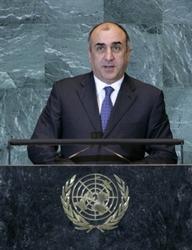
The unresolved status of the Armenia-Azerbaijan
conflict over Upper (Nagorno) Garabagh is now affecting the world
on the global scale, Azerbaijani Foreign Minister Elmar Mammadyarov
has said.
Addressing students and faculty at the Columbia University in the United States on Tuesday, Mammadyarov said Russian President Dmitry Medvedev has been closely involved in talks on settling the nearly two decade-long dispute. Medvedev is participating in discussions on key documents on the negotiating table, which indicates Moscow`s resolve to reach a solution, he said.
The Azerbaijani minister said only a stage-by-stage solution is possible, adding that peace talks are very challenging. He noted that Baku still binds hopes with diplomatic efforts, but the lingering conflict is detrimental to the country.
``We are still seeking ways that will foster a peaceful resolution of the conflict. On the other hand, Azerbaijan cannot accept the status quo. Every day, every month and every year that this issue drags on affects priorities in our foreign policy,`` Mammadyarov said.
Asked why the language of peace talks has been changed from English to Russian, he said this was due only to Armenian President Serzh Sarkisian`s lack of the knowledge of English.
Regarding Turkey-Armenia relations, Mammadyarov termed the recent rapprochement between the two countries as positive overall, but reminded that Turkey severed its link with the neighboring country after the invasion of Azerbaijan`s strategic Kalbajar district, in other words, when the conflict trampled the boundaries of Upper Garabagh.
``Nothing has changed so far. Kalbajar is still under occupation,`` Mammadyarov said.
Armenia has occupied 20 percent of Azerbaijani territory for two decades. From 1988 to 1991, Upper Garabagh was invaded, with the exception of Shusha and Khojaly. In 1992-93, Shusha, Khojaly and seven districts around Upper Garabagh were occupied. Azerbaijan and Armenia signed a cease-fire in 1994 after fighting a lengthy war and peace talks, brokered by the OSCE Minsk Group, are still underway. But numerous rounds of negotiations have produced little tangible result thus far. Baku says the occupied districts must be freed and Azerbaijani refugees displaced during the armed conflict in the early 1990s returned home, and only after that could the status of Upper Garabagh be determined within the territorial integrity of Azerbaijan.
According to the Azerbaijan Foreign Ministry, the event at the Columbia University`s School of International and Public Affairs was hosted by its professor, Stephen Sestanovich, the former special envoy of the US Secretary of State for the Newly Independent States.
Besides the Garabagh problem, Mammadyarov spoke in his address, entitled ``Azerbaijan`s foreign policy: affecting factors and priorities,`` about plans and programs on the country`s integration into Euro-Atlantic institutions, in particular, NATO and the European Union.
The Azerbaijani minister, who is in the U.S. to attend the 64th session of the United Nations General Assembly, on the same day met with his Slovenian counterpart, Samuel Zbogar, and the EU Special Representative for the South Caucasus, Peter Semneby.
According to the UN website, the GA session will discuss a total of 164 issues, including the situation in the Armenia-occupied territories of Azerbaijan, as well as the conflicts flaring in the member states of GUAM, a group comprising Georgia, Ukraine, Azerbaijan and Moldova, and their impact on regional security and development.
Here we are to serve you with news right now. It does not cost much, but worth your attention.
Choose to support open, independent, quality journalism and subscribe on a monthly basis.
By subscribing to our online newspaper, you can have full digital access to all news, analysis, and much more.
Subscribe
You can also follow AzerNEWS on Twitter @AzerNewsAz or Facebook @AzerNewsNewspaper
Thank you!