
Garabagh settlement at an advanced stage: Medvedev
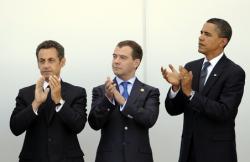
Russian President Dmitry Medvedev has said the
Armenia-Azerbaijan conflict over Upper (Nagorno) Garabagh is one of
the disputes whose solution has progressed to a most advanced
stage, Russian Vesti (News) TV channel reported.
"I have decent expectations to that end," Medvedev told a news
conference on Friday at the conclusion of the G8 summit in Italy.
"The number of nuances that remain to be agreed upon are becoming
fewer and fewer."
According to the Russian leader, the Azerbaijani and Armenian
presidents "hear and understand each other quite well." The main
point is for the conflicting sides to remain willing to agree,
Medvedev said.
"This [the Upper Garabagh conflict] is not something that will be
resolved in the decades to come. I believe that result can be
achieved here," Medvedev said.
He pledged to provide all-around assistance to the efforts of the
OSCE Minsk Group, a team of US, Russian and French diplomats
charged with brokering the peace process.
Medvedev earlier expressed content with the joint statement passed
at the summit by the presidents of the MG co-chairing countries,
according to Vesti.
"We have adopted a relevant statement and call on the sides to make
additional efforts on resolving the Upper Garabagh conflict."
In a joint statement, US President Barack Obama, France`s Nicolas
Sarkozy and Russia`s Dmitry Medvedev called on Armenian and
Azerbaijani leaders to resolve their differences and move towards a
final accord on the long-standing conflict.
"We urge the presidents of Armenia and Azerbaijan to resolve the
few differences remaining between them and finalize their
agreement," it said. "We are instructing our mediators to present
to the presidents of Armenia and Azerbaijan an updated version of a
proposed peace outline brought forward in the Madrid Document of
November 2007."
Among the principles called for in the Madrid Document, and which
the U.S., Russia and France reaffirmed Friday, were "the return of
the territories surrounding Upper Garabagh to Azerbaijani control
and an interim status for Upper Garabagh providing guarantees for
security and self-government."
It also embraced "a corridor linking Armenia to Upper Garabagh" as
well as a future determination of the final legal status of Upper
Garabagh "through a legally binding expression of will" and the
right of "internally displaced persons and refugees to return to
their former places of residence."
Encouraging statements
The MG co-chairs delivered hopeful statements in Baku upon
conclusion of their visit to the region.
Yuri Merzlyakov, the Russian co-chairman, told a joint news
conference Friday that the key goal of the visit was to set the
stage for the Moscow meeting of Presidents Ilham Aliyev and Serzh
Sarkisian scheduled for July 17. He emphasized that the mediators`
meetings with the two leaders were "substantial and constructive",
and both presidents spoke of their readiness to attend the upcoming
meeting.
"We hope that this meeting will allow us to step on the finish line
in the Garabagh conflict settlement," Merzlyakov said.
French diplomat Bernard Fassier expressed hope that the sides would
reach agreement on at least two important issues regarding the
basic principles of the peace process at the presidential meeting.
He hopes that the talks would facilitate completing the current
stage of negotiations and pave the way for launching discussions on
a new topic.
"We hope to secure agreement on the basic principles of settlement
from the presidents by the year-end. In this case, an opportunity
will emerge to transform these principles into a draft of a peace
accord next year," Fassier said.
Matthew Bryza, the US mediator, noted that peace talks have entered
a new stage.
"There is a sense that the presidents of both countries are ready
to achieve results at the upcoming meeting. We are also expecting
that this meeting will be a step forward in the process of agreeing
to the basic principles," Bryza said.
Armenia and Azerbaijan waged a war over the mountainous region of
Upper Garabagh in the early 1990s which claimed some 30,000 lives
and displaced about one million Azerbaijanis. Since then, Armenia
has been occupying over 20% of Azerbaijan`s
internationally-recognized territory. The ceasefire accord was
signed in 1994, but peace talks have been fruitless so far.
Sporadic clashes on the frontline continue.
Non-use of force
The OSCE mediators offered to sign an agreement between Azerbaijan
and Armenia on resolving the dispute without the use of force, the
US co-chair announced, according to the Armenian media.
Bryza told a news conference held by the co-chairs following talks
in Yerevan last Wednesday, that the principle of refraining from
military action in seeking a solution to the conflict is one of the
core issues in the co-chairs` efforts. According to Bryza, the
Garabagh settlement should be focused on three principles: non-use
of force, self-determination of nations and territorial integrity.
Without all of these principles in place, settling the conflict
would be impossible, Bryza said.
His Russian counterpart, Merzlyakov, said the mediators had
suggested that the conflicting sides pull their snipers from the
frontline. He noted that the measure could strengthen stability and
security on the contact line of the two countries` troops. "But,
unfortunately, we have been unable to convince the Azerbaijani
leadership on the appropriateness of this step," Armenian media
quoted Merzlyakov as allegedly saying.
The French mediator said that, though the co-chairs had not
succeeded in obtaining Baku`s consent to that end, they have not
lost hope because, "as our British friends say, `never say
never`".
Here we are to serve you with news right now. It does not cost much, but worth your attention.
Choose to support open, independent, quality journalism and subscribe on a monthly basis.
By subscribing to our online newspaper, you can have full digital access to all news, analysis, and much more.
You can also follow AzerNEWS on Twitter @AzerNewsAz or Facebook @AzerNewsNewspaper
Thank you!