
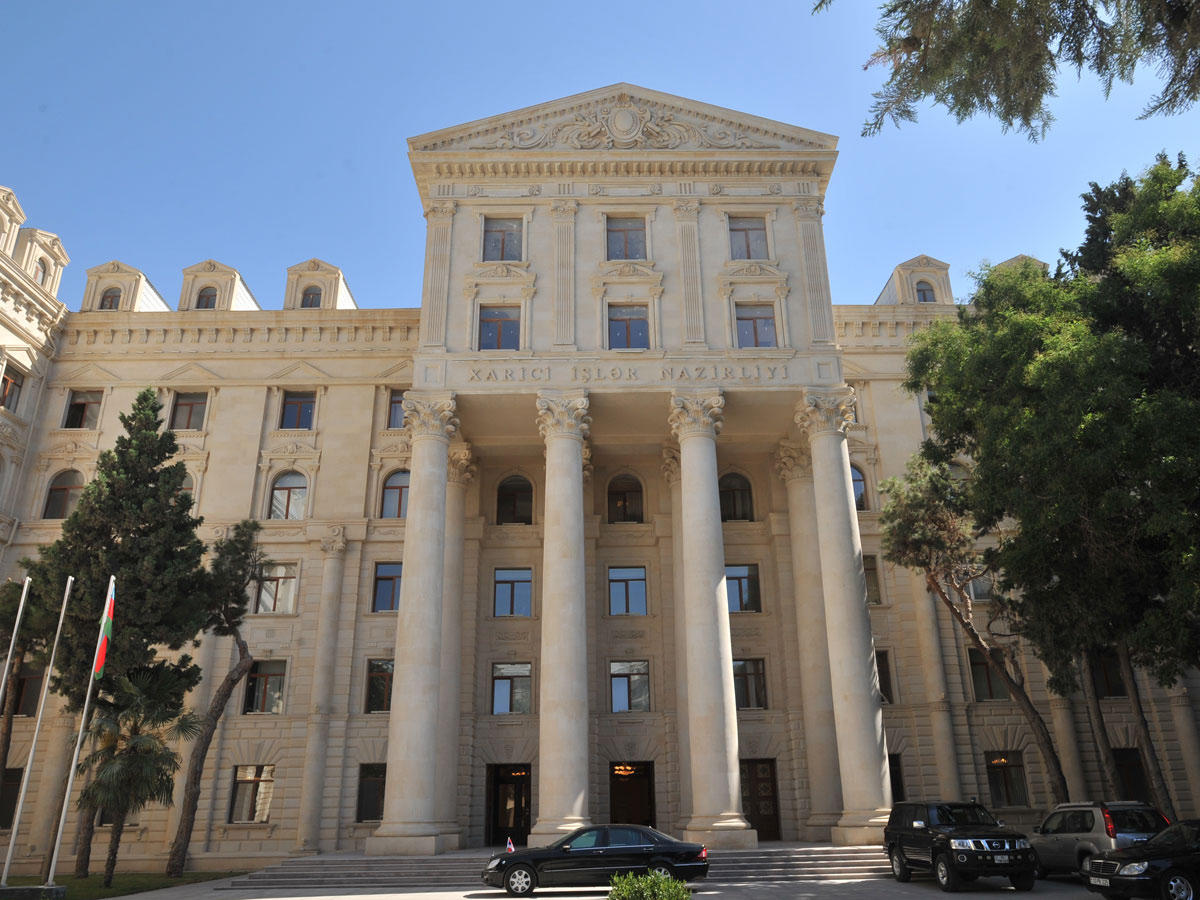
Foreign Ministry issues statement on Day of Genocide of Azerbaijanis
By Trend
March 31, commemorated in Azerbaijan as the Day of Genocide of
Azerbaijanis, reflects the memory of the victims of the bloody
massacre committed by Armenians against Azerbaijanis in March 1918,
reads a statement issued by the Azerbaijani Foreign Ministry on the
Day of Genocide of Azerbaijanis.
"After the October Revolution in Russia in 1917, the Bolsheviks
seized power in Baku and viewed the Armenian nationalist party of
Dashnaksutyun as an ally to capitalize the situation on the
ground," the statement reads. "Leader of the Russian Bolsheviks
Vladimir Lenin appointed ethnic Armenian Stephan Shaumyan as
Extraordinary Commissar of the Caucasus."
The statement notes that at the beginning of tragic March events,
the Baku Soviet and Dashnaksutyun Party, under the pretext of
combating counter-revolutionary elements, set about a plan to
liquidate Azerbaijanis throughout the Baku Province.
"By the acknowledgements of Stephan Shaumyan, 6,000 armed
soldiers of the Baku Soviet and 4,000 armed men from Dashnaksutyun
Party took part in the massacre of Azerbaijani civilians. On March
30, Armenian-Bolshevik units subjected Baku to volley fire from
ships. Then, armed Dashnaks attacked the homes of Azerbaijanis and
carried out their merciless slaughter only because of their
ethnicity. In this period, Armenian-Bolshevik units wiped out more
than 20,000 Azerbaijani civilians in Baku," according to the
statement.
"Genocide of the Azerbaijanis by the Dashnaks was not limited to
Baku. Within a short period of time, Armenians committed massacres
in Shamakhi, Guba, Irevan, Zangezur, Karabakh, Nakhchivan and Kars.
As a result, more than 16,000 people were killed with utmost
barbarity in the Guba province in the first five months of 1918; a
total of 167 villages were destroyed, 35 of which do not exist to
this day. Armenian forces also slaughtered local Jews in Guba," the
statement reads.
The statement said the massacre of March 1918 was well prepared and
ruthlessly implemented against Azerbaijanis based on deliberate
policy of racial discrimination and ethnic cleansing.
"The March events of 1918 became the focus of attention following
the proclamation of Azerbaijan Democratic Republic (ADR). The
Extraordinary Investigation Commission (EIC) was established by the
ADR on July 15, 1918 in order to investigate the violence against
Azerbaijani population. An important trait of this commission was
that it was comprised of the best lawyers of that time representing
different nationalities – Russians, Jewish, Polish, Georgians and
even Armenians. Based on this evidence, the EIC prepared 128
reports and drafts to file lawsuits against 194 persons accused of
different crimes against a peaceful population. Thus, by
mid-August, 24 people in Baku and about 100 people in Shamakhi were
arrested. This was the first attempt to conduct a political and
legal assessment of the policy of genocide perpetrated against the
Azerbaijanis. However, the demise of the Azerbaijan Democratic
Republic made it impossible to complete this work," the statement
reads.
The statement notes that after restoring its independence in 1991,
Azerbaijan resumed political assessment of genocide of March 1918
and is committed to complete ADR’s unfinished attempts to bring
about justice. On the eve of the 80th anniversary of the tragedy,
the then President Heydar Aliyev issued a Decree to announce March
31 as a national day of mourning. The Decree has become a key
document for conducting a political and legal assessment of the
genocidal acts committed against Azerbaijanis in the beginning of
the 20th century.
The commemoration of the Day of Genocide of Azerbaijanis raises the
awareness of the world community to the facts of massacre and
ethnic cleansing of Azerbaijanis in the past and present, according
to the statement.
"Since late 1980s, unleashing a war against Azerbaijan and
occupying its territories, Armenia continued the policy reminiscent
of March Massacre by carrying out ethnic cleansing of more than one
million Azerbaijanis in Armenia and in the seized lands of
Azerbaijan, committing numerous war crimes, crimes against
humanity, and acts of genocide, including Khojaly Genocide of
February 1992."
"While commemorating the 100th anniversary of March Massacre and
remembering the innocent victims, we strongly condemn the
deliberate and continued policy of genocide, crimes against
humanity, racial discrimination and ethnic cleansing by Armenia
against the people of Azerbaijan, and reiterate the importance of
ceasing impunity of Armenia to prevent occurrence of such inhumane
crimes," the statement reads.
---
Follow us on Twitter @AzerNewsAz
Here we are to serve you with news right now. It does not cost much, but worth your attention.
Choose to support open, independent, quality journalism and subscribe on a monthly basis.
By subscribing to our online newspaper, you can have full digital access to all news, analysis, and much more.
You can also follow AzerNEWS on Twitter @AzerNewsAz or Facebook @AzerNewsNewspaper
Thank you!