
Azerbaijan key partner in the region - NATO chief
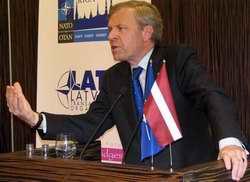
NATO considers Azerbaijan a partner playing an
important role in the region, its Secretary General, Jaap de Hoop
Scheffer, said in a meeting with President Ilham Aliyev in Belgium
last week.
Scheffer noted that the military bloc places a high priority on successfully developing cooperation with Azerbaijan. He expressed confidence that President Aliyev`s working visit to Brussels would promote the expansion of NATO-Azerbaijan relations.
Also, the NATO secretary general highly praised Azerbaijan`s contribution to international anti-terror operations. He said the country was closely involved in implementing the joint Individual Partnership Plan (IPAP).
Aliyev said Azerbaijan was actively participating in various programs and events sponsored by the alliance. He stressed that bilateral relations were part of his country`s integration into Euro-Atlantic institutions.
At a joint news conference after the meeting, Scheffer touched on the Armenia-Azerbaijan Upper (Nagorno) Garabagh conflict. He noted that, although NATO is not directly involved in the conflict resolution, it believes that the principle of territorial integrity is not to be questioned in the peace process. "The Garabagh conflict must find its solution strictly on the basis of the mentioned principle."
Referring to Azerbaijan`s importance for the region, Scheffer said: "At a time when energy security is taking on great significance, Azerbaijan`s role has further increased."
Aliyev, for his part, thanked the alliance for its taking a resolute stance on the Garabagh problem which dwells upon the territorial integrity principle.
Azerbaijan and Armenia fought a lengthy war that ended with the signing of a cease-fire in 1994, but Armenia continues to occupy Upper Garabagh and seven other Azerbaijani districts in defiance of international law. Peace talks have not yet resulted in resolving the conflict.
Azerbaijan joined NATO`s Partnership for Peace (PfP) program in 1994. The country is currently expanding its ties with the bloc within IPAP.
During his visit to Brussels, President Aliyev also met with the European Union foreign policy chief Javier Solana. Solana told reporters after the talks that, if necessary, the EU would become more closely involved in the process of settling the Armenia-Azerbaijan conflict in the future.
Solana sidestepped a question whether or not he had discussed with President Aliyev the situation regarding media in Azerbaijan and only said that discussions on some outstanding issues would be continued. "This is such a problem that we have to keep on discussing while hoping for its solution."
The EU foreign policy chief welcomed last week`s verbal "road map" agreement reached by the governments of Turkey and Armenia to normalize relations between the two countries, which have been historically strained. He noted that the EU lacks comprehensive information about that document, but added that steps being taken toward a solution of any problem should be supported in principle.
The "road map" is the first move by Ankara and Yerevan to mend ties since Turkey closed its border with Armenia in 1993 due to Armenian occupation of the territories of Azerbaijan, Turkey`s ally, and Yerevan`s claims on the alleged World War I-era genocide.
Here we are to serve you with news right now. It does not cost much, but worth your attention.
Choose to support open, independent, quality journalism and subscribe on a monthly basis.
By subscribing to our online newspaper, you can have full digital access to all news, analysis, and much more.
Subscribe
You can also follow AzerNEWS on Twitter @AzerNewsAz or Facebook @AzerNewsNewspaper
Thank you!