
Aliyev: ECO has turned into well-known group worldwide
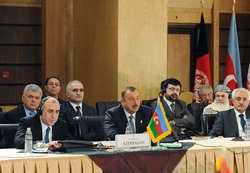
The Economic Cooperation Organization (ECO) has
turned into a well-known group in the region and around the world,
Azerbaijani President Ilham Aliyev said at an ECO summit in Tehran
last week.
"The more the organization develops, the more this will benefit its member states," Aliyev told the group, which brought together the leaders of numerous Islamic nations.
The Azerbaijani leader welcomed talks underway among the ECO states. According to Aliyev, meaningful discussions have been held to further countries` cooperation in a number of areas including energy security and cargo transportation.
Further, President Aliyev handed over the ECO chairmanship, which has been held by his country, to his Iranian counterpart, Mahmoud Ahmadinejad.
Ahmadinejad said a new stage had begun in the development of ECO while Azerbaijan headed the group and it has made great progress since its inception.
The Iranian president went on to express his proposals on taking ECO`s development to an even higher level, saying that the unfair economic system in the world should be replaced with one that is more responsive with the rights of nations. He proposed initiatives to create a common ECO currency and a bank operating under the organization, lift taxes and duties on imports and exports among its member states, and increase the commodities turnover among them.
Ahmadinejad also accused US officials of weakening the economic power of other countries. He said US economic policies were "useless and unfair" and detrimental to the interests of other nations.
Turkish President Abdullah Gul, in his address, said the joint efforts of the ECO members would further peace and cooperation in the volatile region. He emphasized that these countries should fulfill the obligations they had assumed as soon as possible.
"In a globalizing world, the solution of a number of problems single-handedly is impossible. Therefore, countries should collaborate with each other in a number of areas, including economics," Gul said.
He added that the ECO members should reduce customs-related spending among each other.
The 10th ECO summit was attended by the heads of state and government of Azerbaijan, Iran, Turkey, Pakistan, Turkmenistan, Tajikistan, Kazakhstan, Kyrgyzstan, Uzbekistan, and Afghanistan. Also, the leaders of neighboring Iraq and Syria joined the event as honorary guests. The group`s agenda included regional integration, joint large-scale projects, transit transportation, energy issues as well as the challenges posed by the ongoing world economic crisis.
The meeting also discussed transport relations between Azerbaijan and Iran as well as construction of railways with a link to Pakistan, the Iranian Press TV channel quoted Foreign Minister Manouchehr Mottaki as saying. "With the participation of the ECO member states, we will be able to implement these projects in the near future."
Among the issues discussed at the summit were three key railway construction projects - creating a rail link between Iran and Turkey, Kuwait and Taftan in Pakistan, and increasing the throughput capacity of the Sarakhs station in Iran, which is pivotal for the country`s railway communication with Turkmenistan.
According to Mottaki, attendees also weighed laying a railway to China through Kyrgyzstan, Tajikistan, Afghanistan and Iran, and the project was approved by the ECO members.
Participants signed agreements at the end of the summit calling for further cooperation among countries in such key areas as trade, transport, energy, tourism and agriculture.
However, former Azerbaijani ambassador to Iran, MP Nasib Nasibli, has noted that the ECO`s becoming strong enough to turn into an influential organization does not appear realistic, as there is no state in its midst that could lead the way in the organization.
"But first and foremost, the ECO countries have serious differences on security issues. These countries have a slant toward opposite poles - part of the member states toward Russia, while the other part - toward the West," Nasibli said.
The ECO was established by Iran, Turkey and Pakistan in 1985 to promote socio-economic development of its member states. Azerbaijan joined the group in 1992. The South Caucasus republic`s trade with other ECO countries in 2008 ended with a positive balance of over $247 million.
Here we are to serve you with news right now. It does not cost much, but worth your attention.
Choose to support open, independent, quality journalism and subscribe on a monthly basis.
By subscribing to our online newspaper, you can have full digital access to all news, analysis, and much more.
Subscribe
You can also follow AzerNEWS on Twitter @AzerNewsAz or Facebook @AzerNewsNewspaper
Thank you!