
Aliyev, Sarkisian `agreed to meet` in coming months
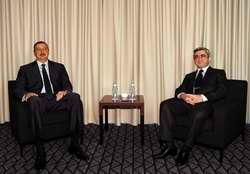
The Azerbaijani and Armenian presidents have
agreed to meet in the next two months, international mediators
brokering a settlement to the Upper (Nagorno) Garabagh conflict
said at the conclusion of their visit to the region early last
week.
The venue and date of the meeting has not yet been determined,
according to the co-chairs of the OSCE Minsk Group, who have held
talks with officials in Baku and Yerevan. Overall, the mediators
termed their visit to be successful.
Presidents Ilham Aliyev and Serzh Sarkisian last met in Zurich on
January 28.
The co-chairmen had begun their visit in Baku on February 26. After
holding talks with President Ilham Aliyev and Foreign Minister
Elmar Mammadyarov, they headed to Yerevan where they discussed the
Garabagh settlement with President Serzh Sarkisian and Foreign
Minister Eduard Nalbandian, as well as in Khankandi, an Azeri town
now used by Armenians as the center of the self-proclaimed
republic.
US mediator Matthew Bryza said the co-chairs had not expected
considerable progress during this visit.
"The talks were not that easy, both in Upper Garabagh and Armenia.
Nonetheless, we and the Armenian government have come to an
agreement that there is a need for continuing the [peace] process.
The meetings we held had laid the grounds for us to return to Baku.
We had meaningful and constructive discussions with President
Aliyev that will give an incentive to the process," Bryza
concluded.
Bryza further said there is "both good and bad news" regarding the
meetings focusing on the Garabagh settlement.
"The bad news is that complicated issues are on the negotiating
table and it is challenging for both presidents to accept them. But
the good news is that these issues are extremely important for both
heads of state."
Bernard Fassier, the French co-chairman, dismissed his previous
statement concerning the participation of Upper Garabagh in peace
talks as being like a party. Fassier said he had never used this
expression and merely considered the involvement of the Azerbaijani
and Armenian communities of Upper Garabagh in negotiations as being
important.
"I did not say `the Garabagh side.` We are referring to the
Azerbaijanis and Armenians who lived there before the war. Both
communities should take part in the negotiating process and
determine their future fate," Fassier added.
The separatist regime is seeking participation in peace talks as a
party, a claim repeatedly dismissed by Baku as a blatant
contradiction of international law. Azerbaijani officials have, on
many occasions, made it clear that preserving the country`s
territorial integrity is a must in reaching a solution to the
Garabagh problem.
Azerbaijan and Armenia fought a lengthy war that ended with the
signing of a cease-fire in 1994 but Armenia continues to occupy
Upper Garabagh and seven other Azerbaijani districts in defiance of
international law. The OSCE-brokered peace talks have been
fruitless so far.
Appeals to UN
Azerbaijan`s representatives at the United Nations have submitted
two documents to the Security Council and General Assembly covering
the international groups` support for the country`s territorial
integrity and diplomacy aiming to condemn Armenia.
One of the documents, forwarded to the UN chief by Agshin Mehdiyev,
the Azerbaijani ambassador to the UN, is entitled "The report on
the support of the UN and other international organizations to
Azerbaijan over the conflict that took place in its Upper Garabagh
region and adjacent districts." The 11-page paper notes that
Armenia has carried out military aggression in Garabagh and
adjacent regions and reviews the further backing of Azerbaijan`s
fair stance by the world community.
The other document, sent to the UN secretary-general, is called
"The report on international legal obligations of the government of
Armenia, which occupies Azerbaijani territory." The 30-page paper
urges a reply to three questions. First, is Armenia considered a
state occupying Azerbaijani territory under international law?
Second, if Armenia is an invader, what are its obligations in such
areas as ensuring law and order in the occupied land and protecting
human rights?
Finally, Baku asked the UN administration how the hostile neighbor
would be urged to honor international law.
The submission of the two documents brings the number of papers
concerning the Garabagh settlement forwarded to the UN by the
Azerbaijani government in the past three months to four. Baku is
expecting a swift response to its appeals.
The UN has already passed five resolutions on the unconditional
pullout of the Armenian armed forces from the occupied Azerbaijani
territories. Nonetheless, Yerevan is sticking to its policy of
occupation and ignoring international law.
Here we are to serve you with news right now. It does not cost much, but worth your attention.
Choose to support open, independent, quality journalism and subscribe on a monthly basis.
By subscribing to our online newspaper, you can have full digital access to all news, analysis, and much more.
You can also follow AzerNEWS on Twitter @AzerNewsAz or Facebook @AzerNewsNewspaper
Thank you!