
Turkish FM`s visit raises questions
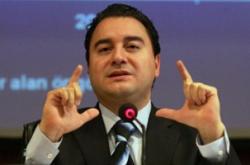
Turkish Foreign Minister Ali Babacan`s short visit
to Baku and his meetings with President Ilham Aliyev and Foreign
Minister Elmar Mammadyarov are being widely discussed in local
political circles.
It is also indicative that unlike his previous visit, the two ministers did not hold a news conference after the talks on Monday.
Babacan`s visit, which followed his meeting with his Armenian counterpart, Eduard Nalbandian, on the sidelines of a security conference in Munich and came prior to Turkish President Abdullah Gul`s visit to Moscow, is considered extraordinary.
Khazar Ibrahim, spokesman for the Azerbaijan Foreign Ministry, said there was no need for a special reason for paying such visits between fraternal states.
"This was a working visit. The situation in the region, including bilateral and international issues, were a focus of attention during the meeting and views were exchanged on those issues in amicable conditions. Such visits are quite regular among friendly and brotherly countries and may take place any time."
According to the Foreign Ministry, Minister Elmar Mammadyarov praised Turkey`s Caucasus Peace and Stability Platform, pointing out the importance of this proposal that seeks to promote peace in the turbulent region and the need to continue discussions to make peace a reality.
Babacan, for his part, stressed the importance of restoring peace in the region, saying it was pivotal to find a speedy solution to regional conflicts. He emphasized that settling the Armenia-Azerbaijan Upper (Nagorno) Garabagh conflict was possible only within Azerbaijan`s territorial integrity.
In a meeting with President Aliyev, the parties discussed Azerbaijani-Turkish relations and ways of resolving the Garabagh problem.
Some political analysts point out that the Turkish minister had visited Baku about two months ago and that the Azerbaijan Foreign Ministry`s statements overlap those it made during the previous visit, thereby claiming that other reasons may be the catalyst for this latest visit.
Arastun Orujlu, the head of the local East-West Research Center believes that, currently, one of the main issues of concern for Ankara is the potential threat of war in the region becoming a reality in the backdrop of the latest actions by Russia. After a brief Russia-Georgia war in August 2008 Turkey, which undertook the responsibility of promoting regional security, is trying to prevent a military stand-off.
Political analyst Rasim Musabayov says Turkish President Abdullah Gul`s upcoming visit to Russia lies at the core of the talks held in Baku.
"Ankara was looking to inform the Azerbaijani side about the essence of the discussions to take place in Moscow so that Baku would not receive any unexpected news from Russia thereafter.
Ankara is also trying to clarify Azerbaijan`s stance, as the parties will discuss the situation in the Caucasus, including the Garabagh problem, in Moscow," Musabayov said.
Another pundit, Zardusht Alizada, says Turkey-Russia talks are about to enter a crucial stage.
"Russia is trying to make Turkey a partner in its policy on the Caucasus and the East. In this respect, there are certain conditions that Ankara will put forward to Moscow. Turkey is trying to bring into compliance its diplomacy with that of Azerbaijan and adhere to a common stance. Ali Babacan therefore came to a friendly country to determine a common ground."
Alizada added that Turkey has turned into a powerful regional state with an active policy on the Caucasus, Russia, Iran, Europe and the Islamic world. This policy, he said, is considerably different from that pursued by the United States and allows it to take broad initiatives. From this standpoint, not only Turkey-Russia talks but also those between Turkey and Armenia could be beneficial for Azerbaijan.
The Turkish foreign minister had arrived in Baku after attending the 45th Munich Security Conference held Febuary 6-8. While in Germany, he had meetings with Armenian President Serzh Sarkisian and Foreign Minister Eduard Nalbandian. Afterwards, participants addressed a panel entitled "The Balkans and Caucasus states."
Babacan said the goal of the meetings with Armenian leaders was to normalize relations in the region. "If we manage to fully normalize relations between Armenia and Azerbaijan and those between Turkey and Armenia, the situation in the region will drastically change."
The Turkish minister said achieving regional peace would bring considerable benefits to all parties involved.
Sarkisian claimed that if intense talks continue, the second half of 2009 might see the establishment of "very different ties" between Turkey and Armenia.
He said, further, that the negotiating process that started with the Turkish president`s visit to his country last year has advanced considerably since then. Additionally, a meeting of the Turkish and Armenian presidents was followed by several meetings between the two countries` foreign ministers.
Sarkisian said he was optimistic about the future due to "the abundance of those ready to take courageous steps in the region." He said Yerevan was seeking to expand cooperation with all regional states to bolster the importance of the South Caucasus region as an alternate transportation route, adding that a lesson should be learned from the bitter developments of the past.
Armenia and Turkey currently maintain no diplomatic ties and the border between the two countries has remained closed since 1993.
Here we are to serve you with news right now. It does not cost much, but worth your attention.
Choose to support open, independent, quality journalism and subscribe on a monthly basis.
By subscribing to our online newspaper, you can have full digital access to all news, analysis, and much more.
Subscribe
You can also follow AzerNEWS on Twitter @AzerNewsAz or Facebook @AzerNewsNewspaper
Thank you!